How to Read an Appropriations Act, Part 4: General and Administrative Provisions
The accounts appropriate the money. The provisions set the rules.
1. Where to start?
2. Structure
3. Account Text
4. General and Administrative Provisions
5. Reports and Explanatory Statements
The 60-Second Version
| Question | Answer |
|---|---|
| What are General Provisions? | Rules that apply across the entire department or bill (or division) |
| What are Administrative Provisions? | Rules that apply to a specific component |
| Where do I find them? | End of each component (APs) or end of title (APs/GPs) or final title of division (GPs) |
| Why do they matter? | They constrain, redirect, and reshape how appropriated funds can be used |
| Are they permanent law? | Usually no—they expire with the fiscal year unless stated otherwise |
Key insight: The dollar amounts in account paragraphs tell you how much. The provisions tell you how—and sometimes whether.
Click here for a quick visual explainer.
Part I: The Basics
Administrative Provisions: Component-Specific Rules
In general, administrative provisions appear at the end of a bureau. after the account paragraphs. They apply only to that component.
Translation: This is pretty straightforward. The Appropriations Committees want to see EPA's trust fund receipt reports each quarter. Part of the reason this is an administrative provision and not an account-level proviso is that there are multiple trust funds at the EPA. There are at least three: Superfund, Leaking Underground Storage Tank, and Oil Spill Liability. An administrative provision is an efficient way to apply one requirement to multiple accounts. Note the scoping in the provision: it only applies to the EPA. While included in the Interior, Environment bill, it has no effect on the Department of the Interior, for example, because it's scoped to just the EPA.
Fun fact: Not all bills format administrative provisions the same way. Some (like MilCon-VA, THUD, Defense) use numbered sections. Others (like Interior/Environment, CJS) just append unnumbered paragraphs at the end of each agency's text. Same legal effect, different typography. When in doubt, look for the scope language. Plus, both formats have some sort of clear heading that says you're looking at administrative provisions.
General Provisions: Bill-Wide Rules
General provisions for a department appear at the end of that department, or in their own title, it kinda depends on the structure of that particular bill. They apply across the entire title or bill, depending on the scope.
There are extra special general provisions in title VII of the Financial Services and General Government Appropriations bill. These general provisions apply across the entire government. Super efficient.
Here's a bill wide General Provision from the same Interior and Environment bill:
Translation: This is a belts and suspenders approach to ensuring that when there is no period of availability mentioned in the statute, it's one-year money. And it applies to every account in the Interior and Environment bill. Interior, EPA, the Smithsonian, National Endowment for the Arts, even the Holocaust Museum. Note the scope: "any appropriation contained in this Act". If it's an account in this bill (or this division if it's a minibus or omnibus) it applies.
The Difference Matters
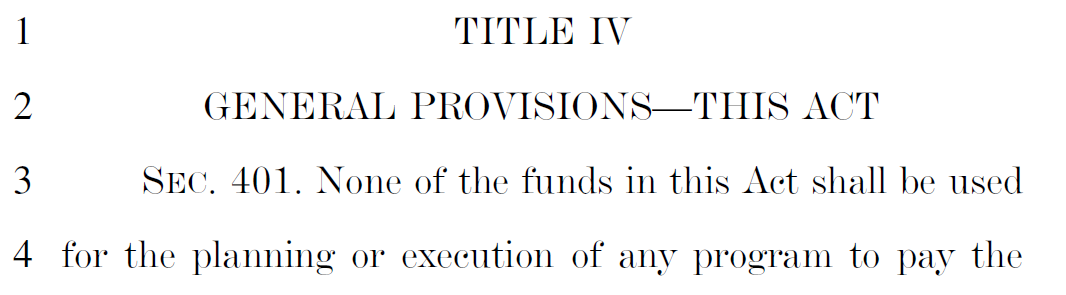
| Feature | Administrative Provisions | General Provisions |
|---|---|---|
| Location | End of each component | End of title or final title of division |
| Scope | Single component | Entire department, bill, or government |
| Numbering | SEC. 201, 202... (restarts each title) | SEC. 401, 402... (continuous) |
| Typical content | Transfer authority, hiring caps, reporting | Policy riders, government-wide limits |
Words Matter More Than Position
I'm going to contradict myself a bit. In the table above I gave you helpful pointers as to where APs and GPs are located. Sometimes, a general provision that applies to just one part is mixed in with the bill-wide general provisions. That doesn't change its scope just because it's located back there. While location is a great shorthand, you still need to read the provision. Here's an example from the Military Construction/VA bill:
Sec. 415. The Secretary of Veterans Affairs shall ensure that the policies and requirements described in the transmittal sheet of the Veterans Health Administration published on August 8, 2019, titled “Smoke-Free Policy for Employees at VA Health Care Facilities (VHA Directive 1085.01)” remain in effect.
Sec. 416. (a) Each department or agency funded in this or any other appropriations Act for fiscal year 2026 shall, no later than 60 days after enactment of this Act, report to the Committees on Appropriations of the House of Representatives and the Senate on funds that are allotted and available for obligation as of the end of the reporting period and on obligations as of the end of the reporting period:...
Translation: Sec. 414 and 416 have scopes that apply to funds or agencies in the entire Act. Sec. 415 only applies to the VA because the provision applies it only to "The Secretary of Veterans Affairs".
Pro tip: Some bills, Agriculture for example and you just saw VA above, put both GPs and APs in the back-of-the-bill provisions. As you begin to get a feel for the personality of the bills, it will become easier to know where to look.
Part II: When One Sentence Does Six Things
Now let's look at a provision that makes law students cry. I mean that's just a saying, I guess. I've never been to law school. This is a single sentence:
That's one sentence. One grammatical unit with a period at the end. Welcome to appropriations drafting.
Breaking It Down
The "Provided, That" construction is how appropriators chain conditions onto a single appropriation or authority. Each "Provided further" adds another layer. Let's unpack this one:
| Clause | Plain English |
|---|---|
| Notwithstanding... | "Ignore these two rules that would otherwise block this" |
| Main grant | Agency heads can transfer funds to GSA's shared services fund |
| with approval of OMB | But only if OMB says yes |
| Provided 1 | Here's what GSA can use the money for |
| Provided 2 | Cap: $29 million max |
| Provided 3 | Money stays available through end of FY2027 |
| Provided 4 | GSA must send Congress a spend plan within 90 days |
| Provided 5 | Here's exactly what the spend plan must include |
| Provided 6 | No transfers until 15 days after notifying Congress |
Why Write It This Way?
Three reasons:
-
It's self-contained. Everything about this authority—the grant, the limits, the reporting, the timing—lives in one place. No chasing cross-references.
-
It's amendable. In conference or on the floor, you can strike or modify a single "Provided further" clause without touching the rest.
-
Tradition. This is how it's always been done. Appropriations drafting conventions predate modern plain-language norms by about a century. Recall our example from 1925 in Part II.
Some appropriations subcommittees have started modernizing their drafting, using more subsections and numbered paragraphs.
So why don't they all do this?
Tradition, mostly. The "Provided, That" construction has been standard in appropriations drafting since the 19th century. Some subcommittees have modernized, while others stick with the old style. When you're reading across all 12 bills, you'll see both. And to be honest, you might see a mix of styles within a subcommittee.
There is a deep institutional bias on the Committees to sticking with what works. Sec. 752 was enacted into law in this form this fiscal year, last fiscal year, and the year before that. With old reliable text, everyone knows what they're getting into. If you change the style or words, you introduce the potential of error or confusion that because you changed it, you must mean something different.
But for you, the good news: once you can parse the "Provided, That" chain, the subsection format is a breeze.
The Hidden Oversight
Notice that final clause: "no transfers or reimbursements may be made... until 15 days following notification." That's Congress keeping a leash on executive discretion. They can't approve the transfers (that would be unconstitutional after INS v. Chadha), but they can make the executive branch wait while they review. We'll dig into this notification-not-approval pattern in Part IV.
Part III: "None of the Funds" — The Policy Rider
The most powerful phrase in appropriations law might be four words: None of the funds. This may be the purest exercise of Congress' power of the purse.
What It Does
A "none of the funds" provision is a funding prohibition. It doesn't change substantive law—it just says the government can't spend money on something. Here's one from the Defense bill:
Examples
Translation: Don't give money to the Taliban. That's it. One sentence, no exceptions, no definitions needed.
Sometimes Congress is aware of a law (I mean, writing and passing them is their entire job), but doesn't want to enforce it. A strategy could be to deny funding enforcing that law. Here's an example from the Commerce, Justice, Science bill:
Translation: DOJ can't use federal funds to interfere with state medical marijuana programs. But notice the structure: instead of saying "any state or territory with a medical marijuana law," Congress lists every single jurisdiction. Why? Because the list is the negotiation. When it was first enacted into law, the list was shorter-32 states and the District of Columbia. Adding a state or territory to this list is a political act—someone had to fight for each name.
And one more, a little more complex than the last two. This is the Hyde Amendment, the granddaddy of "none of the funds" policy riders. As you'll see here, it's actually two related sections in the Labor, HHS bill.
(b) None of the funds appropriated in this Act, and none of the funds in any trust fund to which funds are appropriated in this Act, shall be expended for health benefits coverage that includes coverage of abortion.
Sec. 507. (a) The limitations established in the preceding section shall not apply to an abortion—
(1) if the pregnancy is the result of an act of rape or incest; or
(2) in the case where a woman suffers from a physical disorder, physical injury, or physical illness, including a life-endangering physical condition caused by or arising from the pregnancy itself, that would, as certified by a physician, place the woman in danger of death unless an abortion is performed.
(b) Nothing in the preceding section shall be construed as prohibiting the expenditure by a State, locality, entity, or private person of State, local, or private funds (other than a State's or locality's contribution of Medicaid matching funds).
(c) Nothing in the preceding section shall be construed as restricting the ability of any managed care provider from offering abortion coverage or the ability of a State or locality to contract separately with such a provider for such coverage with State funds (other than a State's or locality's contribution of Medicaid matching funds).
Translation: No federal funds for abortion (SEC. 506), with three exceptions: rape, incest, or life of the mother (SEC. 507(a)). But notice subsections (b) and (c)—these carve out what the restriction does not prohibit. States can still use their own money. Managed care providers can still offer coverage separately. The Hyde Amendment isn't just a prohibition; it's a carefully negotiated framework that's been refined over decades.
Why Appropriators Use This Tool
Appropriations bills must pass. The government shuts down without them. That makes appropriations bills attractive vehicles for policy provisions that might not survive as standalone legislation.
The Limits of Funding Prohibitions
But funding prohibitions have limits:
- They only last one fiscal year (usually)
- They can be worked around if the agency has other funding sources
- They don't change underlying law—just block implementation
- Courts have sometimes read them narrowly
Spotting Policy Riders
When you see:
- "None of the funds made available by this Act..."
- "None of the funds appropriated or otherwise made available..."
- "No part of any appropriation contained in this Act..."
...you're looking at a policy rider. The question is: what policy fight does it represent?
Part IV: Reprogramming, Transfers, and the Ghost of Chadha
Before we start, you're going to notice that these provisions all start with "none of the funds" and in the last section, we talked about those as policy riders. I'm not going to say I'm wrong. An appropriations act, and its supporting documents, has been described as a conversation between the Legislature and the Executive. So what you're about to read is policy, but it's more about how Congress asserts its constitutional prerogatives surrounding the power of the purse.
What's the Difference?
Before we dive in, let's clarify terms that often get confused:
| Term | What It Means |
|---|---|
| Transfer | Moving funds from one account to another |
| Reprogramming | Moving funds within an account |
| Reorganization | Changing the structure of offices, programs, or personnel |
Transfers usually require explicit statutory authority. And from our last post, you learned that Congress cares so much about it they have a fun parenthetical for it that goes on each account. Reprogramming is often allowed but subject to notification requirements. Reorganizations can be blocked outright or require advance notice.
The Archetypal Reprogramming Restriction
This provision from the Labor, Health and Human Services, Education bill appears, with variations, in many appropriations bills:
(1) creates new programs;
(2) eliminates a program, project, or activity;
(3) increases funds or personnel by any means for any project or activity for which funds have been denied or restricted;
(4) relocates an office or employees;
(5) reorganizes or renames offices;
(6) reorganizes programs or activities; or
(7) contracts out or privatizes any functions or activities presently performed by Federal employees;
unless the Committees on Appropriations of the House of Representatives and the Senate are consulted 15 days in advance of such reprogramming or of an announcement of intent relating to such reprogramming, whichever occurs earlier, and are notified in writing 10 days in advance of such reprogramming.
(b) None of the funds provided under this Act, or provided under previous appropriations Acts to the agencies funded by this Act that remain available for obligation or expenditure in fiscal year 2026, or provided from any accounts in the Treasury of the United States derived by the collection of fees available to the agencies funded by this Act, shall be available for obligation or expenditure through a reprogramming of funds in excess of $500,000 or 10 percent, whichever is less, that—
(1) augments existing programs, projects (including construction projects), or activities;
(2) reduces by 10 percent funding for any existing program, project, or activity, or numbers of personnel by 10 percent as approved by Congress; or
(3) results from any general savings from a reduction in personnel which would result in a change in existing programs, activities, or projects as approved by Congress;
unless the Committees on Appropriations of the House of Representatives and the Senate are consulted 15 days in advance of such reprogramming or of an announcement of intent relating to such reprogramming, whichever occurs earlier, and are notified in writing 10 days in advance of such reprogramming.
Two Tiers of Restriction
This provision creates a two-tier system:
| Tier | Trigger | Threshold | Actions Covered |
|---|---|---|---|
| (a) | Any amount | $0 | Creating, eliminating, relocating, reorganizing, privatizing |
| (b) | Over threshold | $500K or 10% (whichever is less) | Augmenting, reducing, personnel savings |
Tier (a) is about structural changes—you can't create a new program, kill an existing one, move offices, or privatize functions without telling Congress first, regardless of dollar amount.
Tier (b) is about magnitude—smaller shifts in funding are fine, but once you cross $500,000 or 10%, Congress wants to know.
The Chadha Workaround
Notice the careful language: "consulted 15 days in advance... and are notified in writing 10 days in advance."
This is the post-INS v. Chadha formula. In 1983, the Supreme Court struck down the "legislative veto"—provisions that let Congress block executive action without passing a new law. Before Chadha, this provision might have said "subject to the approval of the Committees on Appropriations." That's unconstitutional now.
So Congress adapted. They can't approve reprogramming, but they can require:
- Consultation (talk to us first)
- Notification (tell us in writing)
- Waiting periods (don't act until the clock runs out)
Legally, the agency can proceed after 15 days even if the Committees object. Practically? No one defies the appropriators. The people who control your next budget are telling you they have concerns. You find another way.
What's Covered
Notice the provision's reach extends beyond this year's money:
"funds provided under this Act, or provided under previous appropriations Acts to the agencies funded by this Act that remain available for obligation or expenditure in fiscal year 2026, or provided from any accounts in the Treasury derived by the collection of fees"
Congress is closing loopholes. You can't dodge the restriction by using last year's carryover funds or fee revenue. If the money flows to agencies in this bill, the reprogramming rules apply.
Part V: General Provisions as Permanent Law
Most appropriations provisions expire when the fiscal year ends. But not all.
Some provisions are written to outlast their appropriations bill—either through careful word choice or by directly amending permanent law. Spotting these is important: they're not just rules for this year, they're rules forever.
Words of Futurity: "Hereafter" and Friends
The magic words are hereafter, this or any succeeding fiscal year, or on and after the date of enactment. This text was included in the FY 2020 Transportation, HUD Appropriations Act.
Translation: This provision doesn't just apply to FY2020—it applies to every future year. Those seven words ("this or any succeeding fiscal year") turned a one-time appropriations provision into permanent law. It's now codified at 42 U.S.C. §11364a.
Full disclosure: I worked to draft and secure inclusion of this provision in the FY 2020 THUD bill. The "this or any succeeding fiscal year" language was intentional—we wanted to create a permanent framework for recaptured homeless assistance funds without having to re-legislate it every year. It worked: it's now codified at 42 U.S.C. §11364a. And this provision provides the funding source for HUD's Rapid Unsheltered Survivor Housing (RUSH) program that provides assistance to people experiencing homelessness that were impacted by a natural disaster.
When General Provisions Amend Statutes
Even more direct: some general provisions explicitly amend the U.S. Code. This is an example from the Interior bill:
Translation: This extends a reporting deadline from 90 to 180 days and adds a new reporting requirement about carryover spending. These changes are permanent—they modify the underlying statute, not just this year's appropriation.
When you see language like:
- "Section X of title Y, United States Code, is amended..."
- "Section X of title Y, Insert Short Title of Bill, is amended..."
- "Subsection (a) of section X of the ABC Act is amended by striking '...' and inserting '...'"
- "The second sentence of paragraph (3) is amended to read as follows..."
...you're looking at permanent law being made through an appropriations bill.
Fun fact: In minibus or omnibus legislation, there is often a division or two appended to the bill that is completely authorizing in nature. In this example, Division O of Public Law 115-141. P.L. 115-141 is the "Consolidated Appropriations Act, 2018". Divisions A-L were appropriations acts; Division O was the Wildfire Suppression Funding and Forest Management Activities Act. At the end of the day, a bill is a bill. Congress uses whatever "vehicle" at their disposal to get legislation enacted.
When Congress Doesn't Want to Amend (Yet)
Sometimes Congress extends a deadline or modifies a threshold without actually amending the underlying statute:
Translation: The Higher Education Act has a sunset date of 2021. Congress hasn't reauthorized the HEA, but they don't want the provision to expire. So instead of amending the statute, they just say "read it as if it says 2026." This only lasts one year—they'll have to do it again next appropriations cycle.
This is appropriations as duct tape. The authorizing committees haven't completed their work, so appropriators keep the lights on.
Why This Matters
| Provision Type | Duration | Reversibility |
|---|---|---|
| Standard limitation ("none of the funds...") | One fiscal year | Expires automatically |
| Words of futurity ("hereafter...") | Permanent | Requires new legislation to undo |
| Statutory amendment | Permanent | Requires new legislation to undo |
The appropriators don't just control this year's spending. Sometimes they change the rules forever.
Part VI: Recurring Provisions
Many provisions appear year after year, almost unchanged. These are the "boilerplate" of appropriations—but don't let the familiarity fool you into ignoring them.
Here's one from Transportation:
Looks fine right? Except Congress changed a few words between the FY 2026 version and the FY 2024 version. See the highlighted text. That expanded the scope of the reporting requirement to include cancellations and terminations. It would be easy to miss if you were just glancing through.
Common Recurring Provisions
| Provision Type | What It Does |
|---|---|
| Salary caps | Limits on executive compensation |
| Hiring freezes | Restrictions on new positions |
| Travel limits | Caps on conference attendance or travel spending |
| Lobbying prohibitions | Can't use appropriated funds to lobby Congress |
| Contract requirements | Domestic sourcing, small business set-asides |
Pro Tip: If you're a frequent reader of appropriations texts, you might want to read the GPs and APs from the end to the beginning. Congress usually tacks the new stuff on at the end. Also, from experience, I know that some of the most controversial stuff ends up there because those items were decided last. It's much easier to slap a GP at the end rather than insert it in the middle and wait for another bill to get printed.
Why Should You Care?
"I only care about the dollar amounts."
The provisions can redirect those dollars. A $100 million appropriation with a "none of the funds" provision blocking its primary purpose is worth $0 for that purpose.
"These seem like minor procedural rules."
Some are. Others represent hard-fought policy battles. The Hyde Amendment has been renewed in appropriations bills for 50 years. It's mentioned in some way or another every year.
"How do I know which provisions matter?"
Look for:
- "None of the funds" language (policy fights)
- Dollar thresholds or percentages (transfer limits)
- Notification requirements (congressional oversight)
- References to specific programs or activities (targeted provisions)
- Changes from prior year (new policy)
The Bottom Line
Key takeaways:
- Administrative provisions apply to one department; general provisions apply bill-wide
- "None of the funds" is how Congress makes policy through appropriations
- Transfer authority lets agencies move money between accounts (within limits)
- Reprogramming is within-account movement (often governed by reports, not law)
- INS v. Chadha killed legislative vetoes, but notification requirements survive
- Reorganization restrictions protect congressional intent about agency structure
- Words of futurity ("hereafter") make provisions permanent without amending statutes
- Statutory amendments in appropriations bills change permanent law directly
- Recurring provisions can hide important year-over-year changes
What's Next
In Part 5: Committee Reports and Explanatory Statements, we'll move from binding law to "soft law"—the committee reports and conference explanatory statements that agencies treat as gospel (sometimes!) even though they're not technically law. That's where you'll find the real detail on what Congress expects.
BlazingStar Analytics is building real-time budget execution tracking that connects appropriations, apportionments, and SF-133 reports. Get early access to our platform, launching Spring 2026.