How to Read an Appropriations Act, Part 5: Committee Reports and Explanatory Statements
The bill tells agencies what they can spend. The report tells them what Congress actually expects.
1. Where to start?
2. Structure
3. Account Text
4. General and Administrative Provisions
5. Reports and Explanatory Statements
The 60-Second Version
| Term | What It Is | Legal Weight |
|---|---|---|
| Committee Report | Document explaining the bill, written by House or Senate Appropriations Committee | Not law, but agencies treat it as binding |
| Explanatory Statement | Document accompanying final bill (conference or consolidated) | Not law, but incorporates reports by reference |
| Statutory language | The actual text of the appropriations act | Law—legally binding |
Key insight: Report language isn't law, but agencies follow it anyway. Ignore the report, and you'll answer for it at your next budget hearing.
Part I: What Is a Committee Report?
When the House or Senate Appropriations Committee reports a bill to the floor, they publish a committee report explaining what's in it. The report accompanies the bill but is not part of the bill. These all start with H. Rept. or S. Rept. and you can find them alongside the bill text on the Appropriations Status Table.
But here's the reality: The bill becomes law. The report does not. There's an exception to that and we talked about it in our [Account] post. Congress can incorporate the report into law by reference. The rest is just Congress giving reasons, rationale, and direction.
And yet.
Agencies often treat report language as if it were binding. Why? The first pillar of appropriations law, although unwritten, might be summarized thusly—
"Don't piss off the appropriators."
Because the people who wrote the report are the same people who control next year's budget. If the report says "the Committee expects the Department to prioritize rural broadband," and the Department ignores that expectation, someone will ask about it. Probably in a public hearing. Probably on camera.
And they're big. The FY 2026 Defense bill reported in the House was 160 pages—the accompanying report was 297 pages. The Committee didn't write 297 pages because they're angling for a Pulitzer. They wrote it because they want agencies to read every word.
There's a third document — the explanatory statement or conference report, depending on the form — that accompanies the final enacted bill. We'll cover that in depth in a future series on the conference process. For now, know that it typically incorporates the House and Senate reports by reference.
Translation: Report language is soft law. It's not enforceable in court, but it's enforceable in the budget process. That's often more effective.
Part II: How Reports Are Organized
Committee reports follow the structure of the bill. This makes them navigable once you understand the bill.
A typical report includes:
| Section | What's In It |
|---|---|
| Front matter | Reporting requirements, bill-wide definitions, administrative and technical housekeeping |
| Account-level detail | Specific direction for each appropriations account |
| Administrative and General Provisions | Brief explanations of any GPs or APs in the bill |
| Back matter | Funding tables, earmark tables, required disclosures, amendment votes, minority views |
The report mirrors the bill. If you can find something in the bill, you can find the corresponding discussion in the report.
The first page of the report from the House's 2026 Homeland Security Appropriations Bill's report (H. Rept. 119-173) follows:
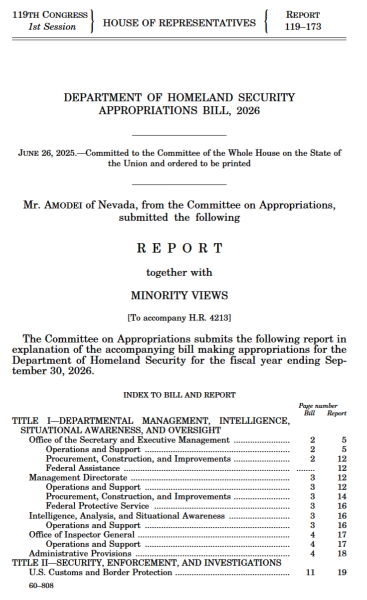
Note that table at the bottom, it's your guide. Homeland does a great job of listing the titles and all of the accounts. Some reports only list the titles. But this index gives you an idea of where to look.
Part III: Reading Report Language
Let's look at an actual report to see how this works. In the FY 2026 Senate Transportation, HUD bill, FAA's Research, Engineering, and Development (RED) Account had this bill text:
At first glance, this account looks simple. There's $290 million, available until September 30, 2028 for research, engineering, and development. There's some words about workforce development programs. Simple enough.
Not so fast. Let's unpack this paragraph closely:
| Purpose | For necessary expenses...for research, engineering, and development |
| Amount | $290,000,000 |
| Time | until September 30, 2028 |
| Proviso 1 | Outside money can be credited into the account |
| Proviso 2 | Congress used the report table to allocate the entire $290M. |
| Proviso 3 | $30 million is for workforce development |
| Proviso 4 | Within that $30 million: $20m is for manufacturing and $10m for community colleges, available until expended |
| Proviso 5 | Within the $10m, 2 community college awards, $5m each |
| Proviso 6 | Ignore the $1m limit in the authorizing statute |
Proviso 2 is pretty important. It says: there's a table in the report that lists amounts and purposes. Act as if they were here in the bill itself. So while this paragraph seems light on details, there's actually another level of detail that's awaiting you (and the agency) in the report. This is the RED account in Senate Report 119-47:
| Appropriations, 2025 | $280,000,000 | |
| Committee recommendation | 290,000,000 |
program description
The research, engineering, and development appropriation provides funding for long-term research, engineering, and development programs to improve the air traffic control system by increasing its safety and capacity, as well as by reducing the environmental impacts of air traffic. The programs are designed to meet the expected air traffic demands of the future and to promote flight safety through improvements in facilities, equipment, techniques, and procedures to ensure that the system will safely and efficiently handle future volumes of aircraft traffic.
The report starts off with an account heading, just like in the bill, and then a quick recap of the funding. THUD and many other subcommittees follow that with a brief description of what the program does.
This brings us to the committee recommendation. This section is where the Committee will go into detail on the rationale, expectations, and assumptions for the funding provided.
The Committee recommends $290,000,000 for the FAA’s research, engineering, and development activities. The recommended level of funding is $10,000,000 more than the fiscal year 2025 enacted level.
The following table provides the Committee’s recommended distribution of funds for each of the budget activities under this heading in this act:
RESEARCH, ENGINEERING, AND DEVELOPMENT
| Committee recommendation | |
|---|---|
| Fire research and safety | $7,200,000 |
| Propulsion and fuel systems | 4,500,000 |
| Advanced materials/structural safety | 4,500,000 |
| Advanced materials/structural safety—joint center of excellence for advanced materials [JAMS] | 11,500,000 |
| Aircraft icing | 3,000,000 |
| Digital system safety | 6,000,000 |
| Continued air worthiness | 8,400,000 |
| Flight deck/maintenance/system integration human factors | 14,300,000 |
| System safety management/terminal area safety | 10,000,000 |
| Air traffic control/technical operations human factors | 5,910,000 |
| Aeromedical research | 10,500,000 |
| Weather program | 15,500,000 |
| Unmanned aircraft systems research | 7,500,000 |
| Unmanned aircraft systems research—center of excellence for UAS research | 14,000,000 |
| Alternative fuels for general aviation | 12,000,000 |
| Commercial space transportation safety | 4,300,000 |
| NextGen wake turbulence | 4,700,000 |
| Information/cyber security | 5,800,000 |
| Environment & energy | 12,500,000 |
| Environment & energy—center of excellence for alternative jet fuels and environment [ASCENT COE] | 8,500,000 |
| NextGen—environmental research—aircraft technologies and fuels | 5,000,000 |
| NextGen—environmental research—aircraft technologies and fuels—continuous lower energy, emissions, and noise program [CLEEN] | 40,000,000 |
| NextGen—environmental research—aircraft technologies and fuels—ASCENT COE | 27,000,000 |
| System planning and resource management | 5,100,000 |
| Aviation grant management | 30,000,000 |
| William J. Hughes technical center laboratory facilities | 7,290,000 |
| Aircraft radio altimeter development, testing, and certification | 5,000,000 |
| Total RE&D | 290,000,000 |
The first sentence of the Committee Recommendation always talks about the money. The second compares it to something, it could be last year's enacted level or the president's request. And then in this example, we have a lengthy table, that adds up to exactly $290 million. Congress has strong opinions about how every dollar of this account should be allocated. Because the bill text referenced the table, this table will have the force of law. I've mentioned this concept before, it's called incorporation by reference.
But the Committee is not done yet; what follows is narrative about the allocation of the account.
Advanced Materials/Structural Safety.—The Committee recommendation includes a total of $4,500,000 for advanced materials/structural safety, and an additional $11,500,000 shall be for advanced materials/structural safety work at the center of excellence [COE] for joint advanced materials and structures [JAMS]. Of the amounts provided in both BLIs, the Committee recommendation provides $6,000,000 to advance the use of these new additive materials (both metallic and non-metallic based additive processes) in the commercial aviation industry and for the FAA to work with the advanced composites institute and private partners to evaluate resin-infused materials and processes for airworthiness certification and $4,000,000 to advance the use of fiber reinforced composite materials in the commercial aviation industry through JAMS.
The Committee recognizes the importance of advanced manufacturing for aerospace. The FAA should conduct research, in partnership with the commercial sector, to address gaps in knowledge for the use of large-scale metal wire arc additive manufacturing in aerospace, including to manufacture aerospace products such as aircraft and other aerospace vehicles. The focus of the research should be: (1) process development for the creation of additive manufacturing design and manufacturing standards for aerospace vehicles; (2) improving certification efficiency of additively manufactured aviation products; (3) evaluating long-term material and structural behavior and associated maintenance, including support for fatigue life determination, structural changes related to fatigue, thermal, corrosive environments, and expected maintenance of such material to include recommended repair techniques; and (4) utilizing commercial partners to mature and certify large-scale metal wire arc additive manufacturing and advanced materials capabilities, including the development and qualification of new material chemistries, optimized for large-scale metal wire arc additive manufacturing, to be used in the manufacture of aerospace vehicles.
UAS Research.—The Committee recommendation includes $7,500,000 for UAS research and an additional $14,000,000 for the UAS COE. Of the amounts for the UAS COE, $2,000,000 is for transportation disaster preparedness and response, in partnership with institutions that have demonstrated experience in damage assessment, collaboration with State transportation agencies, and applied UAS field testing; and $2,000,000 is to continue efforts with the safety standards of UAS for development and validation of certification standards for such systems. The UAS COE research may include cyber security, agricultural applications, and BVLOS.
Environment and Energy.—The Committee recommendation includes $12,500,000 for environment and energy, and an additional $8,500,000 for environment and energy for the aviation sustainability center [ASCENT] COE for research focused on sustainable aviation fuels [SAFs].
NextGen-Environmental Research-Aircraft Technologies and Fuels.—The Committee recommendation includes $5,000,000 for NextGen Environmental Research-Aircraft Technologies and Fuels, an additional $27,000,000 for the ASCENT COE on SAFs and aviation noise, and an additional $40,000,000 for the continuous lower energy, emissions, and noise [CLEEN] program. The Committee continues to direct the FAA to prioritize research related to SAFs, certification of SAFs, and challenges associated with the SAF supply chain. The Office of Environment and Energy and the Office of Airports should work together to identify SAF-related projects at airports that can be funded from airport improvement program grants. The FAA should also support hydrogen and fuel-cell related technologies that could reduce the noise and emissions footprint in future aircraft.
Within the CLEEN program, the FAA may use any unused funds to work with commercial supersonic aircraft manufacturers that will help mature clean and quiet technologies for conventional non-supersonic aircraft manufacturers.
Aviation Grant Management.—The Committee recommendation includes $30,000,000 for the aviation workforce development programs as authorized by section 625 of the FAA Reauthorization Act of 2018, as amended by the FAA Reauthorization Act of 2024.
The Committee encourages the FAA, to prioritize applicants for the aviation workforce development programs that provide an assurance to either use grant funds to: (1) encourage the participation of populations that are underrepresented in the aviation industry, including women, minorities, and individuals in economically disadvantaged communities and rural communities; or (2) strengthen aviation programs at a minority-serving institution, a public institution of higher education, or a public postsecondary vocational institution, including such institutions in rural communities.
Aircraft Accessibility Research.—Persons with reduced mobility have been disproportionately impacted by challenges associated with air travel due to limited cabin space and relevant accommodating technologies. The Department continues to receive numerous consumer complaints related to commonly mishandled and/or damaged equipment in aircraft cargo handling. The Committee supports the FAA and the aviation industry’s efforts to develop, test, and certify aviation accessibility technologies, including solutions for passengers to travel onboard aircraft using power wheelchairs in cabins, accessible lavatories and other boarding and cabin technologies that would enable greater mobility and ease of travel.
PFAS-Free Aviation Fire Suppression Technologies.—The Committee encourages the FAA to conduct research and development activities, including partnerships with the DoD and U.S. industry, to identify, develop, and test technologies that will provide an alternative to fire protection systems with hydrofluorocarbons and halon technologies that are critical to the safety of flight systems in use across civil, commercial and military aircraft today.
Electric Aircraft.—The FAA should identify and prioritize technical assistance, research, workforce development, and funding opportunities to support aircraft operators transitioning to electric aircraft. The FAA should also coordinate with outside stakeholders to identify opportunities to advance electrification of current and future aircraft.
Electric Vertical Take-Off and Landing [eVTOL] Aircraft.—The Committee directs the FAA to conduct research, development, and testing of eVTOL vehicles and AAM systems to ensure that these emerging technologies are integrated into the NAS in a safe manner. The Committee encourages the FAA to collaborate with independent testing and research facilities to help improve the safe certification and deployment of eVTOL vehicles and other AAM systems. The FAA should encourage collaboration with independent testing centers and private-sector partners to: conduct comprehensive testing of eVTOL vehicles for safety, reliability, airworthiness, and operational performance; assess the integration of eVTOL vehicles into urban and rural airspace in coordination with local transportation agencies, air traffic controllers, and airport authorities; develop and test safety protocols, air traffic management systems, and cyber security measures specific to eVTOL vehicles and AAM networks; and create a framework for certification and regulatory approval of eVTOL vehicles and related infrastructure to support commercial deployment.
When you read a report, you should read it as if you're eavesdropping on a very public conversation between the branches. The Legislature (the Senate in this report) is telling the Executive what they'd like to see done with the money. And you can see that the Senate has opinions about a lot of things in addition to the allocation of funds. Sustainable fuel, drones, electric aircraft, additive manufacturing, all get a mention. The language is here for a reason. A Member cared enough about this issue to submit it to the Committee and the subcommittee Chair and Ranking Member thought it worthy enough to include. There's a lot of negotiation that goes into getting the report language just so.
Note the common words used:
| "The Committee notes..." | Informational | We're aware of this. No action required. |
| "The Committee encourages..." | Soft suggestion | We'd like you to consider this, but it's your call. |
| "The agency should..." | Direct suggestion | Consider this, it'll be in your interest. |
| "The Committee expects..." | Strong expectation | Do this. We'll be checking. |
| "The Committee directs..." | Directive | Do this. It's not optional. Report back. |
Part IV: When Congress Isn't Happy
Let's take a look at how it reads when Congress isn't pleased with the management of a program. This is from the Maritime Administration section later in the same report:
USMMA Capital Asset Management Program—The Committee remains deeply concerned about the current condition of the USMMA's facilities, which has a direct impact on the quality of the education provided to students and the ability to attract new entrants to serve as future leaders in the United States Merchant Marine. As such, the Committee's recommendation provides $50,000,000 for the USMMA's facilities maintenance and repair, and equipment [FMRE] activities. In addition, the Committee provides $10,000,000 for the capital improvement program [CIP], which in addition to the $160,000,000 in unobligated balances, provides the USMMA with $170,000,000 to move forward with several CIP projects over the next few years. The Committee reminds the USMMA that, in the event that flexibility is necessary to address imminent safety hazards or quality of life issues, it has the ability to exercise the reprogramming authorities under section 405 of this act, including by seeking approval from the House and Senate Committees on Appropriations.
The Committee is disappointed that the USMMA has yet to submit its annual CIP plan to Congress, leading to further delays in implementing much needed improvements of the campus. Given the significant amount of unobligated balances for CIP projects, it is unacceptable that the USMMA has yet to formulate a long-term plan on which it can move forward. The Secretary is directed to provide the House and Senate Committees on Appropriations with the CIP plan within 30 days of enactment of this act. In addition, the USMMA's Director of Facilities and Infrastructure shall provide quarterly briefings to the House and Senate Committees on Appropriations on the status of all short- and long-term capital improvement projects and FMRE activities and continue to provide the annual report in the same manner and context as in previous fiscal years. The Committee strongly encourages the USMMA to maintain current information on CIP projects and any major repair FMRE activities on its website to expand the availability of this information to students and external stakeholders, such as the alumni foundation which also provides support to USMMA projects. The Committee also directs the OST Assistant Secretary of Administration to brief the House and Senate Committees on Appropriations on the status of its hiring search for the recently vacated Superintendent and Deputy Superintendent positions at the USMMA within 30 days of enactment of this act, as having such leadership in place is critical to advancing FMRE and CIP projects.
Note the change in tone. Here the committee is "deeply concerned" and "disappointed". They note "unacceptable" behavior and then follow up with a direction and a briefing requirement. As I said before, you're eavesdropping on a conversation. Pay attention to the tone.
Part V: The Tables At The Back
Committee reports include extensive tabular material showing exactly how the Committee wants money allocated. These tables often provide more detail than the bill text itself. You saw the incorporation by reference example in Part III with the FAA RED table.
These tables are where you find out that the $500 million appropriated for "Salaries and Expenses" is actually supposed to be $200 million for headquarters, $150 million for regional offices, and $150 million for IT modernization.
CSBA
I want to call your attention to an underappreciated table toward the very back of a report, the Comparative Statement of Budget Authority, CSBA. If you're into tables or just want to understand the bill at a glance, the CSBA is your friend. Here's an example from the report for the 2026 House Energy and Water bill.
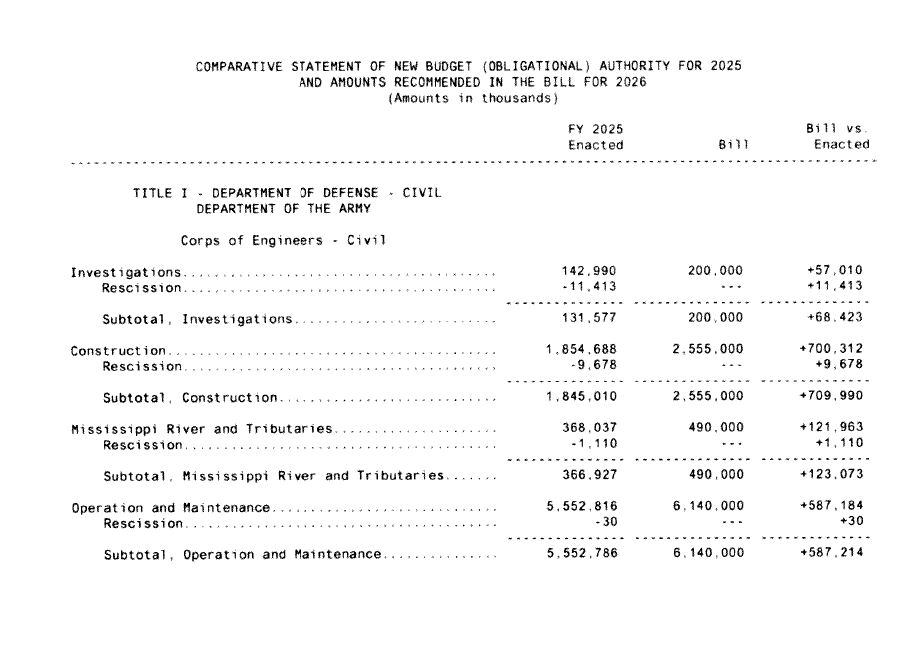
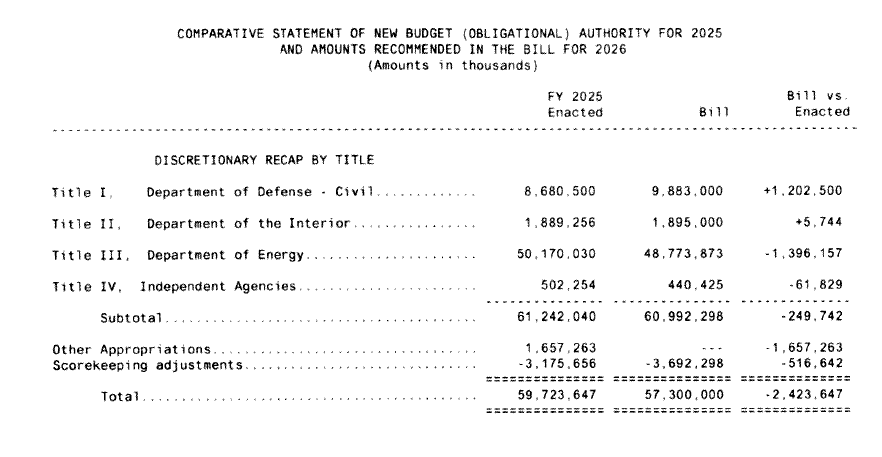
It's a pretty useful reference to get a feel for the funding in the bill and provides a reference point. If you want to know if an account received more or less than last year, this is where you should start. It's organized just like the bill and report, starting with title I and working towards the end of the bill. At the very back, there's a bill summary. Below is an example from that same bill.
Earmark Tables
The other interesting tables at the back of the bill are related to Member projects. House and Senate rules require that reports include a list of all of the projects included in the bill at the request of a Member. Here's an example from the report for the 2026 Senate Labor, HHS, Education bill.
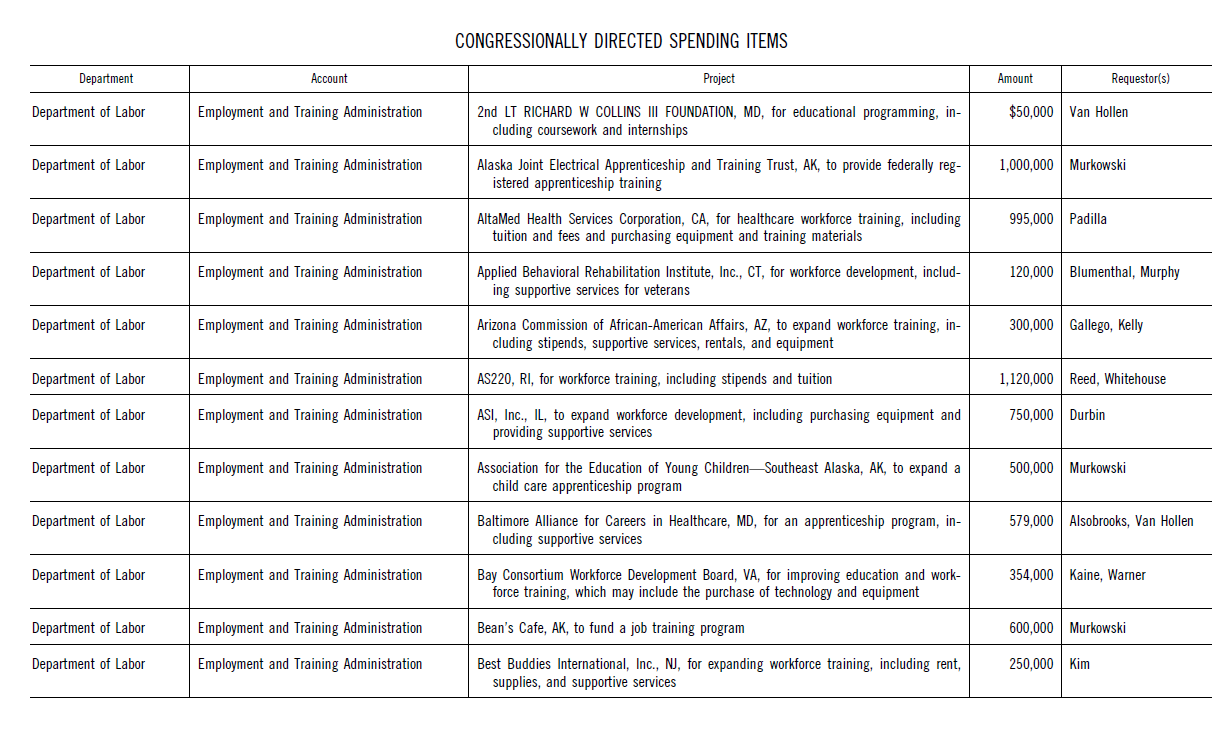
These tables list the account, the project name, the amount of the project, and the congressional requestor. These aren't typeset like the other parts of the report, so they tend to be a little harder to use Ctrl+F on. But there's an order. Typically they're in the order the account is in the bill, then alphabetical by project name or by state. Congress feels strongly about these projects and incorporates them by reference in the relevant account's bill text. Because of the incorporation by reference, these tables are legally binding and any modification to them requires a change in a future year's appropriations bill.
Appropriations Not Authorized
There's also a useful table at the back that shows the status of the authorization of the programs in the bill. Here's an example from the report for the 2026 House Commerce, Justice, Science bill.
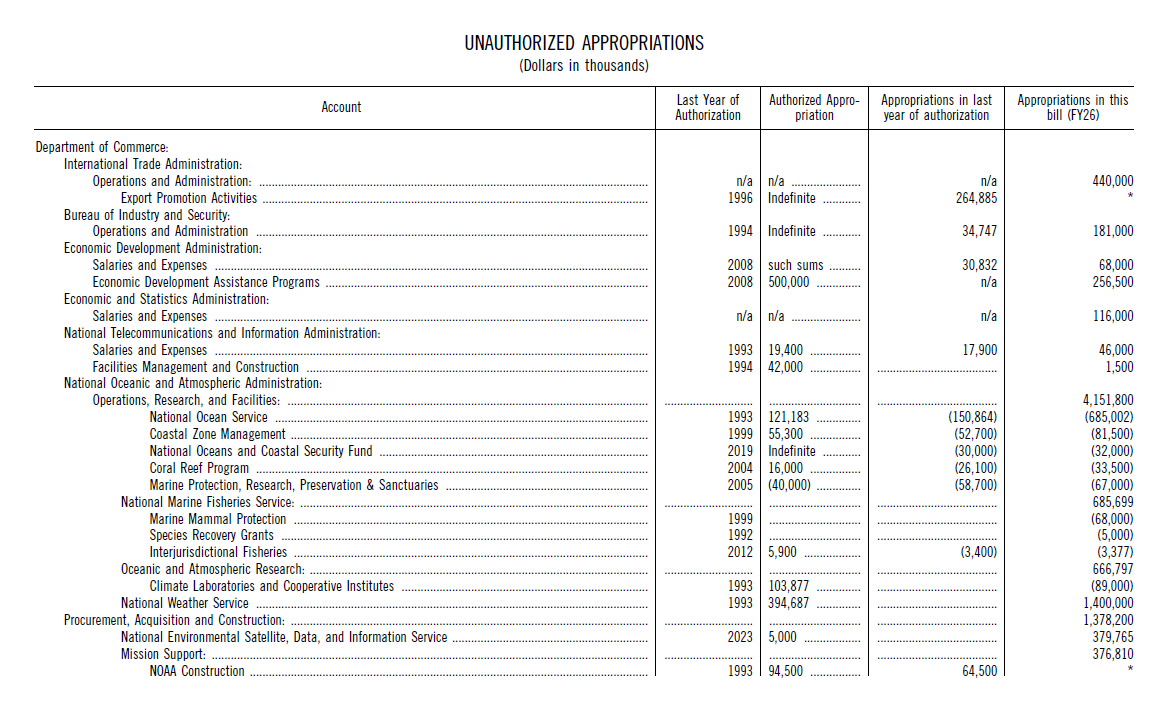
Let's look at the entry for the Department of Commerce, Bureau of Industry and Security, Operations and Administration Account. In the past, the authorizing committees passed an authorization bill for the program. That authorization expired in 1994. Since then, no new authorization has been passed. But, each year Congress, through annual appropriations acts renews the authorization by funding it for another year. Not all programs are this way. The Department of Defense and Department of Transportation have regularly reauthorized programs and their table is shorter. But if you're ever curious about the status of the authorization of a program, this is an invaluable resource.
Part VI: Other Things Back There
Views
If there are minority or dissenting or additional views, they go at the very back of the report. The majorities write the report, so this is an opportunity to learn what the minority thought about it. They might thank the committee for attention to a particular program or note disagreement with a policy choice. Either way, it's an opportunity for the minority (and occasionally members of the majority) to express their theory of the case on this particular bill.
Roll Call Votes in Committee
If there were roll call votes in committee markup, you'll find the results at the back of the report. There's a brief description of the amendment and the position of each member.
Why Should You Care?
"I found the appropriation in the bill. Why do I need the report?"
The bill gives you the ceiling. The report tells you how Congress expects the agency to allocate below that ceiling. Without the report, you're missing the real story.
"Is report language legally binding?"
No. Agencies can technically ignore it. But agencies that ignore report language develop reputations. Those reputations follow them into future budget cycles.
"Where do I find committee reports?"
Congress.gov. Search for the bill number, then look for "Committee Reports" in the sidebar. For explanatory statements, check the Congressional Record from the day the bill passed.
"Do I have to read all the documents? Isn't the bill enough?"
If you care about a specific program, yes. The House report, Senate report, and explanatory statement can each contain different (and sometimes conflicting) direction.
The Bottom Line
Key takeaways:
- Committee reports explain the bill but are not part of the law
- Reports follow the bill's structure—find the account in the bill, find the discussion in the report
- Watch for verb signals: "notes" < "encourages" < "expects" < "directs"
- Funding tables in reports provide program-level detail the bill doesn't
- If you only read the bill, you're missing most of the story
What's Next
You've now completed the "How to Read an Appropriations Act" series. You can navigate the bill structure, decode account text, parse general provisions, and find the real spending priorities in committee reports.
We're gearing up for the release of the 2027 President's Budget Request. We're working on some resources to help you get your footing and make sense of it.
BlazingStar Analytics is building real-time budget execution tracking that connects appropriations, apportionments, and SF-133 reports. Get early access to our platform, launching later in 2026.