How to Read an Appropriations Act, Part 2: Structure
You found the right bill. It's 200 pages. Now what?
1. Where to start?
2. Structure
3. Account Text
4. General and Administrative Provisions
5. Reports and Explanatory Statements
I'll be honest, that last post was kind of a snooze. But, if you can't find the bill you're after the rest of the series won't matter. Now you've got the bill in front of you and a wall of text greets you.
The good news: appropriations bills are among the most consistently formatted documents Congress produces. Once you learn to read the structure, you can navigate any of them—Agriculture, Defense, THUD, all twelve. The formatting isn't arbitrary. It's a map.
This post covers the organizational hierarchy of an appropriations act and how typography signals where you are in that hierarchy. By the end, you'll be able to open any bill to a random page and immediately know what level you're reading.
The 60-Second Version
In an omnibus or minibus, an appropriations bill is contained in a division:
| Level | What It Is | Typography |
|---|---|---|
| Division | Entire appropriations bill | ALL CAPS |
Every appropriations act follows a three-level structure:
| Level | What It Is | Typography |
|---|---|---|
| Title | Major agency or department | ALL CAPS |
| Agency/Bureau | Sub-component of department | Capitalized Small Caps |
| Account | Specific appropriation | small caps |
The rule: The further down the hierarchy, the less shouty the typography.
↳ TITLE (The Department)
↳ Agency (The Bureau)
↳ account (The Pot of Money)
↳ Bill text. (The actual text)
When in doubt, look at the text formatting. If it's screaming at you in all caps, you're at a high level. If it's in gentler small caps or sentence case, you're getting into the details.
Provisos modify language and apply conditions, restrictions, or grant new authority.
Administrative and general provisions apply conditions or restrictions to many accounts at once.
Key insight: Typography is your compass. ALL CAPS = high level. Small caps = you're getting close to the money.
Check out our quick visual explainer.
The Three-Level Hierarchy
We're going to use the Department of the Treasury—Departmental Offices—Salaries and Expenses account from the recently passed "Consolidated Appropriations Act, 2026" as our example in this section. Here's the text:
You can see that there's something going on with the typography and there's a clear organizational structure. This is standardized from bill to bill and helps you understand where you're at in the text and how what you're reading relates to the larger bill structure.
The Wrapper Level: Divisions
We covered this in the last post, but minibus, omnibus, and supplemental appropriations legislation use divisions to encapsulate multiple bills and assemble them into one package. Divisions are ALL CAPS, bold, and centered like this:
Each division is equivalent to a standalone appropriations bill.
Level 1: Titles
An appropriations act is divided into titles, typically one per major department or agency. Titles use Roman numerals and appear in ALL CAPS, centered like this:
Titles are the highest organizational unit within a division. In an omnibus or minibus bill, you'll also see divisions above titles (Division A, Division B, etc.), each containing a complete appropriations act for one or more agencies.
ALL CAPS
All capitals signal high-level structural elements:
- Division names
- Title headings
- Major section breaks
When you see ALL CAPS, you're at a boundary. You've left one major section and entered another.
Level 2: Agencies and Bureaus
Within each title, you'll find agencies, bureaus, or program areas. These appear in Capitalized Small Caps, centered:
This level tells you which component of the department controls the money. A single title might contain a dozen or more bureaus—each with its own set of appropriations accounts.
Capitalized Small Caps
Capitalized small capitals (where the first letter is a larger capital and subsequent letters are smaller capitals) indicate mid-level organizational units:
- Agency names
- Bureau names
Level 3: Accounts
The account level is where the actual money lives. Account names appear in small caps, centered, often with a parenthetical below:
This is the level that maps to a TAFS—the Treasury Appropriation Fund Symbol you'll use to track execution through the SF-133 and USAspending.
Sometimes, accounts have a parenthetical sub-header that follows it like this account, actually the next one in this bill, also small caps, centered:
Parenthetical sub-headers are required by the rules of the House and Senate and indicates that something special is happening with the money in this account. We'll cover that in detail in a bit.
small caps
Small capitals indicate appropriations accounts or parenthetical sub-headers that describe an appropriations account.
Not Just For Organization
The structure in each appropriations bill helps the reader, but it also allows for precise referencing in this or future bills. Here's an example from this year's Ag/FDA appropriations bill:
Take a look at the highlighted sections, and now this text from earlier in the bill:
For necessary expenses of the Food and Drug Administration, including hire and purchase of passenger motor vehicles; for payment of space rental and related costs pursuant to Public Law...
Section 772 uses the hierarchy to precisely reference funds provided earlier in the bill and apply conditions on them. This is why the structure matters beyond navigation—it's the grammar that lets Congress write complex fiscal instructions without ambiguity. When you see a reference like "under the heading X—Y—Z," you can trace it directly back to a specific account in a specific agency in a specific title.
Translation: The hierarchy isn't just for navigation—it's the grammar Congress uses to write precise fiscal instructions. "Under the heading X—Y—Z" is a legal address.
An Aside
I enjoy fonts and typography. If you're into it like I am, take a gander at the U.S. Government Publishing Office Style Manual. Pages 4 and 5 (18 & 19 of the PDF) should produce a feeling in every Appropriations Committee staffer.
Also, U.S. Federal Government legislative text is set in a Century typeface. I use Century Supra, a more modern take on Century (or DeVinne) on this website to denote legislative text. And Century Supra offers true small caps. Which, as you've learned by now, is a necessity in reproducing legislative text.
An Example:
Let's take a look at the Committee on Foreign Investment in the United States (CIFIUS) account I just mentioned:
At its core, the CIFIUS appropriation is just this:
Note the highlighting. I like to diagram my appropriations into these components:
- Time: to remain available until expended
- Purpose: For necessary expenses of the Committee on Foreign Investment in the United States
- Amount: $21,000,000
These three components are the fundamentals of an appropriation and the pillars of appropriations law. I plan a deep dive series on time, purpose, and amount and we'll cover this more in the next part of this series.
Nearly always, the first line of an account is the appropriation. Most appropriations are pretty bland, like this one, but the fun stuff happens in the provisos. The provisos, set off in italics, impose conditions on the funds or impart special abilities.
Italics: The Legal Signal
Italics in appropriations text almost always signal provisos. The most common:
Provided and Provided further
These words introduce conditions, restrictions, or exceptions to the appropriation. When you see italics, slow down—you're reading the fine print. Provisos have scope, they apply only to the funds that they are attached to.
Let's look at the first proviso:
This proviso allows for the CIFIUS chair to transfer money from this account to other accounts. But, to use this authority, the CIFIUS chair needs to notify the Committees in advance. Without this proviso, all of the funds would need to remain in this account and could only be used for the purposes in this account. Transfer authority is so special, it requires a parenthetical header.
The next 3 provisos further describe more conditions required to exercise the transfer authority. The final 2 provisos allow this account to receive collections and have them credited to this account. Collections are usually derived from fees, in this case application fees that corporations pay to get their application reviewed. The last proviso signals that Congress intends for the fees collected to meet or exceed $21,000,000 so that the net appropriation for the year is $0.
| Part | Plain English |
|---|---|
| For necessary expenses, $21M | Here's $21M to run CIFIUS |
| Provided 1 | CIFIUS Chair can transfer money to committee members |
| Provided 2 | Send a report on transfers |
| Provided 3 | Transferred money stays available until expended |
| Provided 4 | You can collect fees and use them here |
| Provided 5 | Fees mean $21M nets to $0 |
In this example, the provisos convert this account from a straight appropriation of $21,000,000 to an account that can transfer funds, receive fees, and credit them to this appropriation so that $21 million becomes $0. Pretty amazing, right?
Account Parentheticals: What They Tell You
Directly below many account headings, you'll see a parenthetical in small caps. These aren't decoration—they're legal shorthand telling you what special authorities apply to this account.
Common parentheticals include:
| Parenthetical | What It Means |
|---|---|
| (including transfer/s of funds) | Agency can move money to/from other accounts |
| (including rescission/s of funds) | Money is being taken back from a prior appropriation |
| (limitation on obligations) | Sets a ceiling on mandatory spending (often contract authority) |
| (airport and airway trust fund) | Funded from trust fund, not general treasury |
Some examples:
And my favorite:
When you see (including transfer of funds), you know to look for transfer authority somewhere in the account's text. When you see (including rescission of funds), you know money is being clawed back.
When Congress Has More To Say
Accounts
So far we've focused on pretty neat, tight and compact appropriations. That's not always the case. Here's an example:
(12) $1,517,000 shall be available for the Office of Tribal Government Affairs; and (13) $60,993,000 shall be available for shared services as authorized in section 327 of title 49, United States Code, for the Office of the Secretary that would otherwise be provided by the Working Capital Fund, in addition to amounts otherwise available for such purposes: Provided further, That the Secretary is authorized to transfer funds appropriated under this heading among the purposes specified in the first proviso under this heading: Provided further, That such transfers combined shall not increase or decrease the amount appropriated for any purpose specified in the first proviso under this heading by more than 7 percent: Provided further, That notice of any change in funding greater than 7 percent shall be submitted for approval to the House and Senate Committees on Appropriations not later than 7 business days in advance of any such change: Provided further, That not to exceed $70,000 shall be for allocation within the Department for official reception and representation expenses as the Secretary may determine: Provided further, That notwithstanding any other provision of law, there may be credited to this appropriation up to $2,500,000 in funds received in user fees.
You see those numbers like (1), (2), (3), etc...? Those are numbered paragraphs and they help organize an appropriations account when there's a lot going on. In this case, the numbered paragraphs further divide that main appropriation, parceling it out to the Office of the General Counsel, the Office of Tribal Government Affairs, and so on.
Administrative and General Provisions
Administrative Provisions
As mentioned earlier, provisos have scope. What happens when you want to say things in multiple accounts? You could copy and paste the same proviso into multiple account, but that's tedious. Enter administrative and general provisions. They are Congress' way of applying to multiple accounts at once.
Take a look at this example, this is the Bureau of Reclamation section from the Commerce, Justice, Science; Energy and Water Development; and Interior and Environment Appropriations Act, 2026. It starts like this:
Then you have a bunch of accounts like this:
Then at the very end you see this:
This is an example of an administrative provision, a provision that applies to an entire bureau or component within an agency. The administrative provision in our example above concerning "not to exceed 30 motor vehicles" applies to all four Bureau of Reclamation accounts at once.
General Provisions
But what if Congress wanted to apply something to an entire agency, an entire bill, or even the entire Federal government? That's a general provision. They are found either at the end of the title they apply to or at the end of the bill. Here's an example from the Title II (HUD) General Provisions from the 2026 THUD bill:
This section applies to all HUD accounts at once, and allows the Secretary to publish funding opportunities and funding awards on the internet. HUD has some authorizing statutes that have been around since before the internet was a going concern, so this provision is pretty convenient. The alternative would be to copy and paste those words into every account in the HUD title. This is cleaner and easier.
And here's an example of a government-wide general provision. Government-wide general provisions are found in Title VII of the Financial Services and General Government bill. They apply to the entire government.
This general provision implements a drug-free workplace policy government-wide.
There's a lot of power in administrative and general provisions and we're going to cover them in-depth in a future post in this series.
Translation: Provisos apply to one account. Administrative provisions apply to one bureau. General provisions apply to an entire title, bill, or the whole government. Scope expands as you move up.
This Isn't New
Before we put it all together, I want to show you something. This is a page from the "Second Deficiency Act, 1924" enacted on December 5, 1924— 101 years ago:
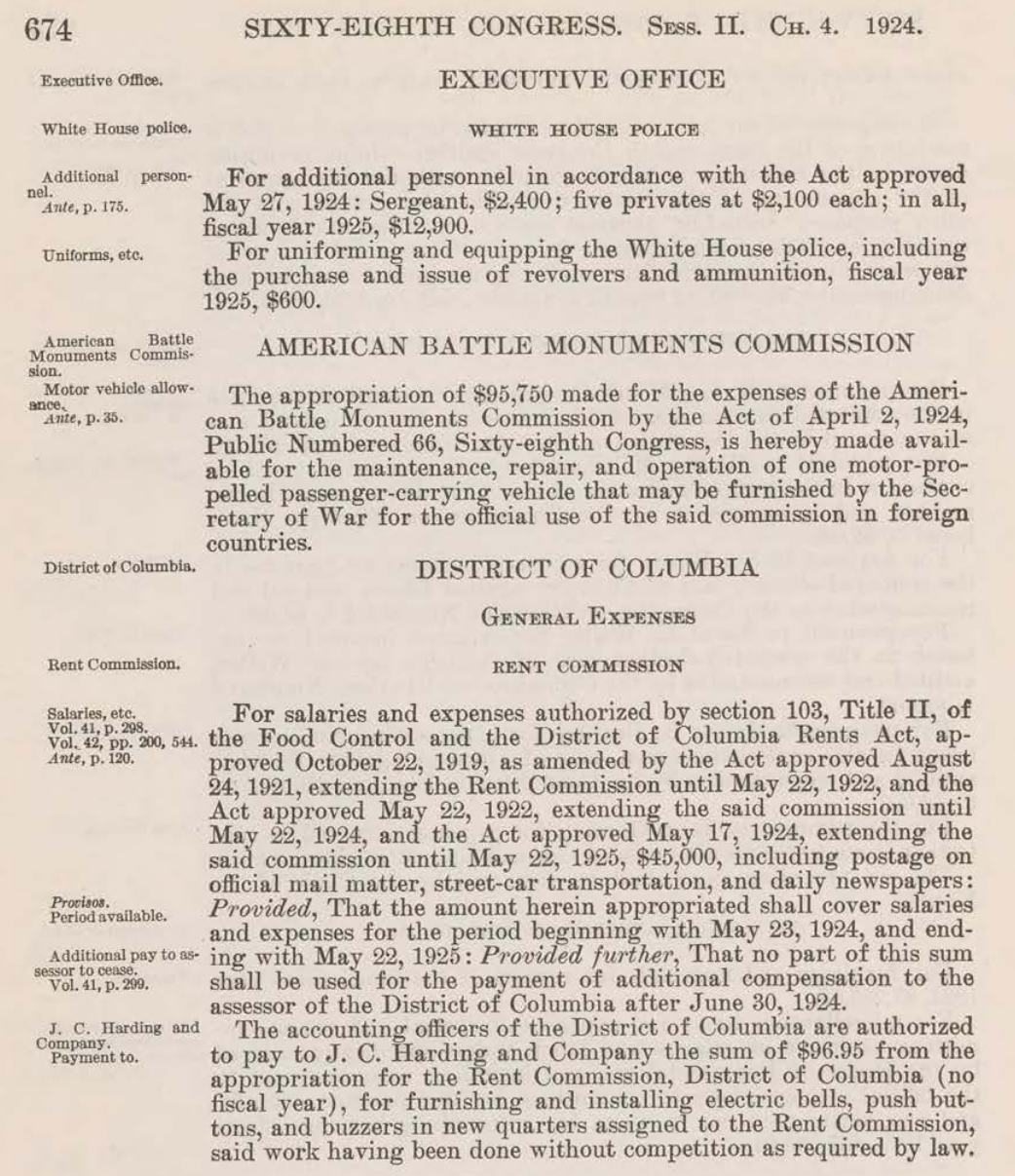
Look familiar?
The structure is identical to what you've been learning:
- Bureau headers in all caps (EXECUTIVE OFFICE, AMERICAN BATTLE MONUMENTS COMMISSION)
- Account names as small-caps headers (white house police, rent commission)
- Dollar amounts with line-item detail
- Provided, That chains, italicized
- Marginal sidenotes flagging key terms ("Provisos.", "Period available.", "Additional pay to assessor to cease.")
Even the granularity is familiar. See that payment to J.C. Harding and Company? Congress appropriated exactly $96.95 for "furnishing and installing electric bells, push buttons, and buzzers" in the Rent Commission's new offices. A century later, appropriators are still getting specific.
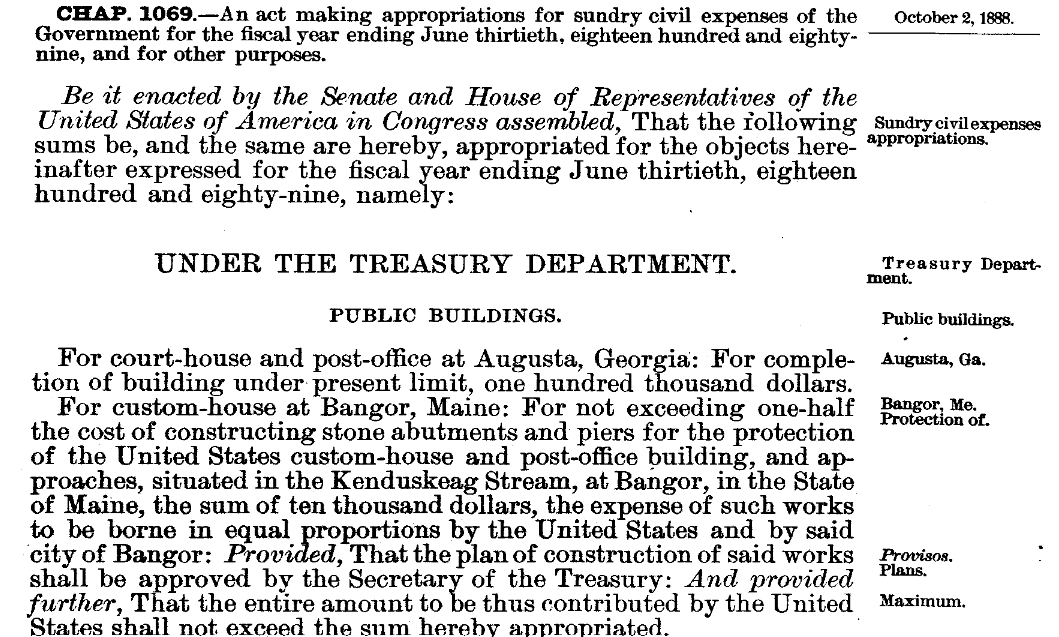
Our feature image at the top is the Sundry Civil Expenses Appropriations Act, 1889. With some minor puts and takes (typesetting was still molten lead based back then) it looks like an appropriations bill.
The conventions you're learning aren't modern inventions—they're inherited. When you struggle with a "Provided further, That" chain, know that readers in 1924 or 1889 faced the same sentence structure. The drafters of today didn't choose this style; they inherited it from drafters who inherited it from drafters before them. And they use it because it works.
The more things change, the more appropriations bills stay the same.
Putting It Together
Let's trace a complete path through the hierarchy:
Reading top to bottom:
- Division tells you which appropriations bill you're in
- Title tells you the major department or program area
- Agency/Bureau tells you which component
- Account tells you the specific pot of money
- Parenthetical tells you special authorities
- Provisos (in italics) tell you the conditions and restrictions
- Administrative and General Provisions apply conditions and restrictions to many accounts at once
Taken together, the order things appear in an appropriations act are called bill order. Bill order is fairly stable, with few changes from year to year. Bill order is not alphabetical order. Let's look at one together. This is the Department of Commerce title from the recently passed CJS appropriations act. I've only put the headers here, and removed the bill text.
If you were interested in Pacific Coastal Salmon Recovery, you'd need to navigate to the CJS bill, to Title I, then to the National Oceanic And Atmospheric Administration, and then finally past a few accounts, and then right after Procurement, Acquisition and Construction, you'd see Pacific Coastal Salmon Recovery.
Think of it like this:
↳ DEPARTMENT OF COMMERCE
↳ National Oceanic And Atmospheric Administration
↳ pacific coastal salmon recovery
If you come back next year, you'll likely find Pacific Coastal Salmon Recovery right after Procurement, Acquisition and Construction and right before Fisheries Disaster Assistance.
Translation: Bill order is your friend. Once you know where something lives—say, Pacific Coastal Salmon Recovery comes after Procurement, Acquisition and Construction—you can find it in seconds next year.
And even within an account, order is usually stable. Let's say you were a State and you were very interested in the state matching requirement for the Pacific Coastal Salmon Recovery program. Here's the bill text:
The last proviso in that account deals with the matching requirement-33 percent. Let's say you were advocating for it to be 25 percent or 50 percent. Keep an eye on the last proviso. It will likely be the last proviso next year as well.
Why Should You Care?
"I opened the bill to a random page. Where am I?"
Look at the typography. ALL CAPS = title or division level. Small caps = agency or account level. You now know exactly where you are in the hierarchy.
"I found my account. How do I know if there are special rules?"
Check for parentheticals under the account name. "(including transfer of funds)" means money can move. "(rescission)" means money is being clawed back.
"Someone cited 'the first proviso under this heading.' What does that mean?"
Provisos are the italicized Provided clauses. They're numbered by position, but you have to count. The first one after the appropriation amount is the first proviso, the one that says "Provided,". The first one that says "Provided further," is proviso two.
The Bottom Line
Key takeaways:
- Division → Title → Agency → Account (the hierarchy never changes)
- Typography tells you where you are: ALL CAPS → Capitalized Small Caps → small caps
- Parentheticals signal special authorities (transfers, rescissions, trust funds)
- Provided and Provided further introduce conditions—slow down when you see italics
- Administrative provisions apply to a bureau; general provisions apply to a title or the whole government
- Bill order is stable year to year—find something once, it's in the same place next year
The structure mnemonic:
- ALL CAPS = boundaries (you're entering/leaving a major section)
- small caps = money (you're at or near an account)
- Italics = fine print (provisos: conditions, restrictions, exceptions)
What's Next
Now that you can navigate the structure, the next post will cover what you find inside each account: the anatomy of an appropriation paragraph. We'll break down the lump sum, the carve-outs, the provisos, and how to trace specific dollar amounts to specific purposes.
BlazingStar Analytics is building real-time budget execution tracking that connects appropriations, apportionments, and SF-133 reports. Get early access to our platform, launching Spring 2026.