How to Read an Appropriations Act: Where to Start?
Congress passed a 567-page spending bill. You need to find one thing. Where do you even start?
1. Where to start?
2. Structure
3. Account Text
4. General and Administrative Provisions
5. Reports and Explanatory Statements
The 60-Second Version
- 12 subcommittees write 12 bills. If you know which subcommittee covers your agency, you know which bill to read.
- Use a table of contents if it exists. Some omnibus and minibus bills have tables of contents, but stand-alone bills rarely do.
- Find it once, know it forever. Bill structure is stable year to year, but omnibus and minibus structure changes. Build your mental map.
- Where to get bills: Start with CRS Appropriations Status Tracker. If that doesn't work try: Congress.gov or GovInfo. Use the enrolled bill or public law, when available.
Click here for a quick visual explainer.
Key insight: The 12-bill structure is stable. Once you know your subcommittee, you know your bill—this year and every year.
- What is an Appropriation? Understanding Congress's Power of the Purse
- How Appropriations Work: Duration and Distribution
The Basic Structure: 12 Subcommittees, 12 Bills
Congress funds the government through 12 annual appropriations bills. Each bill is written by a subcommittee of the House and Senate Appropriations Committees. Each subcommittee has jurisdiction over specific departments and agencies.
This is the first thing to understand: if you know which subcommittee covers your area, you know which bill to look at.
Thankfully, the House and Senate mostly use the same subcommittee structure. Here are the two biggest exceptions:
For the Department of State and related international programs, the subcommittee names are different:
- House: National Security, Department of State, and Related Programs
- Senate: State, Foreign Operations, and Related Programs
The Commodity Futures Trading Commission has different subcommittees:
- House: Agriculture, Rural Development, Food and Drug Administration, and Related Agencies
- Senate: Financial Services and General Government
The subcommittees have thematic jurisdiction. Sometimes that means that a department gets split across multiple subcommittees.
Here's the cabinet-level breakdown:
| Department/Agency | Bill |
|---|---|
| Agriculture | Agriculture, Rural Development, Food and Drug Administration, and Related Agencies |
| Agriculture, Forest Service | Interior, Environment, and Related Agencies |
| Commerce | Commerce, Justice, Science, and Related Agencies |
| Defense | Defense |
| Defense, Army Corps of Engineers | Energy and Water Development and Related Agencies |
| Defense, Base Closure Account | Military Construction, Veterans Affairs, and Related Agencies |
| Defense, Family Housing | Military Construction, Veterans Affairs, and Related Agencies |
| Defense, Military Construction | Military Construction, Veterans Affairs, and Related Agencies |
| Education | Labor, Health and Human Services, Education, and Related Agencies |
| Energy | Energy and Water Development and Related Agencies |
| Health and Human Services | Labor, Health and Human Services, Education, and Related Agencies |
| Health and Human Services, Food and Drug Administration | Agriculture, Rural Development, Food and Drug Administration, and Related Agencies |
| Homeland Security | Homeland Security |
| Housing and Urban Development | Transportation, Housing and Urban Development, and Related Agencies |
| Interior | Interior, Environment, and Related Agencies |
| Interior, Bureau of Reclamation | Energy and Water Development and Related Agencies |
| Interior, Central Utah Project | Energy and Water Development and Related Agencies |
| Justice | Commerce, Justice, Science, and Related Agencies |
| Labor | Labor, Health and Human Services, Education, and Related Agencies |
| State | H: National Security, Department of State, and Related Programs; S: State, Foreign Operations, and Related Programs |
| Transportation | Transportation, Housing and Urban Development, and Related Agencies |
| Treasury | Financial Services and General Government |
| Treasury, International Programs | H: National Security, Department of State, and Related Programs; S: State, Foreign Operations, and Related Programs |
| Veterans Affairs | Military Construction, Veterans Affairs, and Related Agencies |
| Environmental Protection Agency | Interior, Environment, and Related Agencies |
| General Services Administration | Financial Services and General Government |
| National Aeronautics and Space Administration | Commerce, Justice, Science, and Related Agencies |
| National Science Foundation | Commerce, Justice, Science, and Related Agencies |
| Nuclear Regulatory Commission | Energy and Water Development and Related Agencies |
| Office of Personnel Management | Financial Services and General Government |
| Small Business Administration | Financial Services and General Government |
| Social Security Administration | Labor, Health and Human Services, Education, and Related Agencies |
| The Legislative Branch | Legislative Branch |
| The Judiciary | Financial Services and General Government |
Source: House of Representatives, Committee on Appropriations, Subcommittee Jursidiction, 119th Congress
Pro Tip: Nearly no one in the appropriations space ever calls a bill by these long formal names.
- Agriculture, Rural Development, Food and Drug Administration, and Related Agencies: Ag
- Commerce, Justice, Science, and Related Agencies: CJ or CJS
- Defense: Defense
- Energy and Water Development and Related Agencies: Energy & Water or E&W
- Financial Services and General Government: Financial Services or FSGG
- Homeland Security: Homeland
- Interior, Environment, and Related Agencies: Interior or Interior and Environment
- Labor, Health and Human Services, Education, and Related Agencies: Labor-H or LHHS
- Legislative Branch: Leg. Branch or Leg. Pronounced like "ledge"
- Military Construction, Veterans Affairs, and Related Agencies: MilCon or MilCon/VA
- State, Foreign Operations, and Related Programs: SFOPS
- Transportation, Housing and Urban Development, and Related Agencies: THUD or T-HUD
Where to Find the Bills
Once you know which bill you need, here's where to find it:
CRS Appropriations Status Tracker
This is the web resource that I use most frequently. You should use it too. 90 percent of the time, you can find what you need right here. 100 percent of the time, you should start here.
Finding Bill Drafts
There's a lag between when a bill is unveiled in committee and when it's reported. If you need something sooner, here are some resources.
- House Appropriations Committee Website
- Senate Appropriations Committee Website
- Subcommittee and Full Committee Consideration in the House: House Appropriations Committee work is found here.
- On the House Floor: This page lists bills and provides legislative text for bills being considered on the House floor in the upcoming week.
Which Version to Use
Appropriations bills go through multiple versions:
- Subcommittee/Committee Mark: Opening bid
- Reported: After committee markup
- Passed House/Senate: Floor-amended versions
- Conference: Compromise between chambers
- Enrolled: Final, sent to President
- Public Law: Signed into law
If you're looking for what the law is, use the enrolled bill or public law. Everything else is an intermediate draft.
Omnibus and Minibus Bills
Cool, now you know what bill you're looking for and how to find it, but now you need to figure out which minibus package it's in.
As of this writing, Congress has passed 11 of 12 fiscal year 2026 appropriations bills. They didn't pass them individually or as one big package. Budgeteers refer to all 12 bills in one package as an omnibus appropriations act. If there's more than one, but less than 12, we call it a minibus. Fun fact, the English word bus has its origins in the word omnibus. And if you've ever worked on one, you feel like you've been hit by a bus at the end.
So in FY 2026, the government was funded through a series of minibus appropriations acts. A table follows:
| P.L. | Date | Subcommittees |
|---|---|---|
| 119-37 PDF, USLM |
11/12/2025 |
|
| 119-74 PDF, USLM |
1/23/2026 |
|
| 119-75 |
2/3/2026 |
|
A full-year funding bill for the Department of Homeland Security has not been enacted by Congress yet.
The Congress is pretty uninspired when naming appropriations acts. See for yourself:
| P.L. | Date | Name |
|---|---|---|
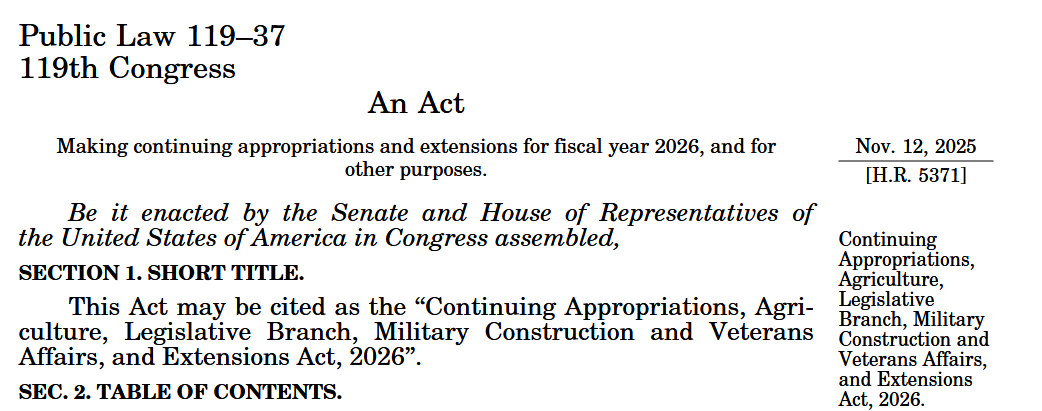
| 119-37 | 11/12/2025 | Continuing Appropriations, Agriculture, Legislative Branch, Military Construction and Veterans Affairs, and Extensions Act, 2026 |
| 119-74 | 1/23/2026 | Commerce, Justice, Science; Energy and Water Development; and Interior and Environment Appropriations Act, 2026 |
| 119-75 | 2/3/2026 | Consolidated Appropriations Act, 2026 |
That's good for you though; the bill's name says what it does.
Divisions?
In a standalone appropriations bill, the bill is self-contained and written to be an Act all by itself. If you're enacting multiple appropriations bills in one go, like in a minibus, things change a little bit. The minibus and omnibus bills use divisions as a wrapper for each of the bills. Let's take a look at the table of contents from the “Commerce, Justice, Science; Energy and Water Development; and Interior and Environment Appropriations Act, 2026”:
Each division in a minibus or omnibus is equivalent to an appropriations bill. At the end of each division, there's language like:
Also, there's usually language like this at the beginning:
These division assigments (A, B, C, etc...) change each year, but they're often the name of the bills in alphabetical order. If it's not in alphabetical order, theres usually a good reason. The House typically goes first in the process, and the Senate amends a bill and sends it back to the House. Sometimes, the Senate takes a bill, amends it and then sticks the rest on after whatever bill it was. For example, the "Consolidated Appropriations Act, 2024" P.L. 118-42 minibus started out as a MilCon/VA bill and was designated Division A, and then the rest (Agriculture (Div. B), CJS (Div. C), etc...) were tacked on to the end.
The internal ordering of Titles is fairly consistent year-to-year. We're going to cover titles and the structure of individual appropriations bills deeply in next week's post.
Translation: Divisions are just wrappers. Each division = one appropriations bill. The division letter changes yearly, but the content inside stays structured the same way.
Which Format to Use?
If you go to the page for the text of the "Continuing Appropriations, Agriculture, Legislative Branch, Military Construction and Veterans Affairs, and Extensions Act, 2026" you'll see this:
Text available as: USLM | USLM/XML (977KB) | TXT (537KB) | PDF (539KB)
Which do you pick?
If you're copying and pasting text, consider using the U.S. Legislative Markup (USLM) or XML formats of the bill. If you want something that looks like a bill or a public law, use a PDF. One drawback is that USLM isn't available immediately after enactment, it takes a few weeks. But, if you wanted to show a colleague the text from Section 4 of P.L. 119-37, you get this by copying and pasting from USLM:
And this from the PDF:
Senate section of the Congressional Record on or about November
9, 2025, and submitted by the chair of the Committee on Appropria-
tions of the Senate, shall have the same effect with respect to
the allocation of funds and implementation of divisions B through
D of this Act as if it were a joint explanatory statement of a
committee of conference.
You're probably thinking, it looks the same. You're right, the words are identical. Some subtle differences- USLM shows the provision as a continuous string of text; the copy paste from the PDF preserves the line breaks and hyphenation from the text. If you want machine readable text that preserves line breaks, use the TXT version of the bill. But, the Congress.gov page defaults to the USLM format. That should tell you something.
The great thing is: you have options. For years I was sold on the XML format, but I want to applaud the folks in the House, Senate, Office of the Federal Register and GPO who made USLM possible. It's my new favorite. It's machine-readable, easy to copy and paste, and preserves all of the sidenotes (Time period. 18 USC 3551 note) and Statutes at Large page numbers (139 STAT. 495) found in the PDF of a public law. It's a big deal and big leap forward in making these laws more accessible.
Why Should You Care?
"I need to find funding for program X. Where do I look?"
Find the subcommittee that covers the agency. That's your bill. The jurisdiction table above is your cheat sheet.
"Congress just passed a minibus. Is my agency in it?"
Check the table above. If your subcommittee isn't listed, your agency is still operating under a CR or prior-year funding.
"Which version of the bill should I cite?"
If it's law, use the Public Law or Enrolled version. Everything else is a draft that may have changed.
The 80/20 Rule
Most people care about a handful of agencies. Once you've found your area once, you'll know exactly where to look next time.
The appropriations structure is remarkably stable year to year. Title I of THUD is always DOT. Federal Transit Administration is always in the same spot within DOT. Account names rarely change.
Build your mental map for the agencies you care about. The first time takes 20 minutes. After that, you're navigating in seconds.
The Bottom Line
Key takeaways:
- 12 subcommittees write 12 bills—know your subcommittee, know your bill
- Start at the CRS Appropriations Status Tracker (90% of the time, that's all you need)
- Use enrolled bills or public laws for what the law actually is
- Omnibus = all 12 bills; minibus = some bills bundled together
- USLM format is your friend for copying and pasting
- Bill structure is stable year to year—find it once, know it forever
Quick links:
What's Next
Now you can find things. In the next post, we'll look at how appropriations bills are structured internally—the hierarchy of divisions, titles, and accounts—so you understand why bills are organized the way they are.
Then we'll get into reading the actual account text: what "to remain available until expended" means, how provisos work, and how to decode the legalese.
BlazingStar Analytics is building real-time budget execution tracking that connects appropriations, apportionments, and SF-133 reports. Get early access to our platform, launching Spring 2026.