The President's Budget Request: Congressional Budget Justifications
Last week, the Budget Appendix told you the President requested $8.7 billion last year for Federal Prison System, Salaries and Expenses. Two pages of numbers. No explanation. The Congressional Budget Justification for the Bureau of Prisons? That's where you'll find out exactly why.
In Part 1, we walked through the Budget Appendix — the account-by-account detail for every federal appropriation. You learned to read the Program and Financing schedule, the object classification, and the personnel summary. You know what the President is requesting.
Now we need the why.
The 60-Second Version
| Question | Answer |
|---|---|
| What is a CBJ? | An agency's detailed budget pitch to Congress |
| Who produces it? | Each agency — not OMB |
| Where do I find it? | Agency websites, not whitehouse.gov |
| How long are they? | Hundreds to thousands of pages per agency |
| When do they drop? | Usually within days or weeks of the budget release |
| Is there a standard format? | No. Every agency does it differently. |
Key insight: The Appendix is OMB's document — standardized, consistent, every account looks the same. Congressional Budget Justifications (CBJs, CJs) are the agencies' documents. There's no standard template. Two agencies can present the same information in completely different ways. That's a feature, not a bug — but it means you need to learn to read each agency's format.
The Congressional Budget Justification Transparency Act of 2021 requires the government to put links to all CBJs in a centralized location. There's usually a lag; agency websites will have the materials the soonest.
Pro tip: You may think that there would be one standardized term that's used across the government for these documents, and if you thought that you'd be wrong. For example, DOJ calls these documents the "Congressional Budget Submission". DOT calls these documents "Budget Estimates". Interior calls them "Budget Justifications". HUD calls them "Congressional Justifications". The Pentagon has a series of files called "Budget Documents". Each agency calls them their own thing, but the utility is the same. Regardless, everyone will be well-advised to avoid abbreviating "Budget Justifications" in the workplace; it will help you avoid awkward conversations with your colleagues.
From the Appendix to the CBJ
Let's pick up where we left off. In Part 1, we looked at the Federal Prison System, Salaries and Expenses account in the Budget Appendix. Here's what you saw:
- Program and Financing schedule — budget authority, obligations by program activity, unobligated balances
- Object classification — how much goes to personnel, contracts, supplies, etc.
- Personnel summary — total FTEs
If you don't have a photographic memory, pop back over to last week's post to refresh your understanding.
That's the math. Clean, standardized, two or three pages. But it doesn't tell you why the Bureau of Prisons is requesting what it's requesting. Why are personnel costs changing? What's driving the contract spending? Is the inmate population growing or shrinking?
For that, you need BOP's Congressional Budget Justification. We're going to use the 2026 CJ
What a CBJ Adds
When you open the BOP CBJ and navigate to the Salaries and Expenses account, you'll find the same numbers from the Appendix — plus everything behind them. After you open the document, you'll see an org chart, then this table:
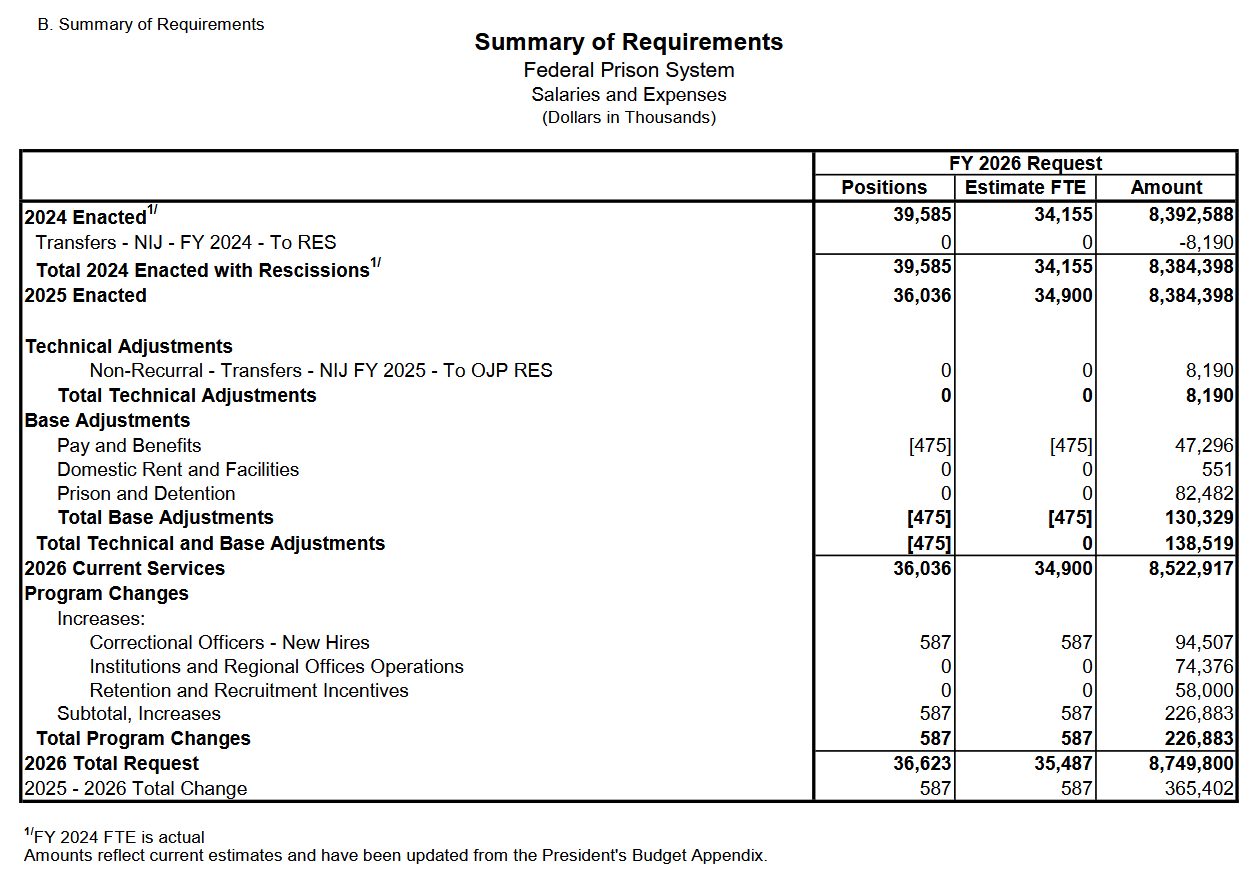
Now we're getting somewhere. First off, the appendix is in millions; here we're working in thousands. Note the Base Adjustments and 2026 Current Services line. This is BOP saying, here's what it costs to run this program next year changing nothing from last year. For Salaries and Expenses accounts, this is really just the new cost of the same number of full-time equivalents (FTEs) from the prior fiscal year. But you get detail. It costs $138 million more to run the same program in 2026 compared to 2025. $47 million of that is pay and benefits; $82 million is for prison and detention.
At the bottom, you see a $227 million line for program changes. This is the detail of the program increases they're proposing this year. From this table you can see that BOP is requesting an additional 587 correctional officers, and that costs $95 million. They also want $74 million for institutions and regional offices operations, and $58 million for retention and recruitment.
So on this chart you have:
| Description | Amount | |
|---|---|---|
| 2025 Enacted | 8,384,398 | |
| + | Current Services | 138,519 |
| + | Program Changes | 226,883 |
| = | 2026 Budget Request | 8,749,800 |
Decision Units
BOP breaks Salaries and Expenses into decision units — the building blocks of the account:
| Decision Unit | What It Covers |
|---|---|
| Inmate Care & Programs | Food, medical care, education, drug treatment, religious services |
| Institution Security & Administration | Correctional officers, facility operations, security technology |
| Contract Confinement | Private prisons, halfway houses, residential reentry centers |
| Management & Administration | Central office, regional offices, staff training, IT |
The Appendix showed you "program activities" as line items. The CBJ tells you what those lines actually mean — what programs fall under each one, what's changing, and why.
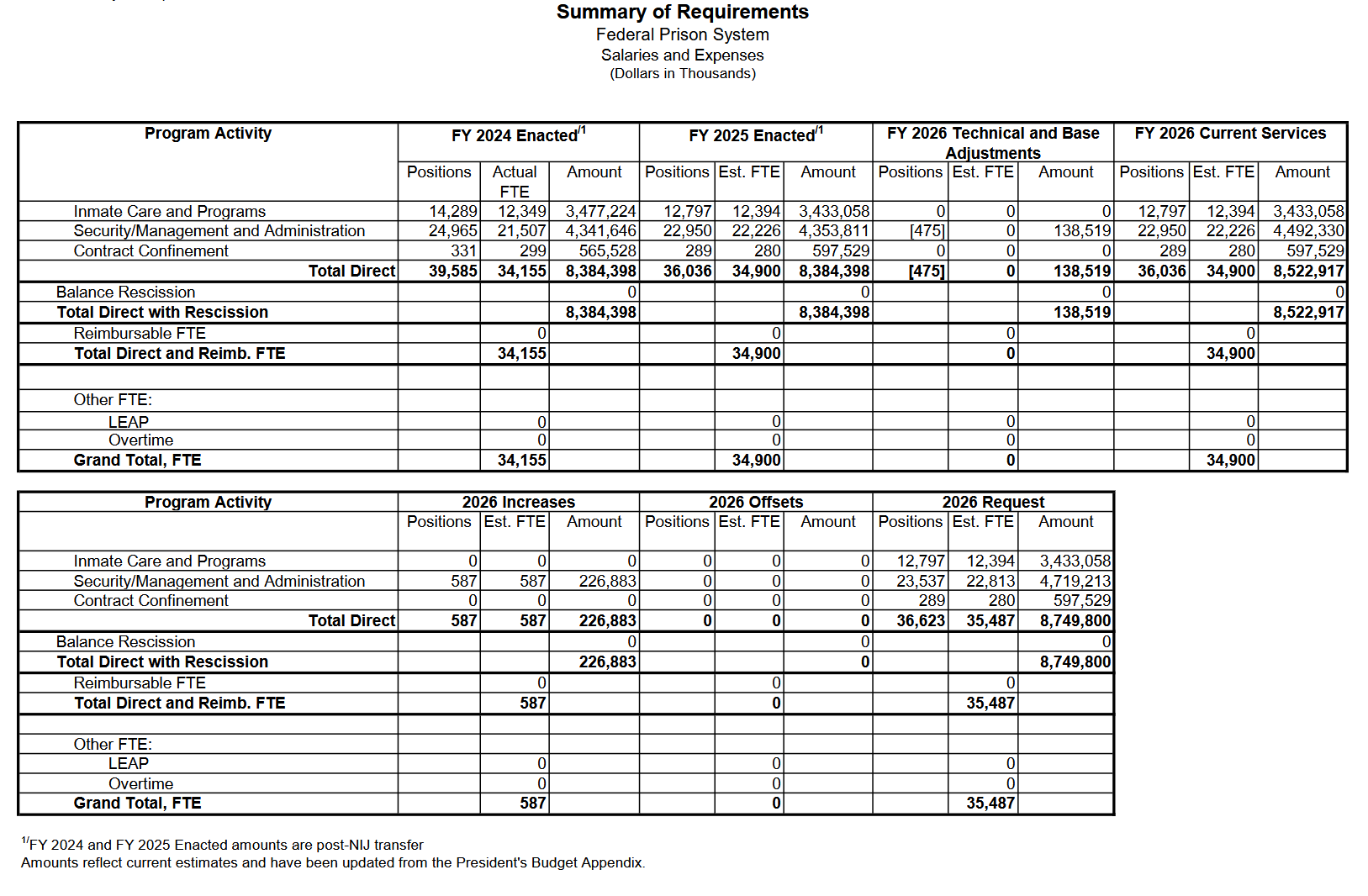
Here you have 2 tables stacked on top of each other. This presents the information from the summary table in more detail. The $138 million in base adjustments, is attributed to the Security and Administration decision unit.
The increase for program changes we saw is also attributed to the the Security and Administration decision unit.
Justification Narratives
This is where agencies make their case. For each decision unit, expect:
- What we're requesting and why: "The FY 2027 request includes $[X] million for Inmate Care and Programs, an increase of $[Y] million over the FY 2026 enacted level, to address [specific need]."
- What changed: New initiatives, inflationary adjustments, population-driven costs
- What happens if we don't get it: Agencies don't always say this explicitly, but the good ones make the consequences clear
Translation: If the Appendix is the invoice, the CBJ is the cover letter. "Here's what we need, and here's what happens if you say no."
BOP includes a table to justify all of the increases to the base, like this:

Let's focus on the Prison and Detention box at the bottom:
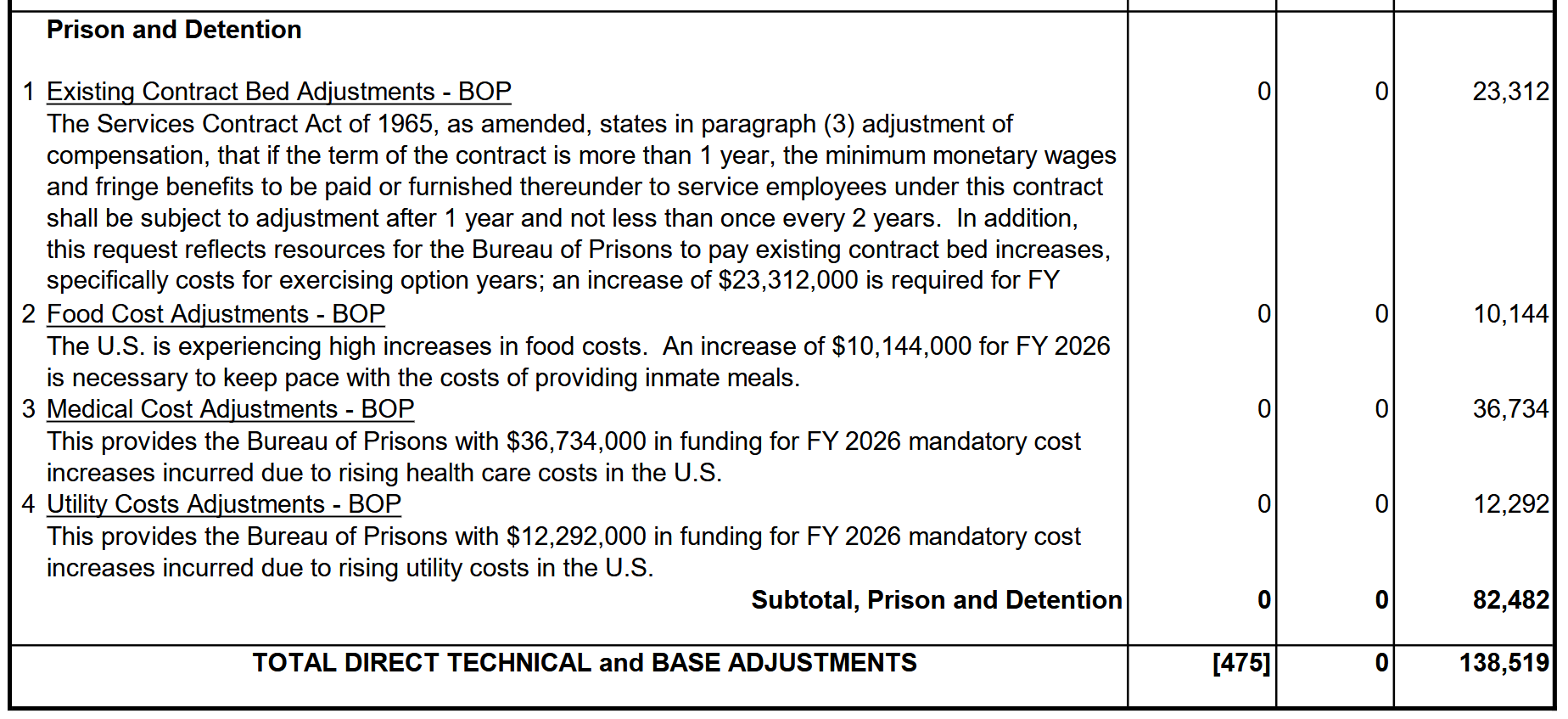
Here you can see the details. BOP estimates that food costs will increase by $10 million next year. Medical costs will go up by $37 million. While the appendix showed you the request, the CBJ shows you the why behind that request.
Staffing Detail
The Appendix gives you a total FTE count. The CBJ breaks it down — how many correctional officers, how many medical staff, how many in central administration. If there's a hiring surge or a reduction in force, this is where you'll see it.
Let's take a look:
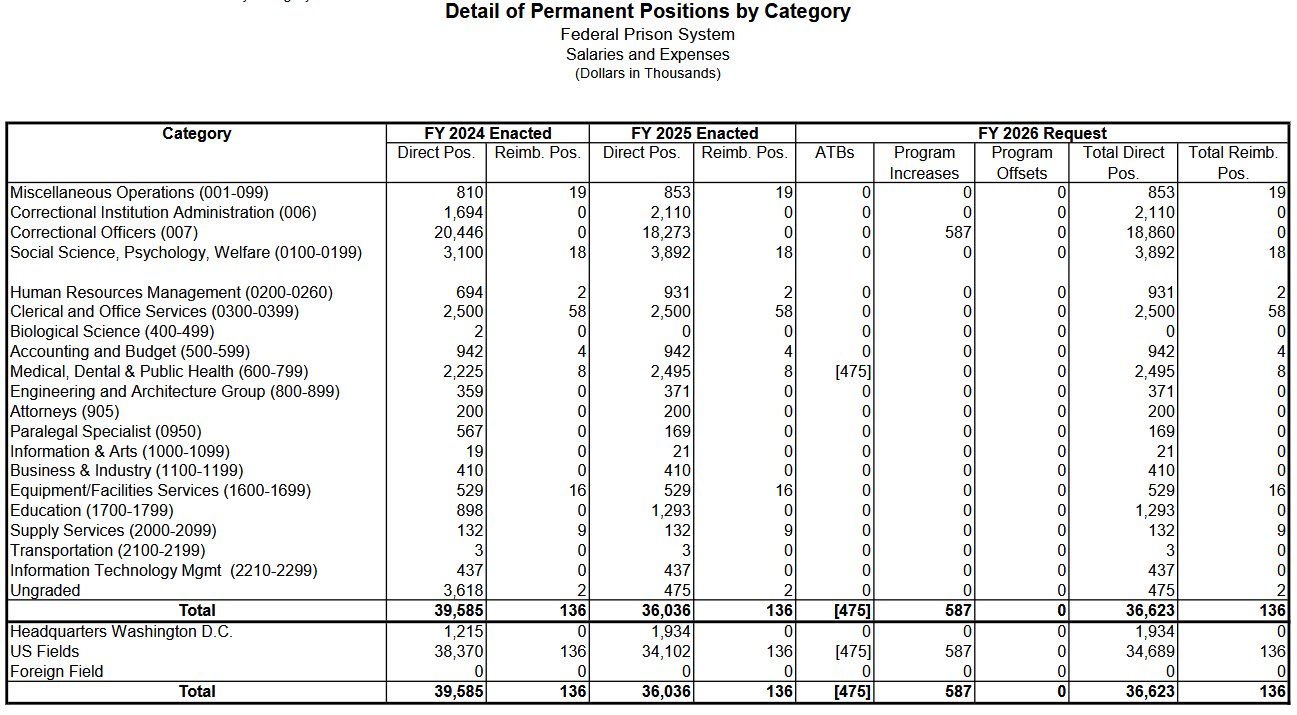
You can see that the vast majority of BOP employees are correctional officers (18,860), they also employ a fair number of social science, psychology and welfare employees (3,892) and medical, dental and public health workers (2,495). And you can also see that all staffing increases in this budget request are for correctional officers (587).
There Is No Standard Format
Here's the thing about CBJs that catches people off guard: every agency does it differently.
OMB gives agencies guidance on what to include, but there's no universal template. The result is that reading one agency's CBJ doesn't fully prepare you for another's. The concepts are the same — justification narratives, performance metrics, staffing tables — but the structure, layout, and level of detail vary widely.
Let's look at how different agencies approach it.
Department of Transportation, Federal Aviation Administration
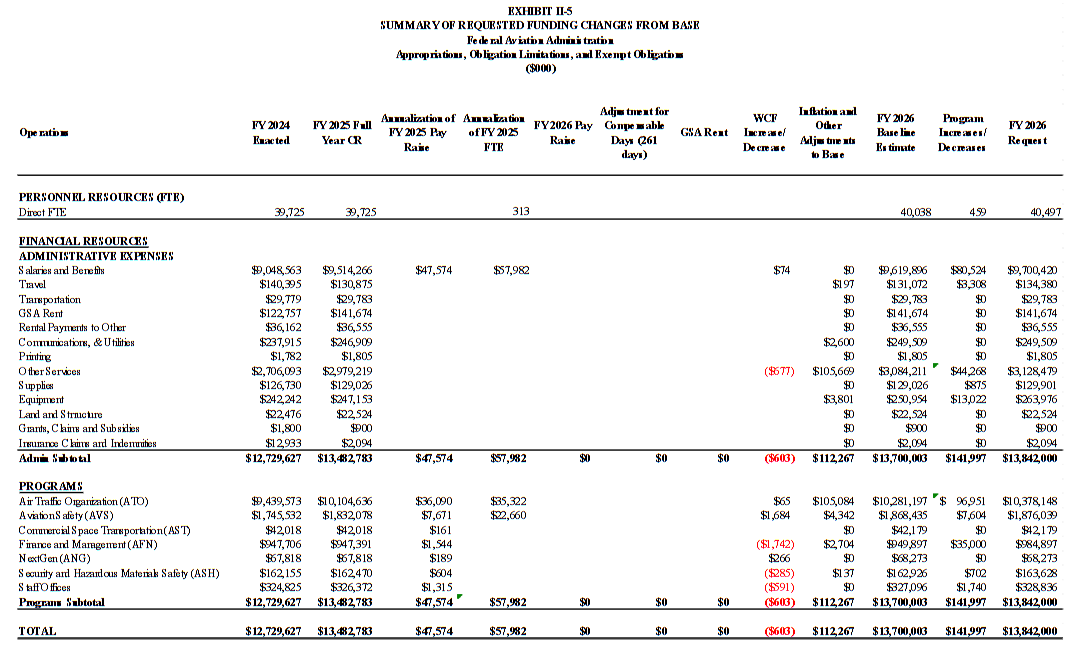
The FY 2026 Budget Estimates for the FAA ran about 385 pages. It's a lot chattier and detailed than the CBJ for Bureau of Prisons. While it has the same tabular material, it also has a lot more narrative. For example:
Operations - The FY 2026 budget requests $13.8 billion for the Operations account, an increase of $359.2 million, or 2.7 percent above FY 2025. The President’s Budget requests funding for the Air Traffic Organization (ATO), which is responsible for managing the air traffic control system, and the Aviation Safety Organization (AVS), which ensures the safe operations of the airlines and certifies new aviation products. In addition, this account also provides for the oversight of the commercial space transportation industry, as well as FAA policy and overall management functions. This funding level enables the agency to preserve the highest level of safety in the national airspace while investing in innovation.
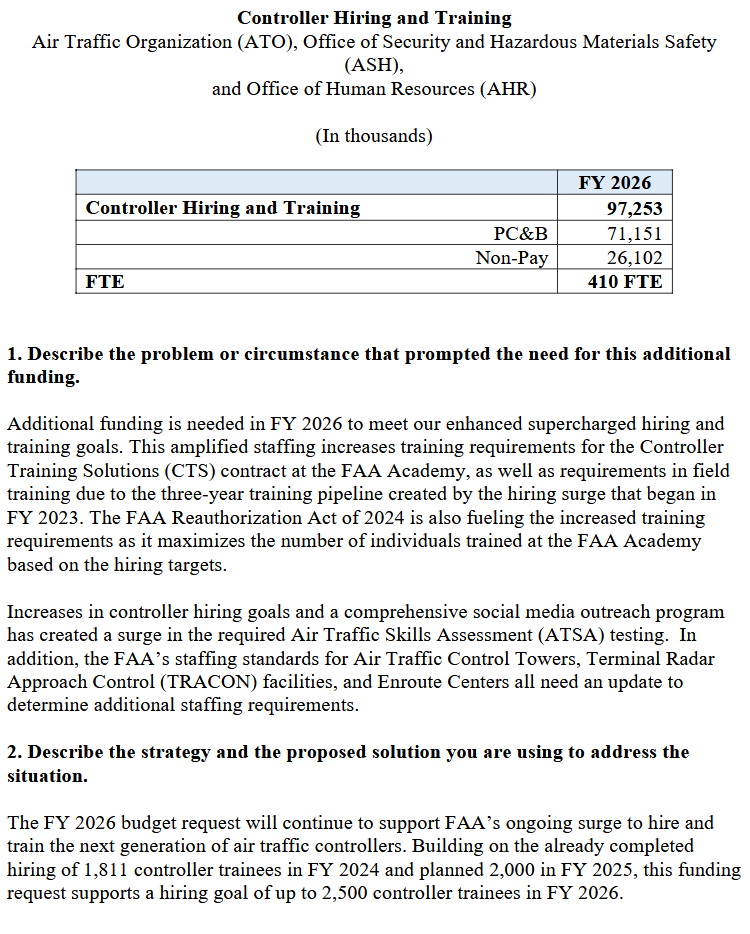
This budget request includes $142.0 million of targeted programmatic increases that will allow FAA to support key initiatives on controller hiring, aviation safety and oversight, and cybersecurity. This includes $97.3 million to meet the hiring and training goal of up to 2,500 air traffic controller trainees in FY 2026, allowing FAA to rebuild the pipeline of the Certified Professional Controller (CPC) staffing levels to meet current traffic demands and improve safety. The hiring and training supercharge will streamline the path for controller training while further increasing resiliency to serve high demand markets.
And the table is a little different too:
And then FAA includes a follow up to each programmatic increase with details like this:
The Point
Same information, different packaging. BOP gives you compact tables with brief narratives. FAA gives you pages of prose with tables woven in. the Pentagon doesn't produce a single CBJ at all — it publishes dozens of justification books organized by appropriation title and military service, using standardized exhibit formats (R-1 for RDT&E, P-1 for procurement) that look nothing like what you'd find from a civilian agency. And at the other end of the spectrum, a small independent agency like the Chemical Safety Board might produce a 30-page document covering everything.
The concepts are always the same: here's what we need, here's why, here's the detail. The format is whatever the agency decided to use. Once you've read two or three, you'll start to see the patterns underneath the differences.
How to Find CBJs
- Try the agency website first. Look for "Budget," "Congressional Justifications," or "Budget and Performance" — usually under the "Office of the Chief Financial Officer" or "Budget" section.
- Check the repository. The Congressional Budget Justification Transparency Act of 2021 requires the government to put links to all CBJs in a centralized location.
- Search for it. "[Agency Name] FY 2027 Congressional Budget Justification" will usually get you there faster than navigating the website. Just remember — the document might not be called a "Congressional Budget Justification." Try "budget estimates" or "budget justification" too.
Timing
CBJs don't all drop on the same day. Some agencies post them the day the budget is released. Others take days or weeks. DOD materials may roll out in batches over several weeks.
The budget is expected April 3. If you can't find a CBJ that day, check back. They'll appear.
Pro tip: Bookmark the budget pages for agencies you follow. You'll be going back to them.
Why Should You Care?
"The Appendix already has the numbers I need. Why bother with CBJs?"
The Appendix gives you the what. The CBJ gives you the why. If you're briefing leadership, preparing for a hearing, or writing analysis, you need the justification — not just the number.
"These are too long."
You're not reading them cover to cover. Find your account, read that section, move on. PDF search is your friend.
"Do appropriators actually use these?"
Appropriations staff use CBJs to prepare questions for budget hearings, inform markup decisions, and evaluate agency requests. These documents are part of the formal justification process. When a subcommittee chair asks the BOP Director why contract confinement costs are rising, they're reading from the CBJ.
"When will the FY 2027 CBJs be available?"
The budget is expected April 3. Some agencies will post CBJs that same day. Others will take days or weeks. DOD materials roll out in batches. If you can't find yours immediately, check back.
The Bottom Line
Key takeaways:
- CBJs are agency-produced, detailed budget justifications — the why behind every number in the Appendix
- Find them on agency websites, not OMB's site — there's no single repository
- There is no standard format. BOP uses compact tables and decision units. FAA writes pages of narrative. DOD publishes a library of exhibit books. Learn the format for the agencies you follow.
- They include justification narratives, staffing detail, and cost breakdowns the Appendix doesn't have
- Timing: They usually appear within days or weeks of the budget release — not always on day one
What's Next
The budget is expected Friday, April 3. When it drops, we'll publish a same-day walkthrough: what came out, what's missing, and where to find what you need. Then the following Monday, we'll close out this series with a look at the supplemental materials most people skip — the credit supplement and the crosscut analyses that tie the whole budget together.
Maximizing Your Effectiveness This Week
If you're a budget professional, or a government affairs professional, or someone who does this sort of thing for a living, what I'm about to write you already know (or should). If you're new to this, this is the guide for you.
- Start now. Build lists of accounts you care about today. Read last year's appendix, read last year's CBJs. By the time Friday rolls around, you should know what you're looking for. You should also know where to look. So bookmark OMB's budget page, bookmark the agency CFO or Budget Office's page. The most likely place for the information you want to find is exactly where you found it last year.
- Always compare to something. A number without a comparison is just a number. Start making lists of what the account got in the enacted bill. If you want to be really pro, make a table of the 2025 Enacted Level, 2026 PBR, 2026 House Mark, 2026 Senate Mark, and the 2026 Enacted Level. Otherwise, you're going to just anchor on the number, say $5 billion. If that's the request for HUD's Homeless Assistance Grants, it's a banner year. If it's the request for Tenant-Based Rental Assistance, it's an 80 percent cut. Without the right context, you don't know if it's good or bad.
- Remember it's the beginning. On budget day, you can only know what's published. Not every jot and tittle will be available. Start big picture, then work towards the details.
- Be nice, patient, and kind. This is good advice for life, but especially when interacting with budget professionals during the days and weeks around the budget release. For OMB and agency staff, this is the culmination of a long and rigorous process that began last spring. They're putting out a product that many people will dislike. No one will recognize the hours it took to make sure the tables add, the crosscut works, and that the work is free of typos. It's an undertaking. For Congressional staff, it's the start of a sprint. They're just getting up to speed on this information. Their bosses want memos and information quickly. And, they're weeks removed from the 2026 process, unless you're Homeland, at which point you're still in it. If you need to interact with either of those two folks for the next two weeks, you'd best come correct. Try to find what you need from publicly available sources before you ask a highly skilled budget professional to google something for you. If you can't find it and need their assistance, be your most polite and humble self. Being polite isn't just about manners; it’s about access. A burned-out budget analyst is much more likely to help the person who treats them like a human being than the one who demands an immediate data dump.
BlazingStar Analytics is building real-time budget execution tracking that connects appropriations, apportionments, and SF-133 reports. Get early access to our platform, launching later in 2026.