The President's Budget Request: The Budget Appendix
The FY 2027 President's Budget Request could drop as early as next week. The Appendix is the heart of the request: 1,200+ pages of account-level detail. This is the document that matters. Let's get into it.
The 60-Second Version
| Question | Answer |
|---|---|
| What is it? | The account-by-account detail for every federal appropriation and fund |
| Who produces it? | Office of Management and Budget |
| How long is it? | ~1,200+ pages |
| Where do I find it? | whitehouse.gov/omb/budget |
| What's NOT in it? | Narrative, economic assumptions, historical trends — those come in companion documents that may not drop this year |
Key insight: The Appendix is where the actual numbers live. Everything else — the main budget document, Analytical Perspectives, the press releases — is context and narrative. If you can read the Appendix, you can read the budget.
Click here for a quick visual explainer.
What Is the Budget Appendix?
In a normal year, OMB releases a collection of budget materials:
| Document | What It Does |
|---|---|
| Budget of the U.S. Government | Narrative, priorities, messaging |
| Budget Appendix | Account-by-account detail |
| Analytical Perspectives | Economic assumptions, crosscutting analysis |
| Historical Tables | Time series going back decades |
The main budget document tells you what the Administration wants to say. The Appendix tells you what they're actually requesting.
Some people call the Appendix "the phone book." It's chunky. It's not glamorous. But if you need to know what the President is requesting for a specific account, this is your source.
Available for preorder now! https://bookstore.gpo.gov/products/budget-us-government-appendix-fiscal-year-2027
And an aside for a second... I'm an appropriator through and through. When I, and many of you, think about the "budget request" it's really the annual discretionary funding request that comes to mind. The full budget request is more than that. It takes into account the discretionary request, mandatory programs, entitlements, debt and deficit projections, revenue and legislative proposals. It also has an articulation of the economic assumptions and makes risk projections on credit programs. So it's not just a table of numbers, it's a fully fleshed out economic policy document.
How It's Organized
The Appendix is arranged by agency. The Legislative and Judicial branches appear first, followed by Executive departments in alphabetical order. Larger non-departmental agencies follow, with small independent agencies appearing alphabetically at the end.
Within an agency, the Federal Funds accounts come first. If you're interested in discretionary appropriations, Federal Funds is your section. In particular, you're probably looking for General Fund accounts.
Here's a tree to guide your journey.
Department of [X]
├── Federal Funds
│   ├── General and Special Funds
│   │   ├── Account Name and Text
│   │   │   ├── Program and Financing Schedule
│   │   │   ├── Object Classification
│   │   │   └── Personnel Summary
│   │   └── [Additional Accounts]
│   └── Public Enterprise Funds
│       └── [Revolving funds, etc.]
└── Trust Funds
    └── [Trust fund accounts]
Every agency follows this pattern. Once you learn to read one account, you can read any of them.
Reading an Account
Proposed Language
At the beginning of an account, you'll see the name of the account and the proposed legislative text for the appropriation. As an example, we're going to look at the Department of Justice—Federal Prison System—Salaries and Expenses account from the FY 2026 appendix, page 627.
Here's what it looks like in the appendix:
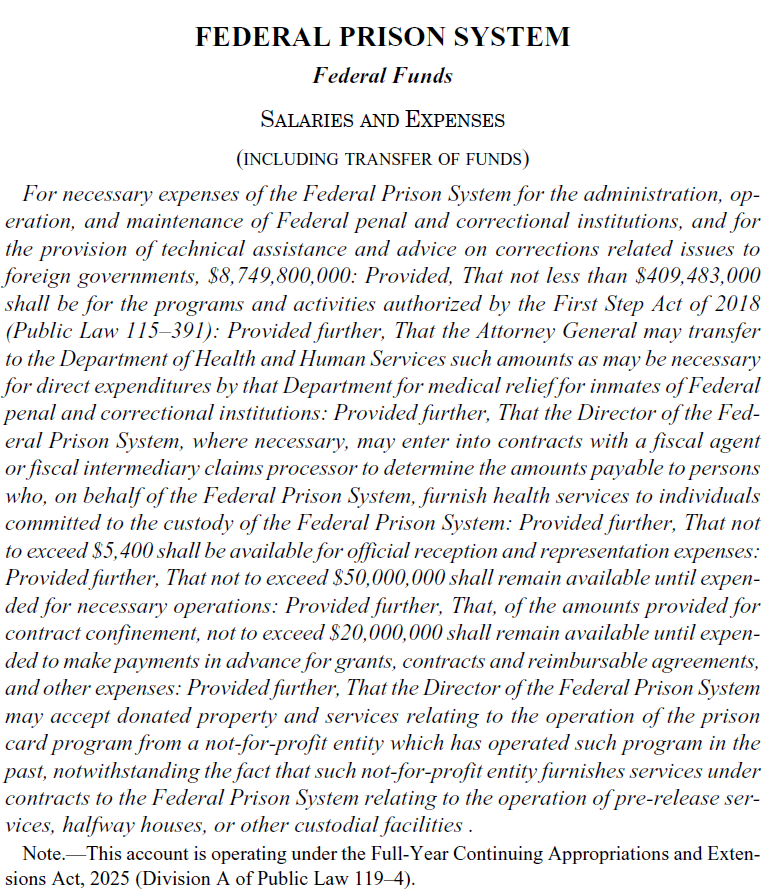
FY 2026 was a weird year for budgeting because the base text was the FY 2025 year long CR. Note that all of the budgetary language is in italics. That means text that's being added. Everything is being added because there's no bill in the current year. Let's go back to FY 2024 and take a look at the same section.
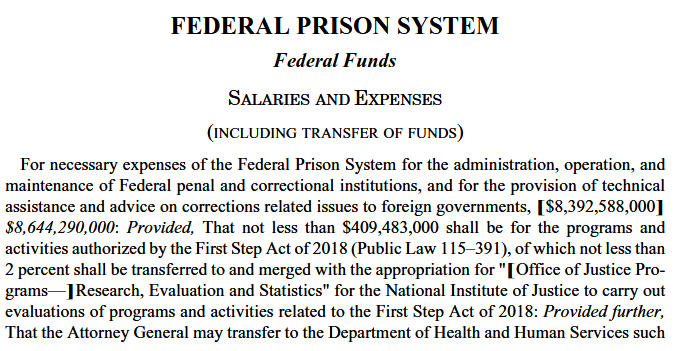
This illustrates the normal convention. The base text is last year's enacted bill, printed in normal text. Anything that's proposed to be struck from last year's bill is included in bold brackets like this: [ delete this text ]. Things that are proposed to be added are in italics.
So, in the first sentence, the budget proposes to strike out "$8,392,588,000" and insert "$8,644,290,000". This is how the sentence would read with those changes:
For necessary expenses of the Federal Prison System for the administration, operation, and maintenance of Federal penal and correctional institutions, and for the provision of technical assistance and advice on corrections related issues to foreign governments, $8,644,290,000:
FY 2026 has enacted 11 of 12 appropriations Acts. I expect you'll see this form in the FY 2027 budget appendix.
The Program and Financing Schedule
This is the core of the Appendix. Every account has one, and it's where most of the information lives. It's also the part that intimidates people the most.
A P&F schedule has three main sections:
1. Obligations by program activity
This breaks the account into its component programs or activities and shows obligations by each. It answers: "What is this money being spent on?"
This is where you'll find program-level detail that doesn't appear in the appropriations act. The 2026 request for federal prisons was $8.75 billion. The P&F schedule shows you how that $8.75 billion breaks down across program activities.
Here's that section of the schedule from the 2026 Appendix:
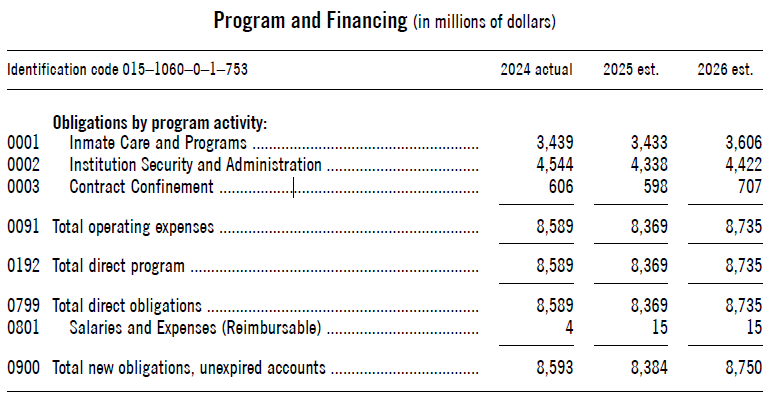
Here we can see that the $8.75 billion is comprised of discrete elements:
- Inmate Care and Programs: $3.6 billion
- Institution Security and Administration : $4.4 billion
- Contract Confinement : $707 million
and $15 million in reimbursable salaries and expenses, for a total of $8.75 billion.
The amounts in the table are presented in millions and have prior fiscal years to compare to. You'll have to do the math yourself, but you can see that the request seeks an additional $109 million in contract confinement, for example.
2. Budgetary resources
This shows the money coming in: new budget authority, unobligated balances from prior years, recoveries, and other adjustments. It answers: "How much does this account have to work with?" This should feel familiar to readers of How to Read an SF-133, Part I: Budgetary Resources (1XXX Lines). The lines mean the same thing.
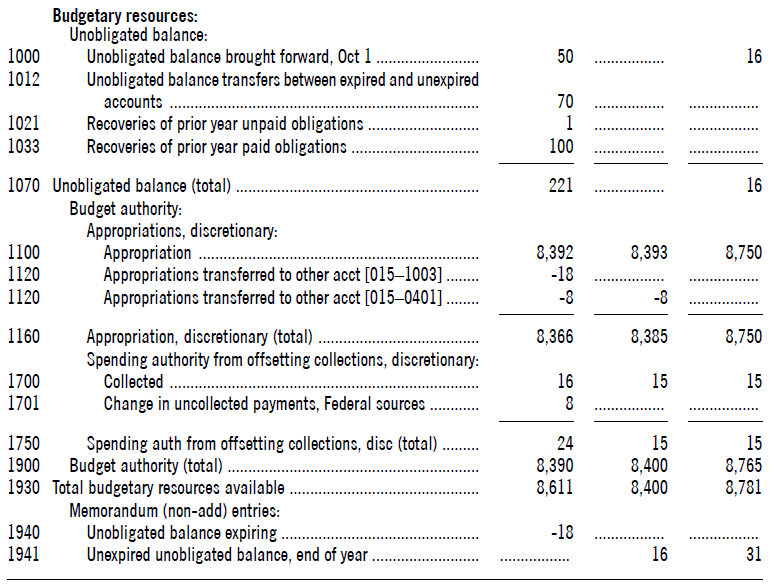
In this section, you have a breakdown of the unobligated balances brought forward, anticipated transfers, offsetting collections and spending authority and the like. If there was a budget proposal for a new fee increase you'd see the fiscal impacts here.
3. Change in obligated balance and 4. Budget authority and outlays, net
This section largely tracks the concepts we covered in How to Read an SF-133, Part III: Change in Obligated Balance and Outlays (3XXX–4XXX Lines). These sections tell you what was obligated and outlayed in the last 2 fiscal years, and what the anticipated obligations and outlays are for the budget request. This is a yearly wrap up of the same information you could get in the SF-133s. After all the same budgetary information is behind it.
Pro Tip: If all you're interested in is how much the Administration is asking for in the upcoming fiscal year, you can skip this section. If you care about the accounting and overall fiscal picture of this particular account, you should dig in. For example, if line 3200 keeps going up, it could mean more resources are flowing into the account or it could mean a problem in program delivery. There's important information here, but it has a narrow audience. I know what I write has a narrow audience to begin with, so that's saying something.

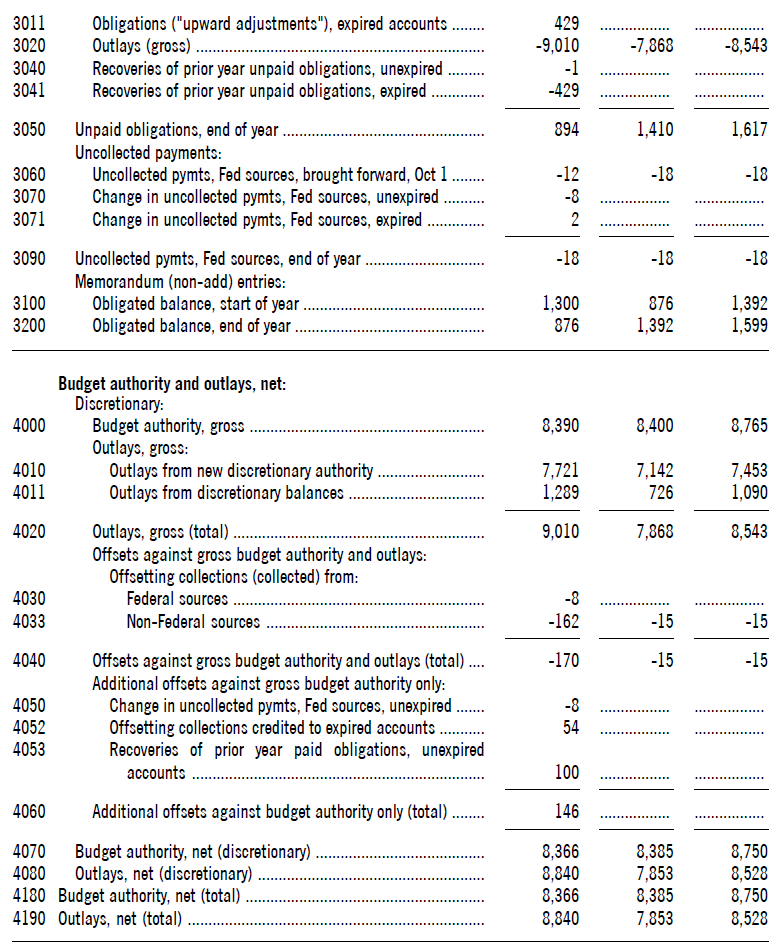
Translation: The P&F schedule is four questions in one table — what are we requesting, what are we doing with it, how much do we have, and how does it obligate and outlay?
Narrative About The Account
After the P&F table, there's a narrative about the account. Don't expect to learn a ton about the budget proposal here. But if you're trying to figure out if you looking at the right account, these descriptions can help make sure you're in the right place.
Here's the text from the 2026 Appendix:
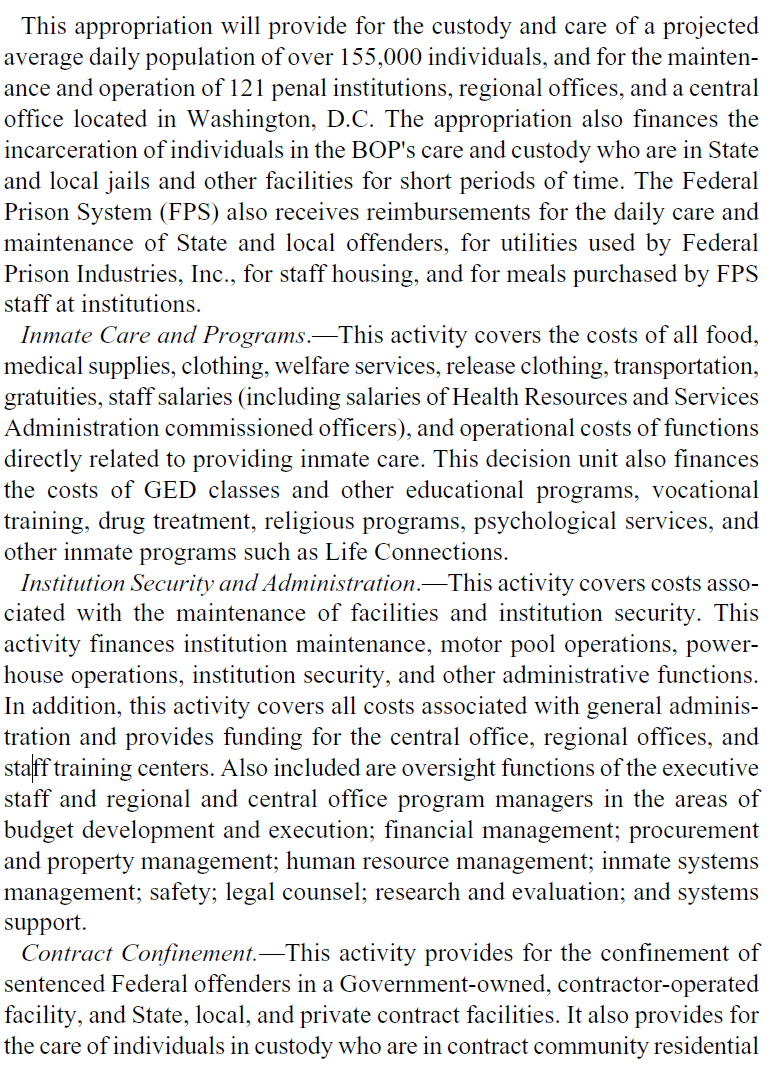
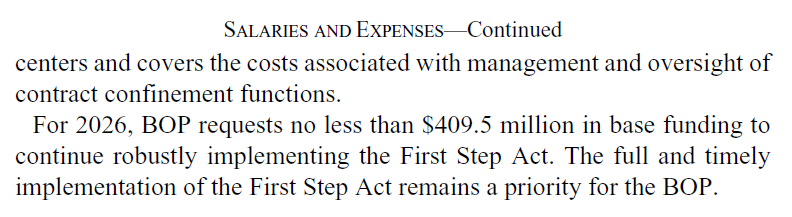
It's not super sexy stuff, but if you were interested in prison construction, let's say, the narrative description should let you know you're not in the right place; buildings and facilities is where that activity happens. If you were interested in funding for BOP staff salaries, you'd know you're in the right place.
Object Classification
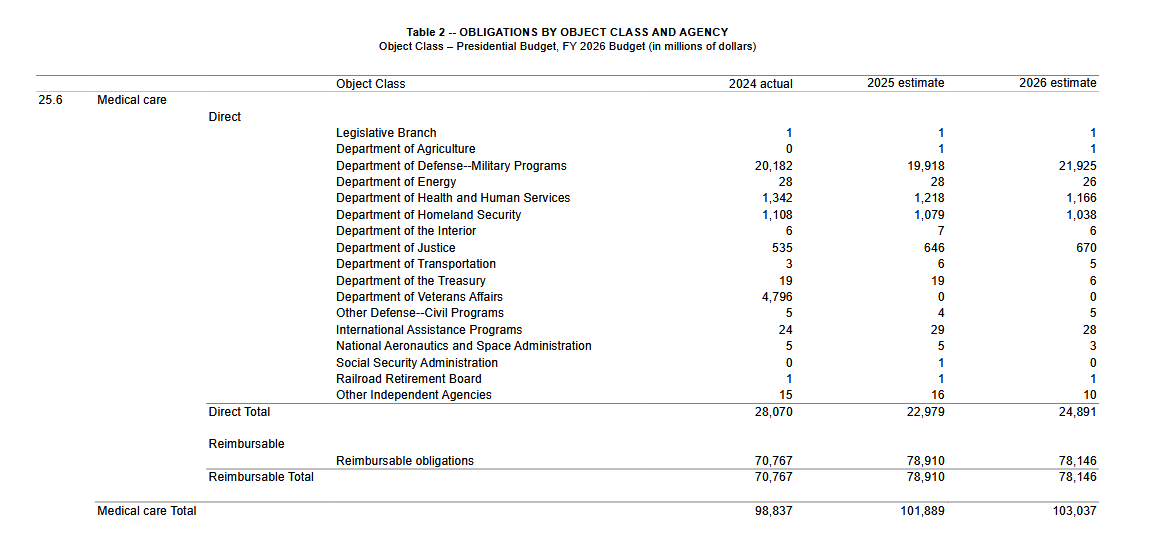
The Federal government breaks down the budget into budget objects. Budget objects are government-wide classifications of expenditures. So, budget object 11 is for personnel compensation in every account of the government. 11.1 is personnel compensation for Full-time, permanent employees. 24 is always printing and reproduction. Each year, the government publishes a breakdown of the budget request by budget object class. Here's the link to the report from FY 2026.
But the account is the unit that it all builds from and there's an object classification table in every account, like this:
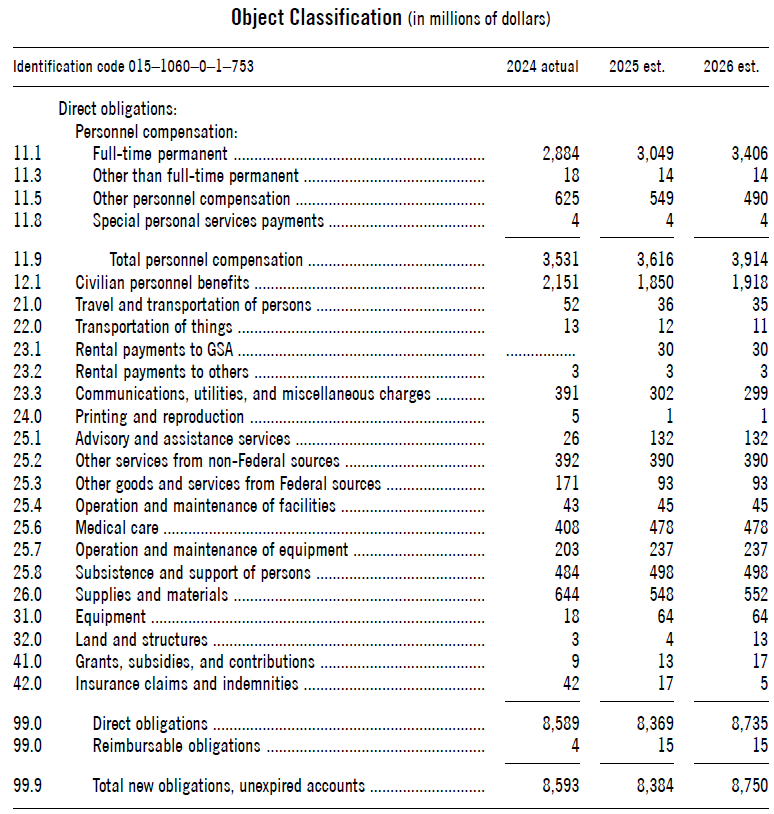
From this table you can see that this account is primarily staffing driven with about $6 billion of the $8.75 billion going towards compensation and benefits. Object 25.6 shows $478 million for medical care. That feeds up into that government-wide budget object class report I mentioned earlier. You can see which agencies fund medical care here:
Employment Summary
The last table shows you the number of full-time equivalent employees the account supports. This is different from the number of employees. Two half-time employees = 1 full-time equivalent employee. Other than that wrinkle, the table is pretty straightforward. If you care about staffing levels, this is the table for you.
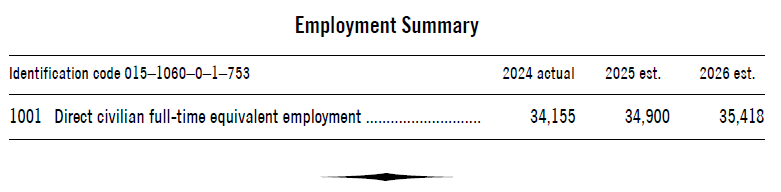
We can see from these data, that the request supports an additional 518 FTEs above the 2025 levels.
Pro Tip: You see that cool diamond at the bottom of the table? That signifies the end of the account. The appendix is in a two-column format. Some can be long and span pages. That diamond (and the breadcrumbs at the top of the page) helps you keep track of what account you're reading.
What to Look For
When you open the Appendix and find your account, here's a checklist:
The request: What's the total new budget authority being requested? Compare to the prior year enacted level — is it up, down, or flat?
The proposed text: The Appendix includes the Administration's proposed appropriations language for each account. This is what they want Congress to enact. Compare it to last year's enacted text — did they add provisos? Remove them? Change availability?
Program activities: Where is the money going within the account? Are programs growing or shrinking? Are there new program activities that didn't exist last year?
Object class mix: Is the account shifting from personnel to contracts? Increasing grant spending? These shifts tell you about strategy even when the total doesn't change much.
Personnel summary: How many FTEs are they requesting? More people, fewer people, or the same? This is often where workforce decisions become visible.
How to Navigate 1,300 Pages
Don't browse. Search.
- PDF search (Ctrl+F): Search for your agency name, account name, or program name
- Table of contents: The first few pages list every agency and account with page numbers
- Account naming: Accounts use the same names as in appropriations acts, so if you know the account from the bill, you can find it here
Pro tip: If you've been following our "How to Read an Appropriations Act" series, the account names in the Appendix will be familiar. The FinCEN Salaries and Expenses account we covered in Part 3? It has a page in the Appendix with all the same elements — purpose, amount, time — plus the P&F schedule that shows you how the Administration thinks the money should be spent.
What You Won't Find
The Appendix is numbers, not narrative. If you're looking for:
- Why the Administration is requesting this amount → Wait for agency Congressional Budget Justifications (CBJs), which we'll cover next week
- Economic assumptions behind the projections → That's normally in Analytical Perspectives
- Historical context and trend data → That's normally in Historical Tables
- Policy rationale and Administration messaging → That's normally in the main budget document
These companion documents fill in the story around the numbers.
Why Should You Care?
"I just need one number."
Go straight to the Appendix, search for your account, done. The request is right there.
"My boss wants to know what this means for us."
The Appendix gives you the what. For the why, you'll need the CBJ when it drops. In the meantime, compare the request to last year's enacted level and note the direction.
"Is this the final number?"
No. This is the President's request. Congress will produce its own appropriations bills, and they will differ. The budget is a starting point, not an ending point.
"I've never opened this document before."
Now's the time. If the Appendix is all we get on day one, everyone's reading the same 1,300 pages. The people who know how to navigate it will be the ones with answers first.
"I need to know about this particular grant program, within a larger account."
You may be out of luck. Check the "Obligations by program activity" section of the P&F schedule. If it's not there, you may need to look in the agency's CBJ to get that level of detail.
The Bottom Line
Key takeaways:
- The Budget Appendix is account-by-account detail for every federal appropriation
- The account language shows the changes the request would make to last year's appropriations text.
- The Program and Financing schedule is the core — status of funds, program activities, object classification
- Search, don't browse — use Ctrl+F and the table of contents
- Compare the request to enacted to see what changed
- This is the President's request, not the final word — Congress will change it
- CBJs will provide the narrative when they drop — we'll cover those next week
What's Next
When the budget drops, we'll do a day-of post walking through the release: what came out, what's missing, and first observations. The following week, we'll cover Congressional Budget Justifications — the agency-produced documents that tell you why behind every number.
BlazingStar Analytics is building real-time budget execution tracking that connects appropriations, apportionments, and SF-133 reports. Get early access to our platform, launching later in 2026.