Earmarks: Time, Purpose, and Amount at Their Tightest
Time, purpose, amount — the three elements we've walked one at a time — don't usually show up in their purest form. Most appropriations are lump sums with room to move. An earmark is the opposite: all three fences drawn so tight they fit on a single line, aimed at a single project, with the force of law. This post is where the series ties together — and where "as tight as possible" comes back to bite.
In 2026, Congress passed a federal law one of whose provisions did nothing but delete a single word. Here it is, in full:
the item relating to "Replacing Five Elevators in a Public Housing Development" is deemed to be amended by striking project "Replacing Five Elevators in a Public Housing Development" and inserting "Replacing Elevators in a Public Housing Development".
That's it. Strike "Five." It took an act of Congress, because Five means exactly five — not four, not six — and it had the force of law. If the building turned out to have six elevators, or the housing authority wanted to do three now and two next year, the money was stranded until Congress went back in and removed one word.
To understand how a typo becomes a federal statute, you have to understand the earmark. Regardless of your opinions on earmarks, they're just appropriations, with the same three elements. But, drawn as tight as they go.
The 60-Second Version
| Term | What it means |
|---|---|
| Earmark | A line directing a specific amount to a specific recipient for a specific project — the three elements at maximum resolution |
| CPF / CDS | The current names: Community Project Funding (House), Congressionally Directed Spending (Senate). Reinstated for FY2022 after a decade-long ban |
| Where they live | Almost never in the bill's own text — in a table in the explanatory statement, pulled into law by reference |
| Incorporation by reference | The bill gives that outside table "the same force and effect as if included in this Act" |
| The catch | Force of law cuts both ways: an error in an earmark takes another law — a technical correction — to fix |
Key insight: Everything the series has been about — how long (time), for what (purpose), how much (amount) — an earmark answers at the finest possible grain, and adds a fourth coordinate the fences never pinned down before: who gets it, and where. An earmark isn't a different kind of appropriation. It's the same three fences, tightened until there's no slack left.
An Earmark Is the Three Fences at Point-Blank Range
Meet the biggest earmark account in the government: HUD's Community Development Fund. Here's the top of it, from the Transportation, Housing and Urban Development, and Related Agencies Appropriations Act, 2026 (Division D of P.L. 119-75, at 140 Stat. 396):
Highlight legend: gold = amount · blue = availability (time) · pink = purpose · coral = the pointer to the earmark table
Read it against the three fences you already know:
- Time. "To remain available until September 30, 2029" — a multi-year clock. Whatever gets earmarked here has four years to obligate. With the 5-year contract execution period, that's 9 years to spend down the money.
- Purpose. "Economic and community development activities," narrowed to "grants for the economic development initiative (EDI)."
- Amount. Of the account's roughly $7 billion, $3,615,244,120 is fenced off for EDI grants — and that pot is then split, project by project, in the table.
Then the fourth coordinate. The table doesn't just say "economic development." It names a recipient and a place for each line — a city, a county, a housing authority, a specific project. That's the earmark: the three fences from Parts 1 through 3, closed down around one grantee. A lump sum says "community development, use your judgment." An earmark says "this many dollars, to this entity, for this project, by this date." No judgment left.
Translation: A normal appropriation hands an agency a purpose and trusts it to pick the projects. An earmark makes the picks in the statute. The agency's job shrinks from deciding to executing exactly what's written. Just as an "of which" shrinks the purpose of a larger appropriation, think of each line on an earmark table as an "of which" of this $3.6 billion.
Where Earmarks Live: Incorporation by Reference
Notice what the bill text does not contain: the projects. It doesn't list the cities or the dollar splits. It points — "for the purposes, and in amounts, specified … in the table … in the explanatory statement described in section 4." The thousands of individual earmarks live in a separate document, the explanatory statement, and the bill reaches over and gives that document legal force.
Incorporation by reference — a law can make an outside document legally binding without reprinting it, just by pointing at it and saying it counts. The appropriations act runs a line (that "section 4") giving the explanatory statement "the same force and effect as if included in this Act," and with those words the earmark table — thousands of lines the bill never physically contains — carries the full force of law. It's how a short bill enacts a phone-book of detail. And the sting: force of law is force of law whether the number sits in the bill or in a table the bill merely gestures at.
Since earmarks came back for FY2022, that table comes wrapped in a transparency regime the old system never had: members post their request letters publicly, certify in writing that neither they nor their immediate family has a financial interest, and the whole category is capped (roughly 1% of discretionary spending), with the House barring for-profit recipients. The upshot for anyone doing oversight is that earmarks are now among the most traceable dollars in the budget — every one has a named member, a named recipient, and a public paper trail.
Finding and Reading the Earmark Table
While the bill points you to "the table entitled "Community Project Funding/Congressionally Directed Spending" … in the explanatory statement described in section 4" it doesn't exactly provide you with directions. Let's break this into parts: First, what does Section 4 say?
SEC. 4. EXPLANATORY STATEMENT.
The explanatory statement regarding this Act, printed in the House section of the Congressional Record on or about January 21, 2026, and submitted by the chair of the Committee on Appropriations of the House, shall have the same effect with respect to the allocation of funds and implementation of divisions A through D of this Act as if it were a joint explanatory statement of a committee of conference.
That's a clue. It's in the Congressional Record. You go to the Congressional Record for January 21, 2026 and you see... not much related to appropriations. Key words here are "on or about". January 22, 2026 has 2 parts, and the second part, book 2, is the explanatory statement referred to in section 4.
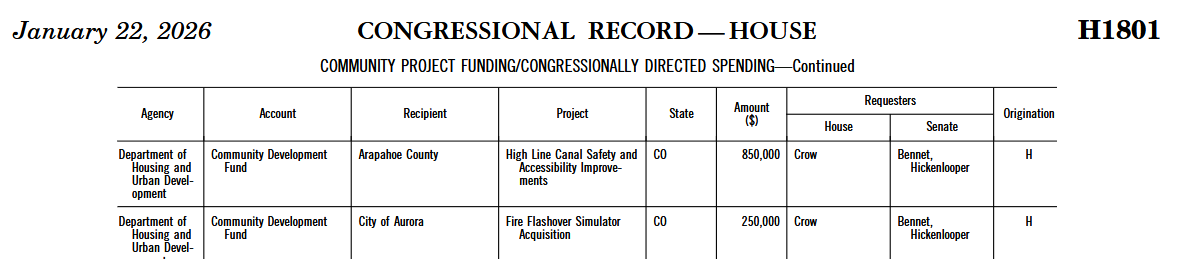
Make it to page H1781 and you'll find:
COMMUNITY PROJECT FUNDING/CONGRESSIONALLY DIRECTED SPENDING—Continued
| Agency | Account | Recipient | Project | State | Amount ($) | Requester (House) | Requester (Senate) | Origination |
|---|---|---|---|---|---|---|---|---|
| Department of Transportation | Port Infrastructure Development Program | Port of Seattle | Pier 86 Grain Terminal Switcher Locomotive Replacement Project | WA | 250,000 | Jayapal | Cantwell | H |
| Department of Transportation | Port Infrastructure Development Program | The Northwest Seaport Alliance | Northwest Seaport Alliance Berth Deepening on the Blair Waterway | WA | 2,000,000 | Randall | H | |
| Department of Transportation | Port Infrastructure Development Program | The Northwest Seaport Alliance | Terminal 18 Shore Power Expansion | WA | 8,000,000 | Murray | S | |
| Department of Housing and Urban Development | Community Development Fund | Petersburg Borough | Banana Point Breakwater Improvements | AK | 2,000,000 | Begich | Murkowski | S |
| Department of Housing and Urban Development | Community Development Fund | City of Soldotna | Marydale Avenue Improvements | AK | 2,387,000 | Begich | Murkowski | H/S |
| Department of Housing and Urban Development | Community Development Fund | Native Village of Diomede | Teacher Housing Renovation | AK | 1,500,000 | Murkowski | S |
Midway down, you see the Agency and account change and the EDI earmarks start. Let's break the first EDI down.
Time. Nothing here on time. These earmarks inherit the "to remain available until September 30, 2029" from the base Community Development Fund appropriation shown above.
Purpose. This is split across columns but think of it this way, the purpose is for "Banana Point Breakwater Improvements" done by "Petersburg Borough". Essentially you glom the project and recipient together.
Amount. $2,000,000.
There's also other metadata here that help with attribution, but at its core each line becomes a standalone appropriation, dividing that larger $3.6 billion appropriation. If you wanted to get rid of tables altogether, "Provided, That of which $2,000,000 shall be for Banana Point Breakwater Improvements performed by Petersburg Borough, Alaska:" would be the functional equivalent.
Pro Tip: To find the sections of the Congressional Record with the Joint Explanatory Statement, please use the CRS Appropriations Status Table. If you go to the notes section for THUD, and click on the little "+", you'll see:
Explanatory Statement materials, CPF/CDS tables, and bill funding tables are available in Book II of the January 22, 2026 Congressional Record as follows:
Explanatory Statement: See pages H1734-H1909
CPF/CDS Tables: H1746-H1887
Bill Funding Tables: H1888-H1909
The Catch: Force of Law Cuts Both Ways
Here's where tightness and precision turn on their maker. A lump-sum appropriation has give and play — if a project stalls or a need shifts, the agency can reallocate or reprogram within the purpose. An earmark has none. The recipient, the amount, the project description: each is now statutory text. And the only instrument that can edit statutory text is another statute.
So when reality diverges from the table — the recipient's legal name was wrong, the named entity can't actually receive the grant, the project needs to be scoped differently, or someone wrote "Five" — the agency can't just fix it. Congress has to. That's a technical correction: the legislature going back in to move a fence it drew too tight, either in a standalone corrections provision or riding on the next available vehicle.
Watch it happen. In the 2026 THUD act, four years after the fact, Congress reached back to repair the 2022 earmark table (Section 421, at 140 Stat. 431, amending the table in Division L of P.L. 117-103):
Look at what needed a law. Two are wrong recipients — the money was directed to an entity that couldn't take it (a port authority that wasn't the grantee; a school district when the city was the actual recipient). One is a redefined project. And number seven is the rookie mistake: an over-specified purpose. "Replacing Five Elevators" fenced the money to exactly five. The fix was to strike one word — but because that word had the force of law, striking it took a federal statute, and the project waited on the calendar until a vehicle came along.
The errors run the full range, from over-tight adjective down to single keystroke. A few subsections later, the same corrections section strikes "Hill Street" and inserts "Mill Street" — a one-letter repair to the "Laconia, NH … Pedestrian Bridge Replacement," whose earmark had named, bindingly, the wrong street. One letter. One act of Congress.
Key insight: Notice the mechanism — "deemed to be amended by striking … and inserting …." Congress is amending a table inside an explanatory statement, by statute. That's incorporation by reference running in reverse: because the bill gave the table the force of law going in, it takes an act of law to change a cell of it coming out. The same move that made the earmark binding is the reason a typo in it is so expensive.
Why It Matters
Earmarks are the clearest live demonstration of everything the series has argued. If you doubted that time, purpose, and amount are real fences and not bookkeeping abstractions, here they are with names attached — a dollar figure, a project, a deadline, a recipient, all enforceable, all in the public record. Earmarks are the three elements you can point at.
They're also a lesson in the trade every appropriator makes. Tight fences buy accountability: you know exactly where the money goes and who asked for it. Loose fences — lump sums — buy flexibility: the agency can adapt when the world doesn't match the plan. Congress chooses the tightness knob line by line, and the elevator correction is what the tight end of that knob costs. There's no free precision. Every fence you draw is a fence you might have to pass a law to move.
And if I may, a personal digression.
Some twenty years ago, I started my career on the House Appropriations Committee writing the database that tracked earmark requests and produced the data for the tables that would appear in the Congressional Record. Right before that, I worked in a personal office on Member requests. I know how stressful this is and how high the stakes are, and I offer my thanks, admiration, and sympathy to every Congressional staffer who works on earmarks. It's the one percent of the bill that can get you 100 percent fired.
For some of us, earmarks and this job are intertwined (it's not and there's a lot more to appropriating than just earmarks), and I'll be honest about what that means. I still get a knot in the pit of my stomach every time I read a technical correction — because I know the panic and the angst behind it, and the "Duck," or the "Oh Shoot," that came a beat before. Every line on that corrections list is somebody's bad day at work, now permanent in the law.
And finally, I didn't include Technical Corrections in here to drag anyone. That's not the point. The point is that time, purpose, and amount matter, not just in earmarks, but in every appropriation. In a small way, every technical correction is a victory for the rule and force of law and for Congress' continued exercise of its Constitutional power of the purse.
— Joe
Wrapping Up
An earmark is the whole series in one line: time, purpose, and amount, tightened until they name a single project — plus the coordinate the fences never fixed before, the recipient. Which raises the next question, and the one the back half of this series is about. Once Congress names who gets the money, how does it actually reach them? A grant? A contract? Something in between?
That depends on the vehicle.
What's Next
Grants, Contracts, and Cooperative Agreements: What's in a Vehicle? The same earmarked dollar can leave the building three different ways, each with its own body of law and its own set of strings. Next, we read the instruments that carry the money the last mile.
Keep following the money.
We do this every week. Necessary Expenses goes out Friday afternoons: the week's CFR redlines, executive actions, notable grants, and what we flagged. Free, and that's the whole arrangement.
Not keen on another newsletter? Our public archive of fiscal data is at: data.blazingstaranalytics.com.