The Law Said $3,990,345,000. So Did the Apportionment. So Did The Execution Report.
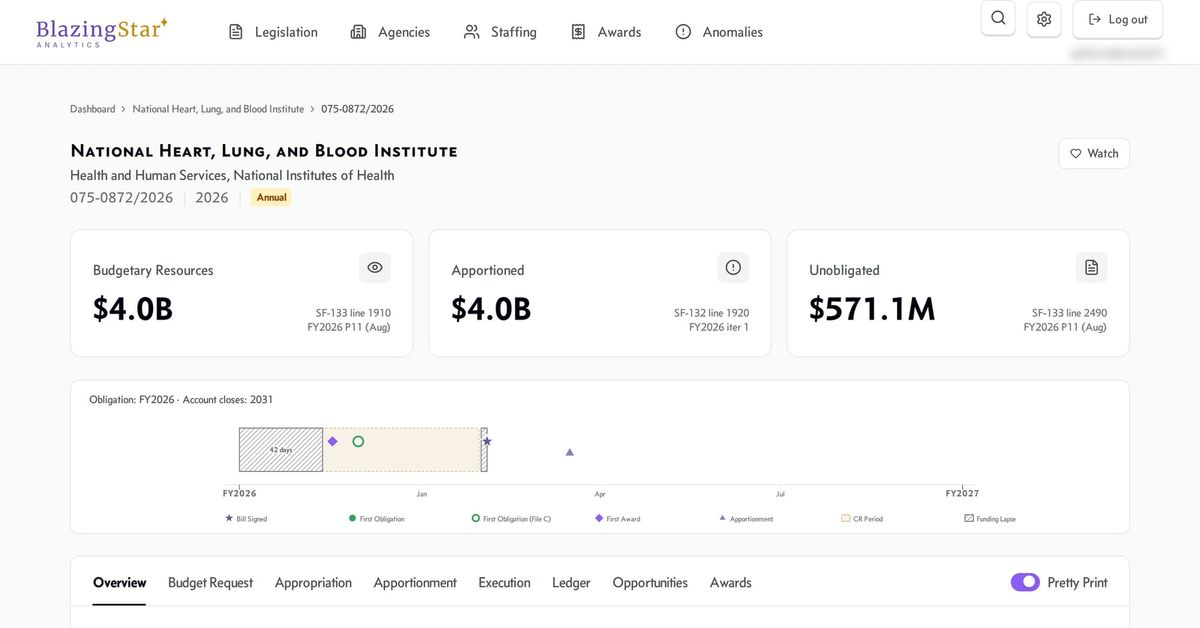
In fiscal year 2026, Congress appropriated $3,990,345,000 to the National Heart, Lung, and Blood Institute. OMB's apportionment carries the same number on its appropriation line. Treasury's figures show the same number again. Three documents, produced by three different offices through three different processes — and they agree to the dollar. The question most people can't answer is a simpler one: where did that money go?
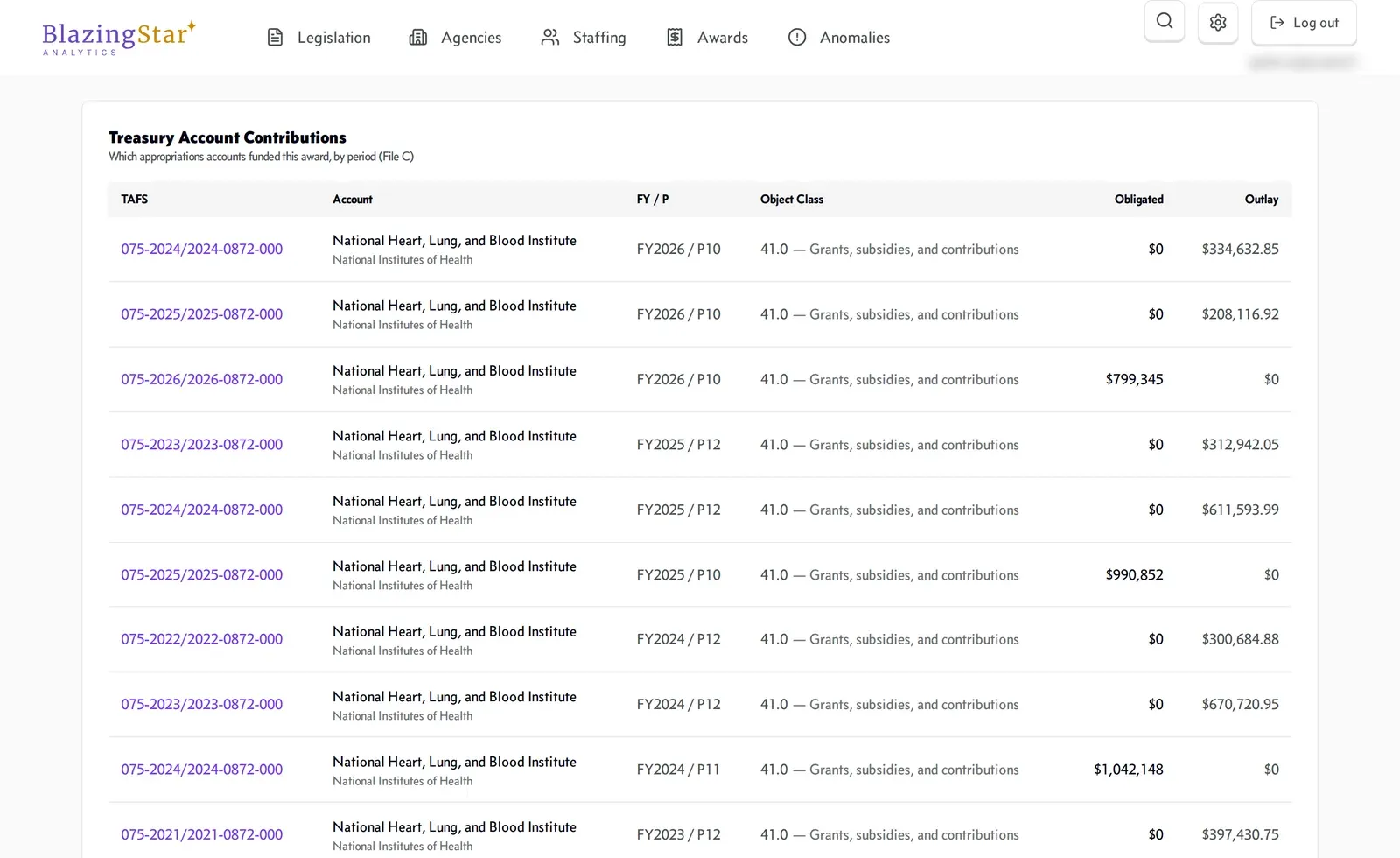
Here's one answer. A training grant at the University of Virginia drew $799,345 from that exact Treasury account in FY2026 — account 075-0872. You can start at the grant and walk backward: the award, to the account it drew on, to the apportionment that released it, to the line in P.L. 119-75 that appropriated it in the first place.
That walk — from the law that appropriated a dollar to the award that spent it, and back again — is the whole product. Today it opens.
What launched today
I started on the staff of the House Appropriations Committee in 2007 and stayed until 2021 — long enough to watch the money move under presidents of both parties. I then served at an agency and at the Office of Management and Budget. The whole time, I believed there had to be a better way to link what the law appropriates to what actually gets spent. Earlier this year I founded BlazingStar Analytics to build it. What we're releasing today takes a lot of the pain out of following a dollar from appropriation to award. We're not finished.
Introducing BlazingStar Analyst. It takes an enacted appropriation and links it to everything that happened to the money afterward: OMB's apportionment on an SF-132, Treasury's monthly execution on an SF-133, and the awards that obligated it — contracts and grants down to the recipient. From FY2022 forward.
We started with enacted law for a reason you can check. An enacted match can be proven. The bill, the apportionment, and the SF-133 come out of three different shops, through three different processes — so when all three land on $3,990,345,000, that agreement is evidence, not a claim. We show it to you account by account. We don't boil it down to a score and ask you to trust the score.
So when you open the NHLBI account, you don't get an assertion that the data ties out. You get the clause from the law, the apportionment line, and the execution report — three tabs on one account page, each carrying the same figure. Read it yourself. That's the point.
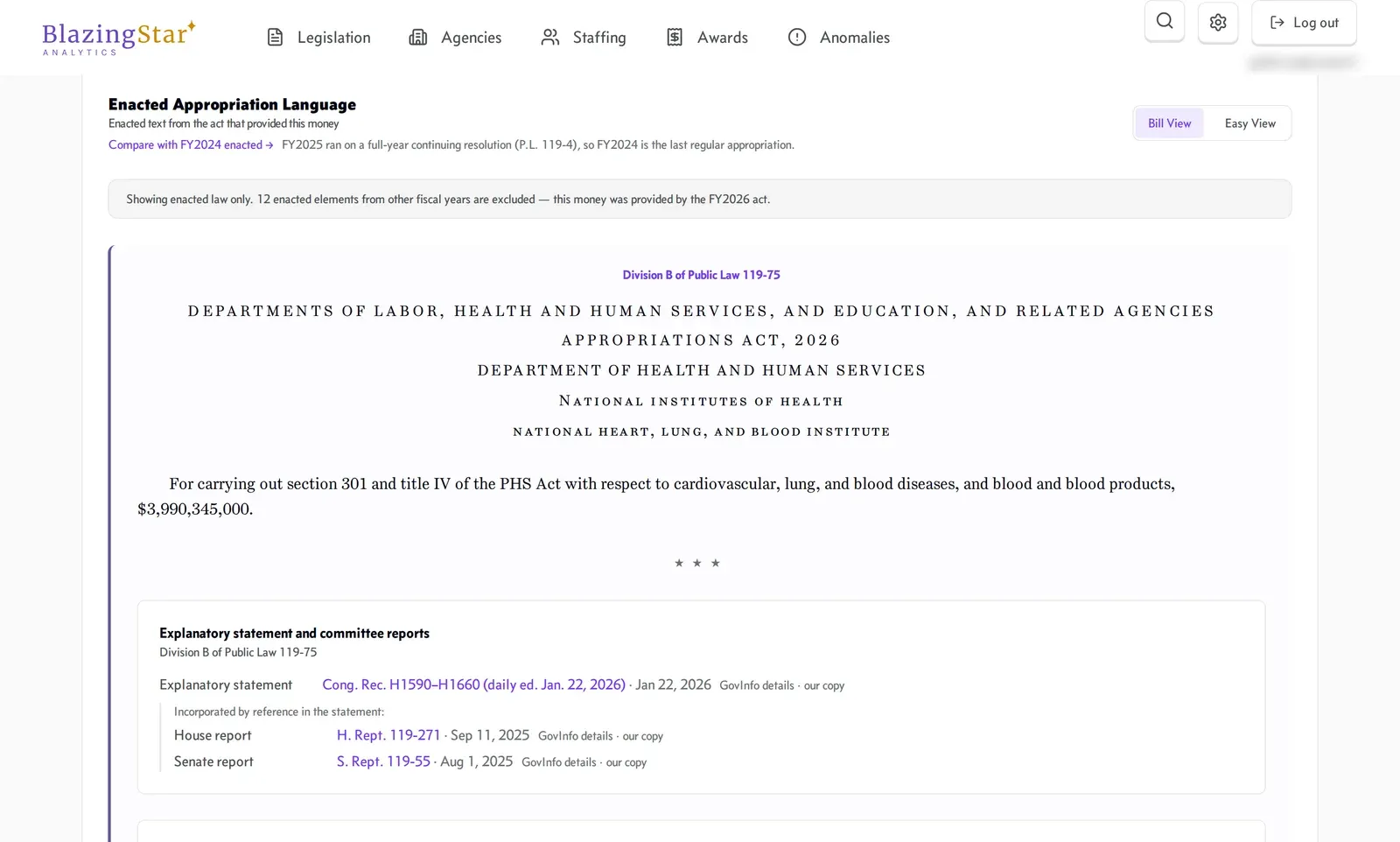
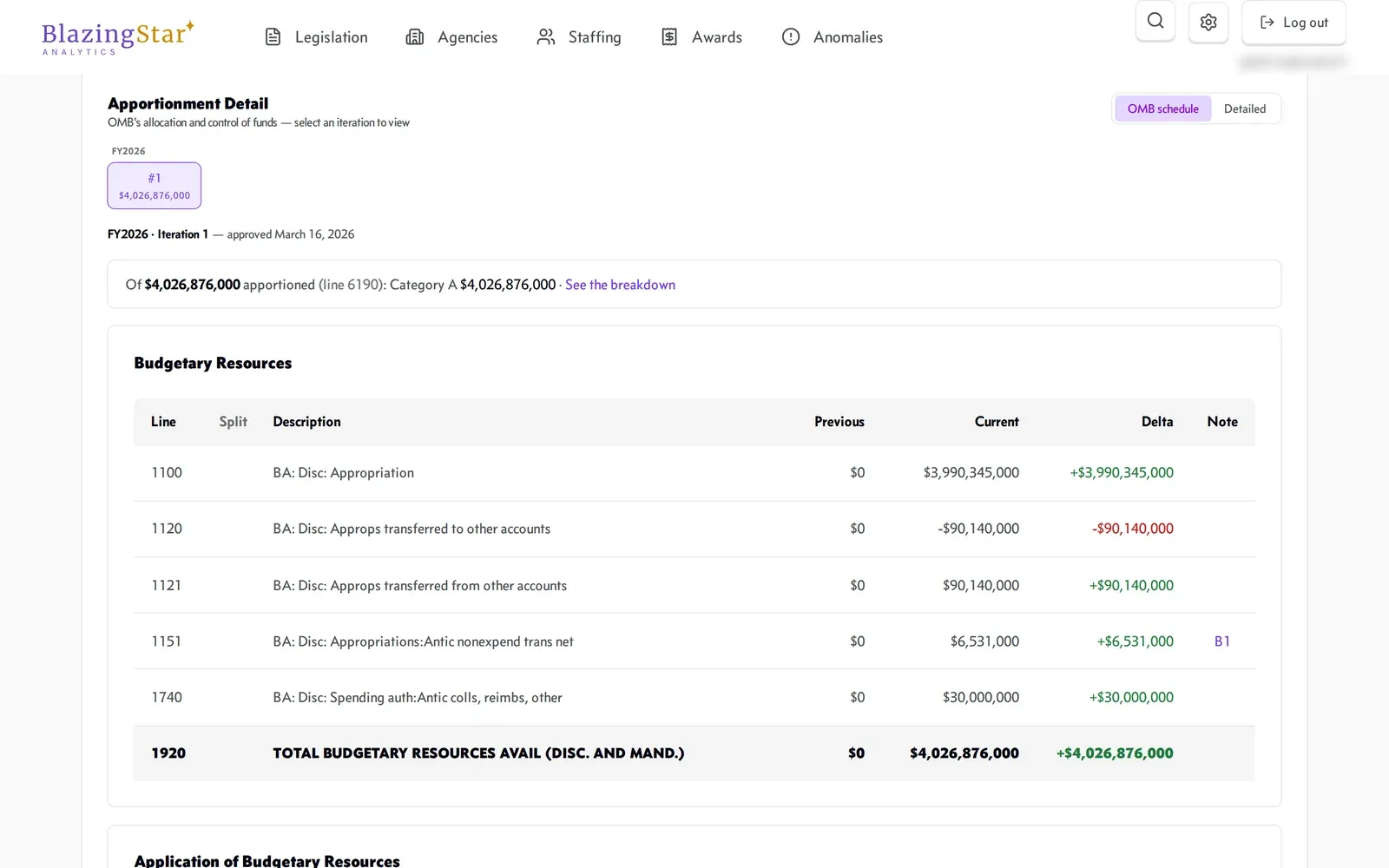
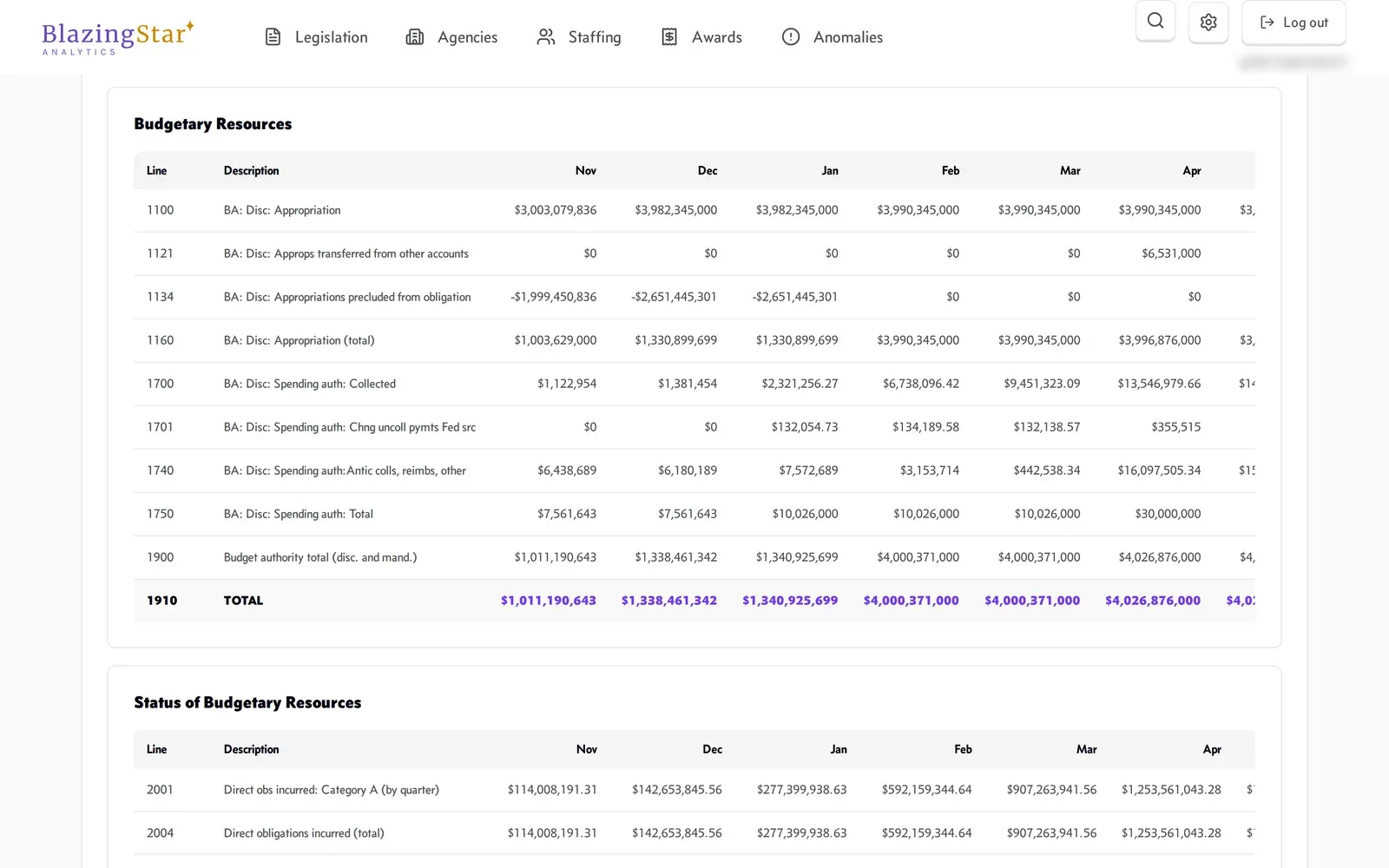
The FY2026 record, nearly complete — and FY2027's first week
We opened the doors days after FY2026 closed, and that timing is deliberate.
FY2026's enacted acts are now linked to almost a full year of execution. Treasury's SF-133 data runs through August; the September close arrives with the year-end report. So for FY2026 you can watch a dollar from the appropriation all the way to how much of it had actually been obligated by late summer.
FY2027 is a different picture, and the product says so plainly rather than showing you a blank page. The new fiscal year began October 1 under P.L. 119-103, the Continuing Appropriations and Extensions Act, 2027, which runs through December 11, 2026 (§106(3)). FY2027 account pages operating on that stopgap carry a banner saying so — a gap in the text, not a gap in the funding. We already hold nearly 2,000 apportionments for FY2027, but there's no execution to link yet, and we don't pretend there is.
There's a nice echo between the two. Watch NHLBI's own monthly appropriation line across FY2026: Treasury's first reading of the year, in November, shows roughly $3.0 billion under a continuing resolution, then $3.98 billion in December and January — and then the full $3,990,345,000 from February, once the full-year act was in force. That is the shape FY2027 is starting in now. A CR today; the enacted number later, if and when the full-year bills arrive.
What you can actually do with it
Not a feature list for its own sake. These are the specific things the account pages and search let you do:
- Read the enacted appropriations text, linked to budget execution data, organized the way the law is.
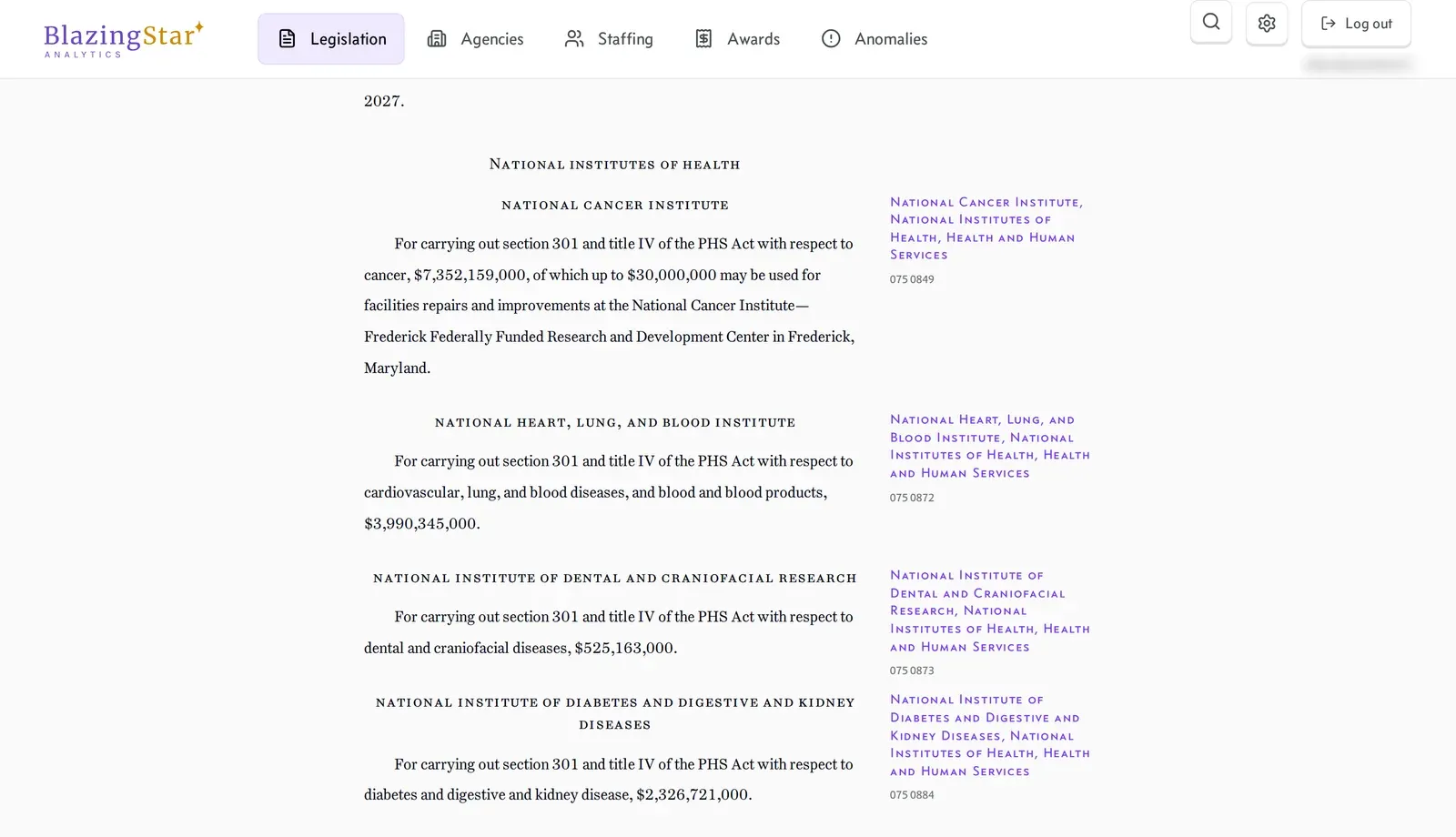
- See OMB's apportionment, iteration by iteration, with the footnotes — including the appropriation line that ties back to the statute. (The apportionment total can be larger; it folds in transfers and other authority. We keep the two separate so you're never comparing the wrong numbers.)
- Follow month-by-month execution on the SF-133, the way Treasury reports it.
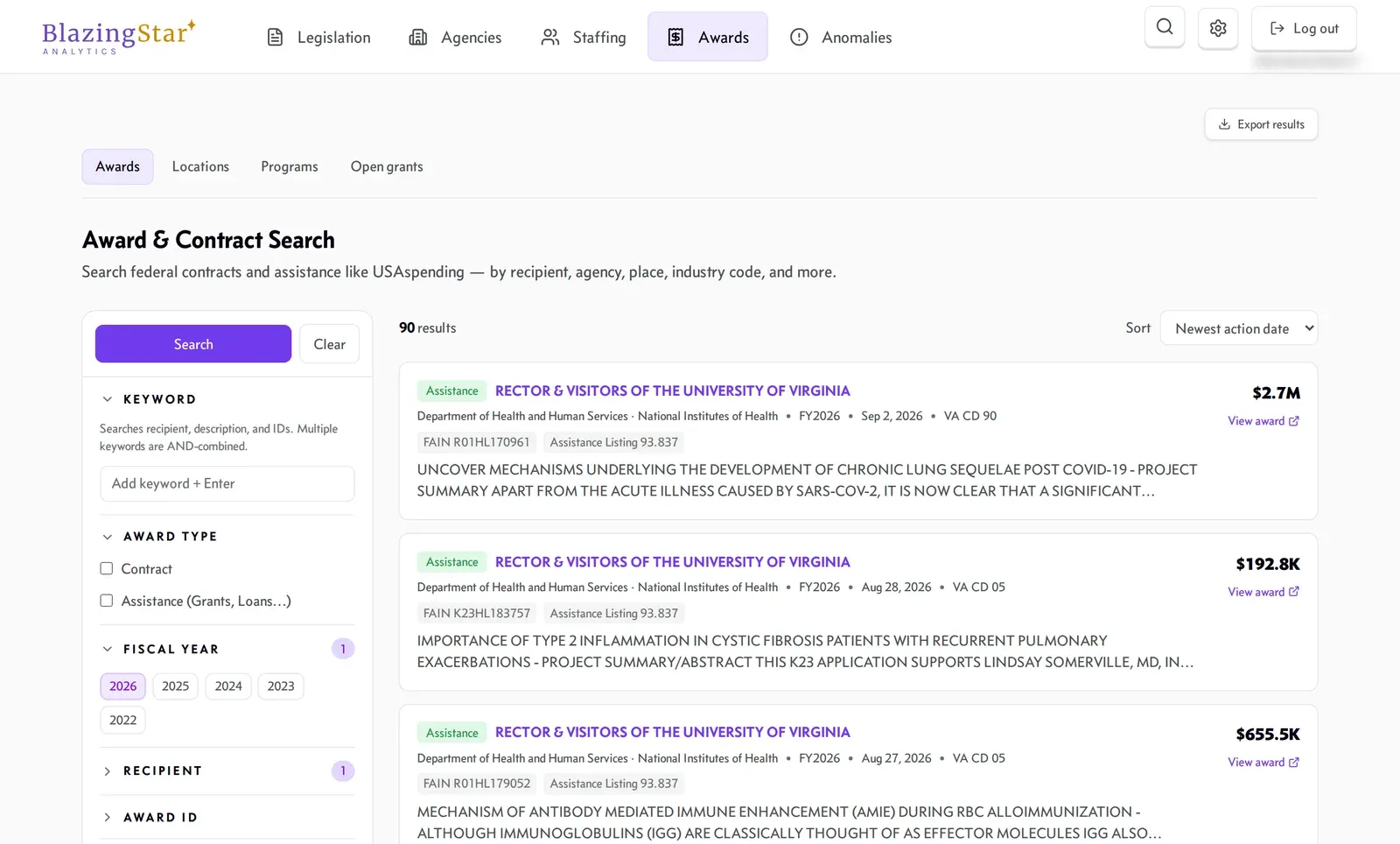
- Walk backward from a grant or contract to the Treasury account that funded it and the law behind that account.
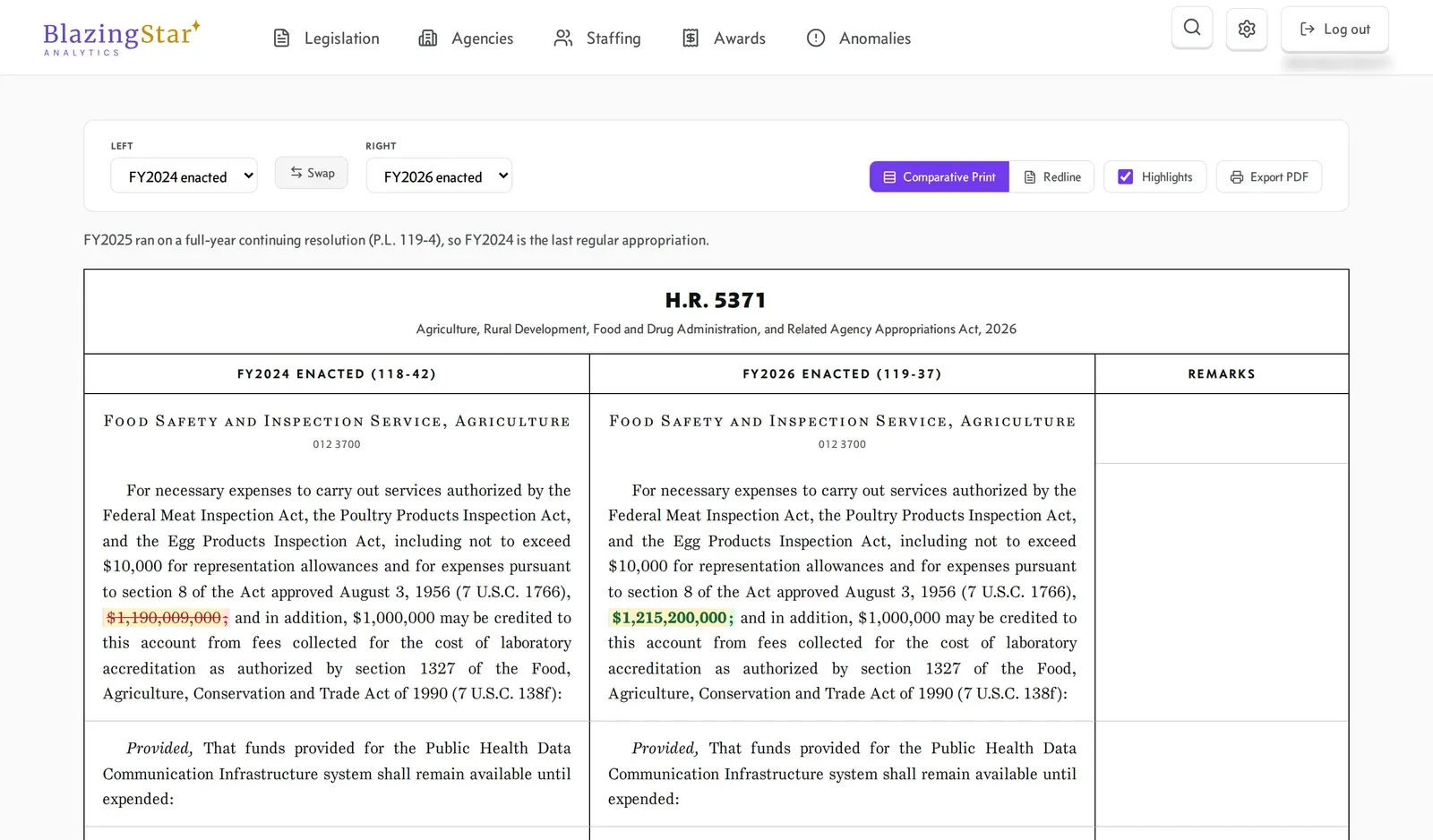
- Compare two enacted appropriations acts — FY2022, FY2023, FY2024, or FY2026 — as a clean comparative print or a redline. (FY2025 ran on a full-year continuing resolution, P.L. 119-4, so there's no regular act to compare; the product says that instead of showing you an empty year.)
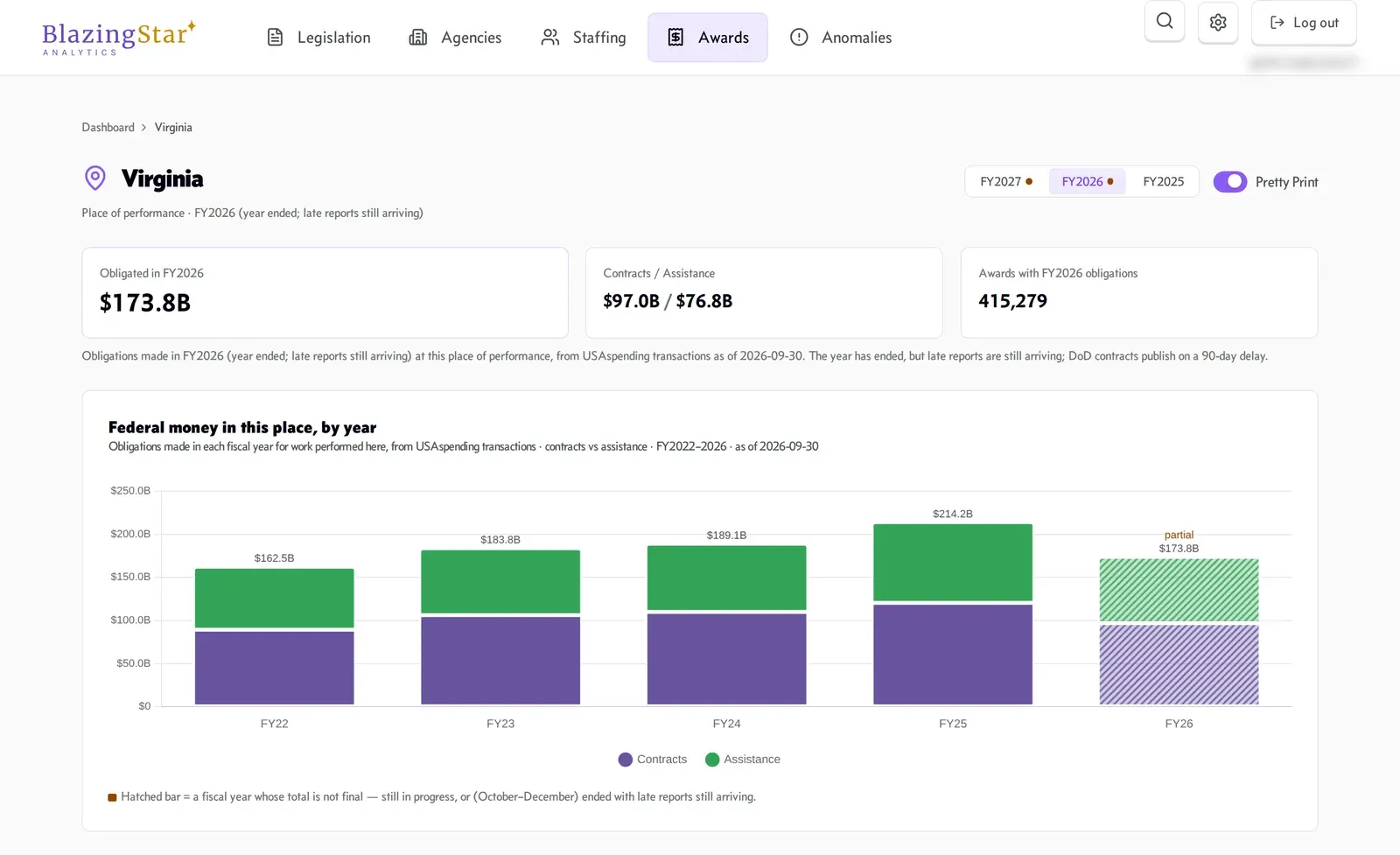
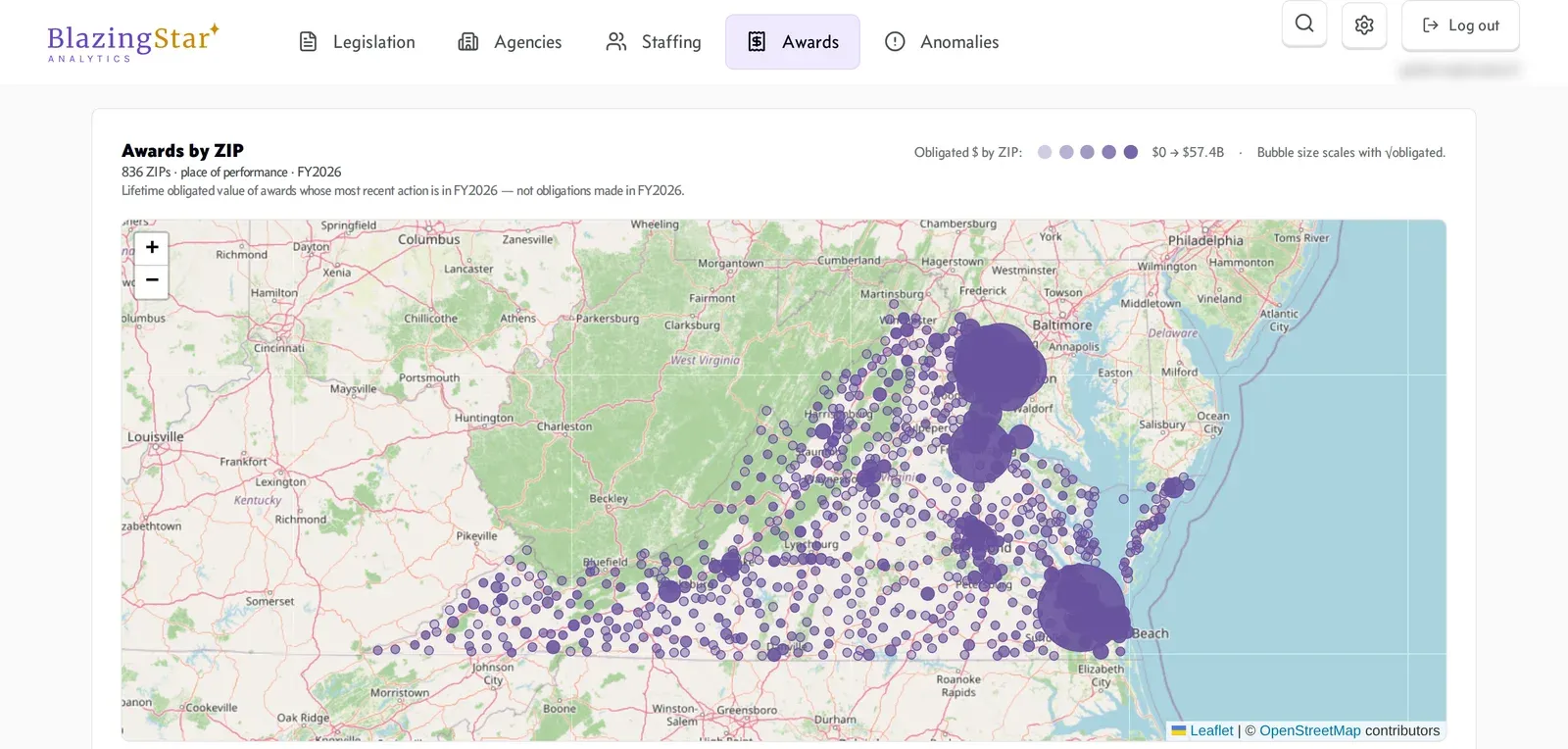
- See federal obligations by state, congressional district, and ZIP, with each fiscal year's total counting only the obligations made in that year — not lifetime award totals rolled together.
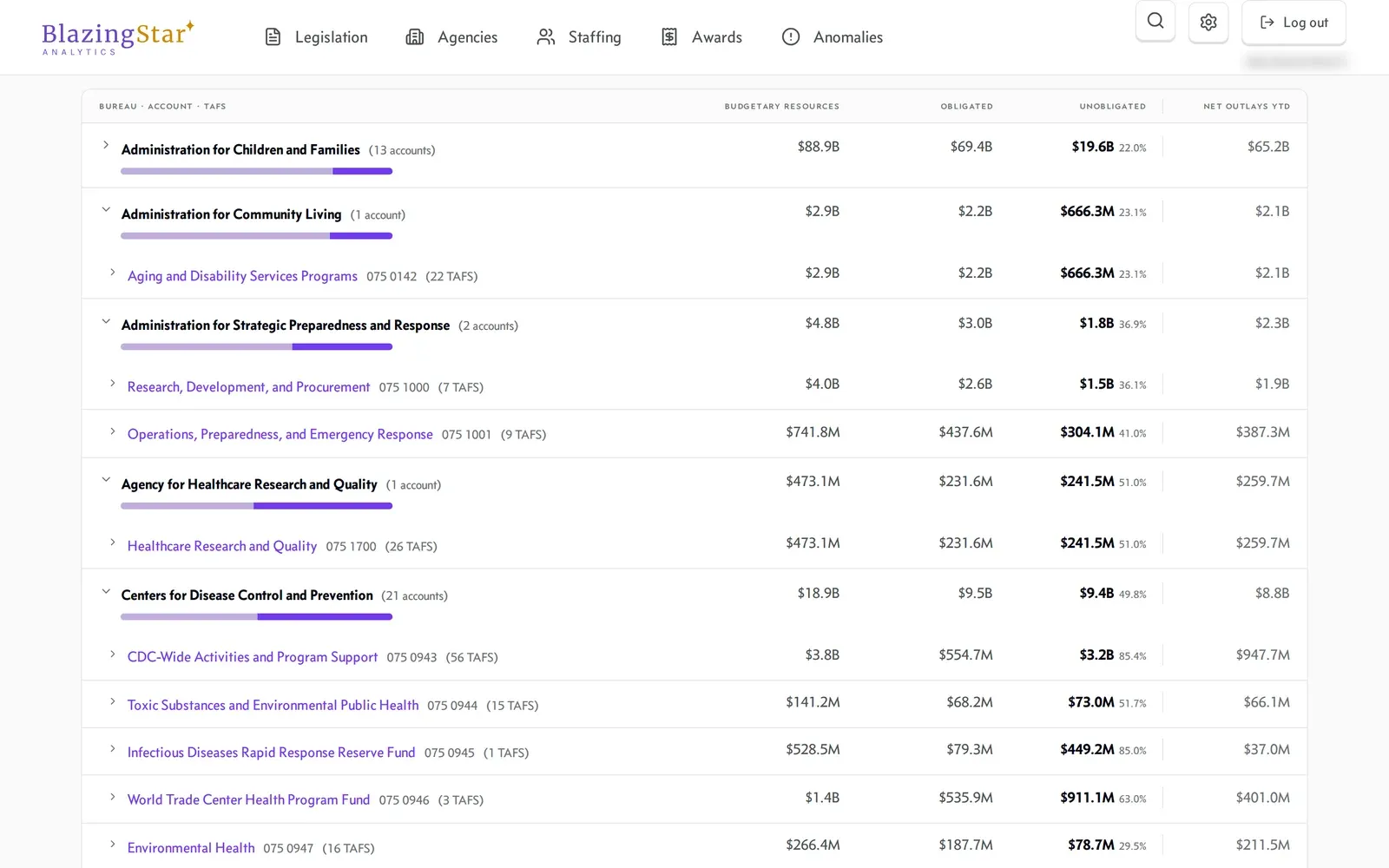
- Open an agency's account structure — bureaus, accounts, and the Treasury accounts beneath them, with money shown at every level. HHS alone resolves to 16 bureaus and 203 accounts, and each account page groups its Treasury accounts by whether the money is still available or has expired.
- Export your award-search results to CSV when you need to take the numbers with you.
Behind all of that: five fiscal years of OMB apportionments, Treasury execution going back to FY2019, tens of millions of federal awards, with some forty million links back to the Treasury accounts that funded them, and a catalog of 2,623 federal programs joined to the grants.gov opportunities that draw on them. The argument isn't the size of the pile. It's that the pieces are connected — and that you can check the connections yourself.
We check for new data every day.
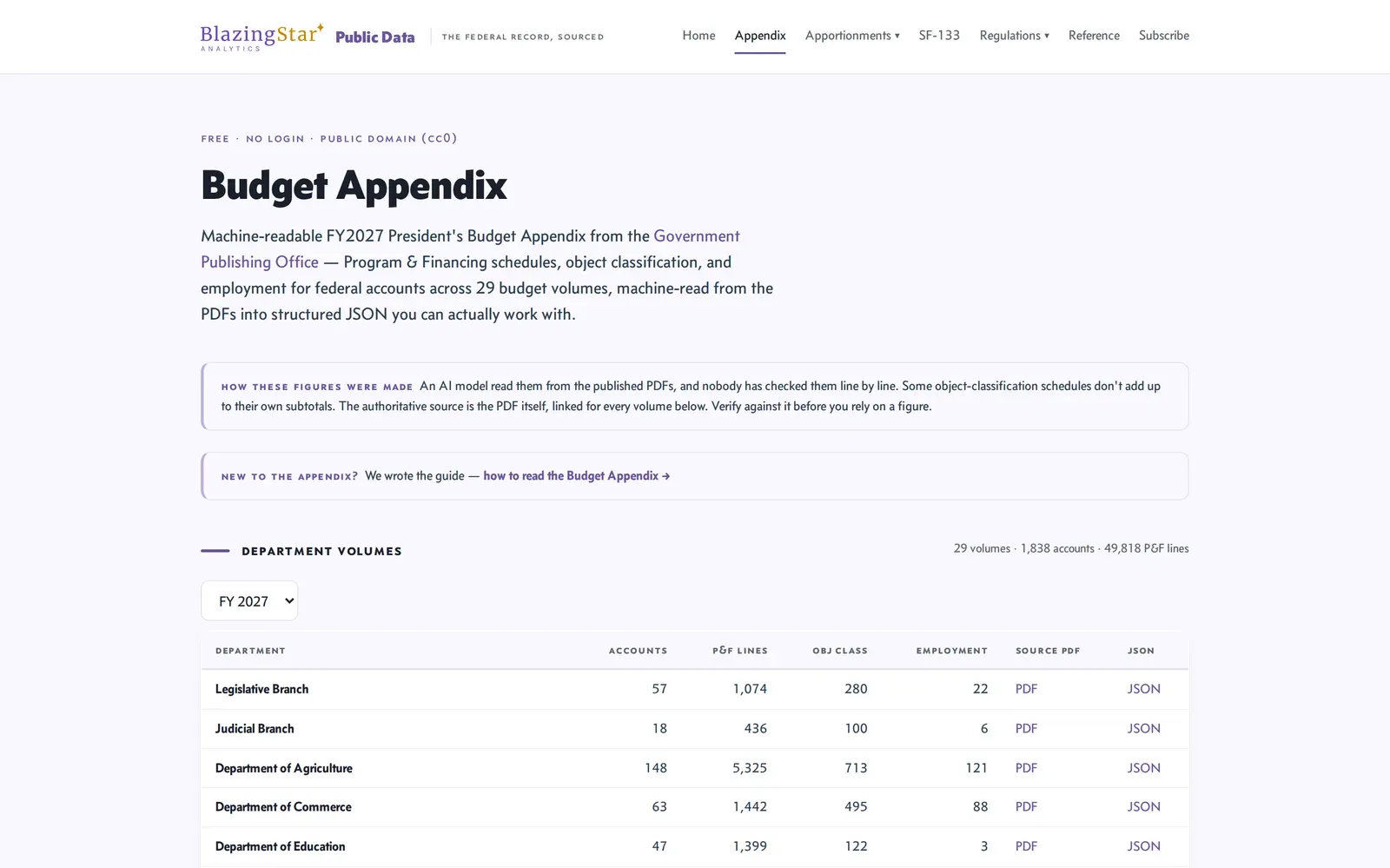
The President's budget request stays free, on data.blazingstaranalytics.com, the public record mirrored from the source. Where we use AI to process a document, we say so.
Who we built this for
The people who already live in this material. Appropriations and budget staff. Oversight. OMB desk officers and agency budget shops. Grants professionals. Government relations teams who need to show a client exactly where the money is. Reporters who need to tie a number to its source before they file. If you've ever reconstructed this chain by hand across six government systems at 11 p.m., this is that night of work, assembled.
On privacy, plainly
We track government spending. Not you.
That's not a slogan standing in for a policy. We don't keep your search history. You can delete your account yourself, from the account page — no ticket, no asking us; we email you a link to confirm.
And we tested every page against WCAG 2.2 AA and published the findings, because a public record you can't actually use isn't public.
The details are on our own domain, not a third party's: the Terms and the Privacy Policy.
The price
One plan: Analyst — $200 a month, or $2,000 a year.
Where we're headed next
This is a first step, and we're saying so on purpose. More soon.
The free half stays free
The public record stays free. data.blazingstaranalytics.com mirrors it from the source, with provenance attached. The blog keeps teaching how to read this material. And Necessary Expenses: Week in Review, our Friday newsletter — the week's redlines, executive actions, and notable grants — is free to join. If that's all you need to follow federal spending, it's yours, no charge, no catch. If you'd rather have the whole chain already built and linked for you, that's what BlazingStar Analyst is for.
Start here
The fiscal year just turned. Twelve months of apportionments, executions, and awards are about to pile up on a new year — and this is the year to follow them from the start.
Follow a dollar from the law that appropriated it to the award that spent it. See for yourself that three offices agree on the number. Then go find where they don't, and why.
Our Getting Started page has some short videos that show the site in action.
The doors are open: app.blazingstaranalytics.com
— Joe