The Elements of an Appropriation, Part 3 — Amount: How Much There Is
Every dollar Congress appropriates is fenced on three sides: how long you can use it, what you can use it for, and how much there is. Time, purpose, amount. We walked the clock and the purpose. This is the last fence — the shortest to state and the one with the sharpest teeth. A dollar can be perfectly on-time and perfectly on-purpose and still break the law, if there isn't enough of it.
Ask a federal budget officer what keeps them up at night and you probably won't hear "period of availability." You'll hear three letters: ADA. For most Americans the ADA means accessibility improvements. This ADA is not that one. The Antideficiency Act is the amount fence, and it's the one appropriations law rule that comes with the real possibility of losing your job — or, in the extreme, going to jail. It is also, at its core, very simple: you cannot spend money you do not have. Everything else in this post is a refinement of that sentence.
The 60-Second Version
| Term | What it means |
|---|---|
| The appropriation is a ceiling | The dollar figure is the most you can obligate — a hard cap on the top |
| …but not a floor of zero | You generally must spend it — the Impoundment Control Act bars simply declining to (impoundment) outside rescission or deferral |
| Antideficiency Act (§ 1341) | You may not obligate more than you have, or before you have it |
| Apportionment (§ 1512) | OMB releases the appropriation in slices — by quarter or by activity. Each slice is its own ceiling |
| § 1517 | Blowing past an apportionment or an internal allotment is its own violation, one level down |
| Augmentation | You can't top up your appropriation with fees, gifts, or another account's money. Receipts belong to the Treasury (§ 3302) |
| The report | A confirmed ADA violation goes in writing to the President and Congress, copy to the Comptroller General |
Key insight: The amount fence has layers. Congress sets the outer ceiling — the appropriation. OMB sets a tighter one — the apportionment. The agency sets tighter ones still — allotments. You can violate the Act by breaching any of them, even while you're comfortably under the number Congress passed. Most real ADA violations aren't "spent more than Congress gave." They're "spent more than this quarter's slice allowed."
Pro Tip: A way to think of it is like this — you need three things to be able to lawfully obligate money:
- Appropriation: Congress' grant of budget authority to the Executive Branch
- Apportionment: OMB's (on behalf of the President) grant of authority to an agency
- Allotment: An agency's grant of authority to an official to make obligations
Obligations are where administrative and criminal liability bite.
A Ceiling — But Not a Floor of Zero
Start with the most common misreading of an appropriation. When the bill says a bureau gets $3.15 billion, that is not a budget the bureau is expected to land on exactly. It's a maximum. The agency may obligate up to that number and not a dollar past it. Going over is the violation, full stop.
Going under is where the tidy "it's just a ceiling" story falls apart — and it's a question with fresh teeth lately. An appropriation caps the top, but it is not permission to spend nothing. Two forces push back from below.
The Impoundment Control Act. Once Congress appropriates money for a purpose, the executive branch generally has to spend it on that purpose. Simply declining to is an impoundment, and since 1974 the Impoundment Control Act (2 U.S.C. §§ 681–688) has made unilateral impoundment illegal — the law was Congress's answer to a President who tried withholding funds at scale. The only lawful ways not to spend appropriated money run through the Act's narrow channels: a rescission, where the President proposes to cancel funds but the money is released unless Congress passes a rescission law within 45 days; or a limited, temporary deferral, allowed for genuine contingencies or savings — not for policy disagreement. Absent one of those, the duty points the other way: obligate the funds.
Directed amounts mean what they say. When the bill carves out a slice — "of which $3,000,000 shall be for [a named activity]" — Congress is not making a suggestion. A "shall be for" amount is effectively mandatory: you make that money available for that activity, an integer as close to $3,000,000 as prudence allows. Not zero because you'd rather spend it elsewhere; not $500,000 because you disagree. Congress named a number, and it means the number.
So the honest version isn't "a ceiling you can undershoot at will." It's a hard cap on top, a duty to spend beneath it, and — wherever Congress bothered to name a figure — an obligation to hit that figure too. Two statutes guard the two edges: the Impoundment Control Act polices the bottom (don't spend less than Congress directed), and the Antideficiency Act polices the top (don't spend more than Congress allowed).
The Antideficiency Act — 31 U.S.C. § 1341 — states that top ceiling in two directions:
- You may not obligate or expend more than the amount available. The obvious one.
- You may not obligate before the money is available. You can't sign a contract this week against an appropriation Congress hasn't passed yet. No spending in anticipation of funding.
Translation: "The money was coming — the bill passed two weeks later" is not a defense. On the day you obligated, the appropriation didn't exist, and an obligation against money that doesn't exist yet is a violation on its own. This is exactly why a funding lapse forces a shutdown: without an appropriation, there is no amount available, so almost every obligation is illegal until one is enacted. (A narrow exception in § 1342 lets agencies keep going for the safety of human life and the protection of property — which is why the air traffic controllers stay and the museums close.)
The Apportionment Chain
Here's the part that surprises people: staying under the number Congress appropriated is necessary but not sufficient. Between the appropriation and the spender sit two more sets of ceilings.
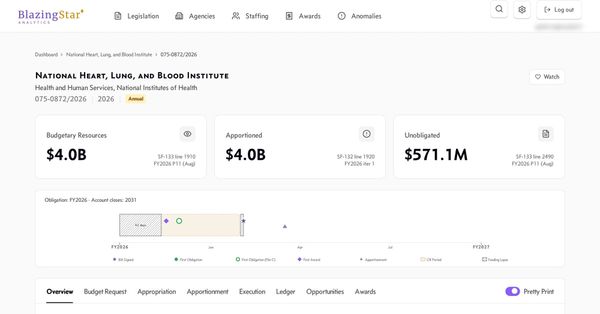
Apportionment (31 U.S.C. § 1512). Before an agency can touch its appropriation, OMB apportions it — releases it in controlled slices, usually by quarter (time) or by project or activity (purpose). The point is to keep an agency from burning through a full-year appropriation in five months and then coming back to Congress for a bailout. Each apportioned slice is a legal ceiling in its own right.
Allotment and below. The agency then subdivides its apportionment into allotments to bureaus and offices, and those can be split again. Every subdivision is another ceiling.
And the enforcement runs all the way down. 31 U.S.C. § 1517 makes it a violation to obligate or expend in excess of an apportionment or an agency subdivision of one. You can be a hundred million dollars under your appropriation and still violate the Act by blowing through the third quarter's apportionment, or by an office overspending its allotment.
Key insight: This is why the apportionment is the most operationally important document in federal budgeting that the public has barely heard of. It's where Congress's appropriation becomes an actual, enforceable spending limit — sliced by time and activity, signed by OMB. When you watch apportionments, you're watching the real ceiling the agency lives under, which is almost always tighter than the number in the bill.
Pro Tip: Apportionments are public. If you want to know not just how much an agency got but how much it's actually been cleared to spend, and on what schedule, the apportionment is the document — and a footnote on an apportionment can quietly reshape what a lump-sum appropriation is allowed to do.
Reading Amounts in the Bill Text
The amount fence looks simplest in the text — it's the dollar figure — but Congress rarely stops at one number. It fences the amount from the inside.
Here's a real one — the Federal Labor Relations Authority's Salaries and Expenses account, from the Financial Services and General Government Appropriations Act, 2026 (Division E of P.L. 119-75):
Highlight legend: gold = the appropriation (outer ceiling) · blue = a directed set-aside you must make available ("shall be … for") · coral = a pure cap where zero is allowed ("not to exceed")
Three numbers, three kinds of limit:
- $29,500,000 is the outer ceiling — the most the Authority can obligate, and (per the last section) not a number it can simply decline to spend.
- "$1,271,000 shall be made available … [for the] Office of the Inspector General" is a directed set-aside — a command. It isn't permission to spend up to $1.27 million on the IG; it's an instruction to reserve that money for it, walled off from the rest of the account. (Same mandatory-minimum family as "not less than $X.") Also, it reduces the amount of money available for the more generic purposes in the $29.5 million bucket. That appropriation is functionally $28,229,000.
- "(not to exceed $1,500)" for reception and representation is a pure cap. Here — and only here — zero is a legal answer. The Authority may spend anywhere from nothing to $1,500 hosting guests.
Key insight: Two of those numbers carve the same lump sum and mean opposite things. The $1,271,000 is money the account must move — the Inspector General gets it whether the Authority likes it or not. The $1,500 is money it merely may — the reception line can sit at zero all year and nothing is violated. One is a floor, one is a cap, and telling them apart is most of reading an amount.
Translation: A lump-sum appropriation isn't always just one number — it's an outer ceiling with directed set-asides and interior caps drawn inside it, each independently enforceable. "Shall be made available" and "not to exceed" are opposite orders: one you obey by spending, the other you obey by not overspending.
The Augmentation Trap
One more rule closes a loophole you might otherwise reach for. If your appropriation is a ceiling and you're near it, could you just... find more money? Charge a fee, accept a gift, pull from a richer account next door?
No. This is the augmentation prohibition, and it's a straight consequence of the amount fence. An agency may not augment its appropriation — increase the money it has available to spend — beyond what Congress provided, unless Congress specifically authorized it. The backstop is the miscellaneous receipts statute (31 U.S.C. § 3302): money an agency receives on the government's behalf generally must be deposited in the Treasury, not kept and spent. You collected a fee? It goes to the Treasury, unless a law says you may keep it.
And here's a law saying exactly that — the last proviso of that same FLRA account:
Highlight legend: coral = the § 3302 override · blue = the fee-retention authority
Read what it does. The Authority runs labor-management conferences and charges non-federal attendees a fee. Left alone, § 3302 would sweep those fees to the Treasury. This proviso overrides § 3302 by name, lets the Authority keep the fees, merge them into its own account, and spend them without further appropriation. That is a congressionally authorized augmentation: the account can grow past its $29.5 million ceiling by whatever it collects in fees. The rule is that you may not augment; the exception is that Congress can let you — and when it does, it says so in words this explicit, citing the very statute it's setting aside.
Key insight: Augmentation is the amount fence read as a positive rule. The ceiling doesn't just cap what you can spend — it caps what you're allowed to have. Otherwise "you may spend up to $3.15 billion" would mean nothing: an agency could top itself up from fees and transfers until the ceiling was decorative. The rule against augmentation is what makes the appropriation the real number.
What Happens When You Break It
This is the fence with teeth, so the consequence ladder is worth stating plainly — and it's where the whole series converges. Recall that a time violation that can't be corrected, and a purpose violation with no right appropriation to absorb it, both become amount violations. If the purpose isn't allowed or the funds are expired, the lawful amount available is $0. A dollar is more than zero. All three fences drain into this one.
When an agency determines an Antideficiency Act violation occurred, the law requires a written report to the President and to Congress, with a copy to the Comptroller General (GAO). The report names what happened, how much, and who was responsible. We walked you through some of these reports in our Budget Bloopers post. On top of that:
- Administrative discipline is mandatory — the responsible officer or employee is subject to adverse personnel action, up to removal.
- Criminal penalties exist for the knowing and willful case — fines and up to two years' imprisonment.
Translation: Most ADA violations are honest, traceable mistakes — a misread apportionment, an obligation recorded in the wrong year, a fee kept that should have gone to Treasury. They still get reported to the President and Congress by name. That reporting requirement is the point: the amount fence is enforced by daylight. A breach of the spending limit becomes a public record, which is exactly what you'd want from the rule that guards Congress's most basic power — the power to decide how much.
Pro Tip: It's easy to think of these limitations in terms of just grants and contracts, but remember these limitations apply to salaries and expenses of Federal employees too. Consider this one:
The phrase "finalize, issue, or implement" is really a limitation on staff time. Sure, there are incidental costs — paper, postage, a Federal Register notice — but the real thing being fenced off is the employee hours it takes to write the rule, paid out of salaries and expenses.
Why It Matters
Amount is the fence where the Constitution's plumbing is most exposed. "No Money shall be drawn from the Treasury, but in Consequence of Appropriations made by Law" is the whole ballgame, and the Antideficiency Act is the statute that makes it operational: not one dollar more than Congress said, not one day before Congress said it, not one purpose Congress didn't name, and no quiet self-topping-up to get around the number. Everything else — apportionments, allotments, the augmentation rule, the reports — is machinery in service of that one constitutional sentence.
For anyone doing oversight, amount is also the most watchable fence, because so much of it is written down and public. The appropriation is in the bill. The apportionment is posted. Overruns get reported. Follow those three and you can see, in near real time, whether an agency is living inside the ceiling the people's representatives set for it.
Wrapping Up
Three fences: how long, for what, how much. Every legal obligation the federal government makes has to clear all three at once — alive on the clock, aimed at the right purpose, and inside the amount. Miss the clock and the money dies. Miss the purpose and you've spent it on something Congress didn't fund. Miss the amount and you've drawn on the Treasury without leave — the one violation the founders wrote a Constitution to prevent.
Read an appropriation and you'll now see all three at once: the availability clause, the purpose clause, the number and its interior floors and caps. That's the whole grammar of an appropriation. It's not that the language is hard. It's that no one ever tells you it's a fence line. Now you know where the fences are.
What's Next
That's the elements in the series — Time, Purpose, Amount, the three elements of every appropriation.
Next week we're going to use Congressional earmarks as a case study to tie it all together.
Then, we'll move from the rules money follows to the forms it takes: grants, contracts, and cooperative agreements — what's in a vehicle? Same dollar, three very different sets of strings.