Budget Bloopers, FY 2025 Edition
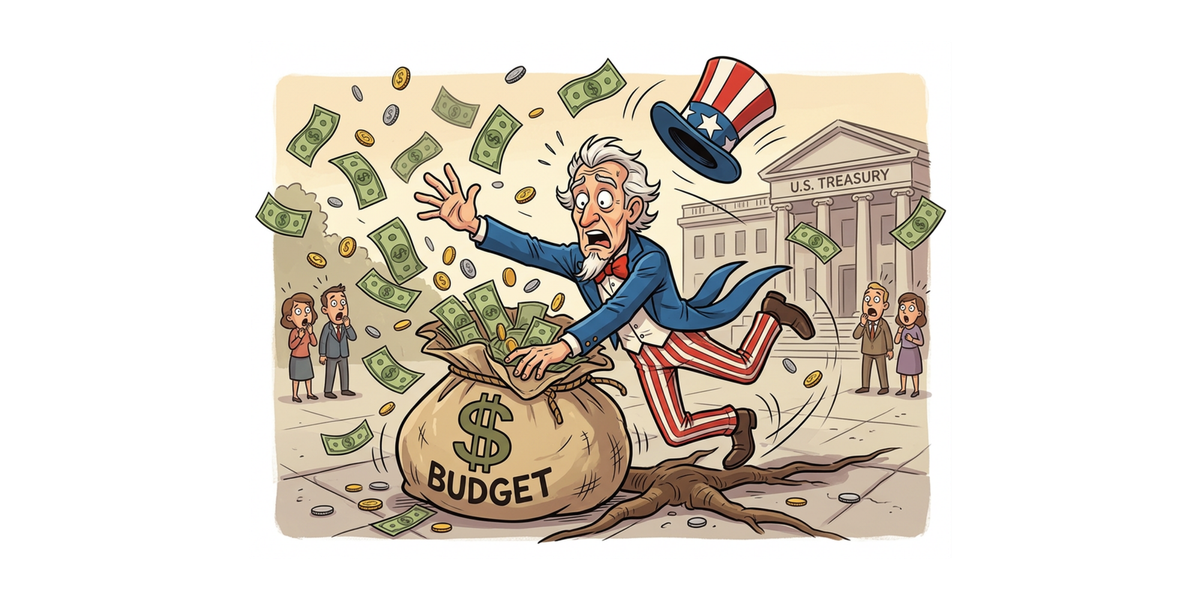
GAO released the annual Antideficiency Act reports compilation last month. Nine agencies. Nearly $6 billion in reported violations. And 97% of that traces to one thing: blowing the apportionment.
On April 30, GAO released its annual compilation of Antideficiency Act (ADA) reports for fiscal year 2025. Nine federal agencies reported violations, totaling $5,998,788,011 — almost six billion dollars in admitted violations of the law that governs federal spending.
That headline number is misleading in two directions. In one direction, it overstates the harm: the single biggest violation — $4.884 billion at the Export-Import Bank for a Mozambique LNG facility — has never actually disbursed a dollar. In the other direction, it understates the lesson. Because of the $5.999 billion in violations, $5.835 billion (97%) comes from just two cases. Both are apportionment failures. Everything else combined accounts for $163 million.
That ratio is not a fluke. It reflects something important about how federal budget execution actually works — and how it actually fails. This post walks through what the ADA forbids, why apportionments matter more than most people realize, and what the FY 2025 class of violations reveals about the real chokepoint in federal money management.
The 60-Second Version
What it is: The annual GAO compilation of Antideficiency Act violations reported by federal agencies. GAO has produced this since FY 2005. The compilation is unaudited — the summaries reflect what the agencies reported.
The FY 2025 class:
| Agency | Amount | Type |
|---|---|---|
| Export-Import Bank | $4,884,000,000 | Apportionment |
| USDA (multiple offices) | $951,406,711 | Apportionment |
| Army National Guard | $102,000,000 | Excess obligation |
| Farm Service Agency | $53,040,426 | Shutdown recall |
| Defense Acquisition University | $4,875,205 | Bona fide needs rule |
| USDA (FPAC-BC) | $2,556,031 | IT approval (CIO) |
| Department of Labor | $498,095 | Reprogramming notification |
| Board of Veterans Appeals | $372,876 | Excess obligation |
| National Science Foundation | $38,667 | Appointee office furnishing |
| Total | $5,998,788,011 |
Key insight: Two apportionment cases account for 97% of the total dollar value. The remaining seven cases — across statutory restrictions, notification failures, the bona fide needs rule, and shutdown actions — add up to about $164 million combined.
The verdict: In every one of the nine cases, the agency determined there was no knowing or willful intent to violate the ADA. These are not malfeasance. They are internal control failures, often years old, often discovered through external review or staff turnover. That makes them more interesting, not less. Honest failures tell you where the system actually breaks.
Read the full GAO product here.
Direct link to the report (PDF).
What the Antideficiency Act Forbids
The ADA is short by federal-law standards and easy to summarize. It prohibits three things:
- Obligating or expending funds in advance or in excess of an appropriation (31 U.S.C. § 1341)
- Accepting voluntary services other than in emergencies (31 U.S.C. § 1342)
- Obligating or expending funds in excess of an apportionment (31 U.S.C. § 1517)
The first prohibition gets the attention. It's the textbook ADA violation — an agency committed money it did not have. The second prohibition is what governs furloughs during shutdowns. The third is the one most people skip past.
That's a mistake. The third one is where the big violations live.
When an agency violates the ADA, it has to report the violation to the President, the President of the Senate (Vice President), Speaker of the House, and the Comptroller General, with all relevant facts and a statement of actions taken. The reports go to GAO as the repository, and GAO publishes the annual compilation. The reporting requirement is itself the discipline — there is no criminal prosecution for an unwillful violation, but there is permanent public documentation. If nothing else, that circulation list should tell you something about how important Congress felt an infraction is when they were crafting the ADA.
Why Apportionments Matter (and Why You Should Care)
Most people who follow appropriations know the lifecycle of a bill: budget request, hearings, markup, conference, enactment. The post-enactment phase gets less attention, but it is where the money actually moves — and where the ADA actually bites.
After Congress enacts an appropriation, the money is not immediately available for the agency to spend. It first has to be apportioned by the Office of Management and Budget. Apportionment is OMB's allocation of the appropriation across time periods (typically quarters), program areas, or activities. The statutory basis is 31 U.S.C. § 1512.
Apportionment serves two purposes:
-
Pace spending. Quarterly apportionment prevents an agency from burning through its entire annual appropriation in October. The discipline forces a sustainable burn rate over the fiscal year.
-
Control execution. OMB uses apportionment footnotes, conditions, and the apportionment schedule itself to enforce policy priorities and ensure agencies comply with statutory restrictions during execution. (This is the same mechanism that gets used — and contested — during impoundment fights.)
Apportionment is binding. An agency cannot obligate or expend more than what OMB has apportioned, regardless of how much appropriation it has on the books. Violations of apportionment trigger 31 U.S.C. § 1517 — distinct from the § 1341 appropriation violations and reported separately.
Translation: An agency can have plenty of appropriation and still violate the ADA — by exceeding the apportionment OMB issued. The appropriation tells you if money is available. The apportionment tells you when it is available, in what amounts, and for what purposes.
Key insight: If you want to understand whether an agency can actually execute the budget Congress gave it, the apportionment schedule matters more than the appropriations act. Congress sets the ceiling. OMB sets the pace.
The FY 2025 compilation contains two case studies in what happens when the apportionment side breaks down. They account for 97% of the year's reported violations.
1. What is an apportionment?
2. How to Read an Apportionment, Part I: Structure and Time-Based Controls
3. How to Read an Apportionment, Part II: Program Controls and Legal Weight
Also, see:
The Constitutional and Legal Framework: Laws That Control Federal Spending
Apportionment Case Study #1: EXIM's Mozambique LNG ($4.884 Billion)
On September 26, 2019, the Export-Import Bank's Board of Directors approved a $5 billion direct loan to finance a liquid natural gas facility in Mozambique. The Board had originally planned to approve the transaction in FY 2020. The approval date was moved forward — to four days before the end of FY 2019.
EXIM had the appropriation. It did not have the apportionment.
The Bank had requested an FY 2020 apportionment that would have covered the transaction. Because the Board approval landed in FY 2019, the obligation hit a quarter without sufficient apportioned authority. EXIM also lacked an approved apportionment authorizing the transfer of negative subsidy generated by the transaction. The total apportionment shortfall: $4.884 billion.
What actually happened in dollar terms: Nothing yet. The Mozambique LNG project has not disbursed a single dollar of the EXIM direct loan. The $4.884 billion is an obligation that exceeded apportionment, not a payment that went out the door.
Why it's instructive:
- Timing risk at the apportionment level is more aggressive than at the appropriation level. A Board vote that slides by one quarter can move a transaction from "fully covered" to "ADA violation," even when nothing else has changed.
- Apportionment compliance failures don't require the agency to be out of money. EXIM had appropriations. It had a sound underwriting case. The violation was procedural — the right OMB paperwork wasn't in place for the date the Board approved.
- Remediation is mostly process. EXIM's remedial actions: quarterly review of all apportionments, updated Administrative Control of Funds with apportionment process steps, an added statement on the Board cover memo confirming apportionment coverage before authorization. The Mozambique loan is still on the books.
EXIM reported no knowing or willful intent. No disciplinary action was considered necessary.
Apportionment Case Study #2: USDA's Reimbursable Receipts ($951.4 Million)
The USDA case is the more instructive of the two, because it shows how compliance fails systemically rather than transactionally.
Starting in FY 2018, USDA's Office of the Chief Financial Officer stopped including reimbursable receipts and anticipated reimbursable authority in its annual apportionment submissions to OMB. The omission also included an apportionment footnote that had historically allowed for upward apportionment adjustments without further OMB action.
Once that footnote was missing from the FY 2018 submission, it stayed missing. The same omission propagated through the FY 2019, 2020, 2021, 2022, 2023, and 2024 apportionment submissions for fourteen separate USDA staff offices — the Office of the Secretary, the Office of the Chief Information Officer, the Office of the General Counsel, the Office of Civil Rights, the Office of the Chief Economist, the Office of Ethics, and others.
For seven fiscal years, USDA's staff offices obligated and expended funds against reimbursable receipts and anticipated reimbursable amounts that had not been apportioned. Each obligation, in the absence of an OMB-approved apportionment, exceeded the apportioned amount — which is zero when no apportionment exists.
Total apportionment shortfall across the seven fiscal years and fourteen offices: $951,406,711.
USDA discovered the exclusion in FY 2024. It submitted retroactive apportionment requests to OMB for the remainder of FY 2024 and for the authority to liquidate pending obligations already incurred between FYs 2018 and 2024. The former OCFO Budget Director and former Associate Chief Financial Officer of Financial Policy and Planning were identified as responsible. Both had left USDA.
Why it's instructive:
- A clerical omission can become a seven-year, billion-dollar ADA violation. The missing footnote was not an act of bad faith. It was a quiet propagation error in an annual submission that nobody flagged for years.
- Compliance backstops have limits. OMB receives the apportionment requests. The agency's internal controls are supposed to catch errors. Six fiscal years passed before a comprehensive review uncovered the omission.
- Discovery often depends on staff turnover. The remediation language is telling: USDA "determined that its previous system of administrative control of funds requires improvement and enforcement."
USDA's remediation plan includes mandatory OMB Circular A-11 training, new standard operating procedures, and reestablishing a system of administrative control of funds pursuant to 31 U.S.C. § 1514. Whether that catches the next footnote-level error in 2030 is an open question.
But These Are All Paper Violations, Right?
Read across the EXIM and USDA cases and a fair objection forms. Nobody got hurt. No contractor went unpaid. No program got cut. The Mozambique LNG project didn't fall apart. USDA's staff offices kept running. The violations look like internal accounting issues that got cleaned up after the fact — important to track, sure, but not actually consequential.
That's the surface read. The deeper read is different.
Think of it like depositing a check. You hand the teller a $5,000 check. The screen says: pending. You have $200 in checking already, which you can spend. But if you try to write a $3,000 check against the $5,000 deposit before it clears, the bank doesn't honor it. The $5,000 doesn't exist yet from the bank's perspective. The deposit is conditional. The clearance is what makes the money real.
Apportionment works the same way:
- The appropriation is the deposit.
- The apportionment is the clearance.
- The obligation is the check you write against it.
Obligating against an apportionment that doesn't exist is writing a check against a pending deposit. If the deposit clears, no harm done. If it doesn't, the agency has written a check it cannot legally honor.
Look, everyone was made whole at the end of this, but that's not the point. Writing a bad check affects your reputation. Incurring obligations without an apportionment does the same, eroding the institutional trust between an agency, OMB, and the Congress that funds them.
EXIM's Mozambique loan is a pending check. The Bank obligated $4.884 billion before it had the apportioned authority to cover it. No funds have disbursed yet. If OMB had declined to retroactively apportion the negative subsidy — or if a policy dispute had held up the schedule — EXIM would have been holding $4.884 billion in obligations against zero apportioned budget authority. The options at that point are bad ones: default on a sovereign-backed loan commitment (international embarrassment, counterparty harm, project collapse), cannibalize other authorized programs to cover the obligation, or go to Congress for a supplemental. None of those are paper outcomes.
USDA's seven-year omission is a stack of pending checks. For seven fiscal years, USDA staff offices obligated nearly a billion dollars against reimbursable amounts that had never been apportioned. OMB ultimately granted the retroactive apportionment. It didn't have to. If at any point in those seven years OMB had pushed back — during a policy fight, an administration change, a CR season — USDA would have been forced to deobligate hundreds of millions of dollars across fourteen offices and break commitments to contractors, grantees, and partner agencies. Real money, owed to real people, with no legal authority to pay it.
The "paper violation" framing misses the actual mechanism. Apportionment violations are conditional violations. They become real harm the moment OMB decides not to bail the agency out — or the moment external circumstances make a bailout impossible. The risk isn't that the violation has already caused harm. The risk is that the agency has positioned itself where a single downstream decision can cause large harm — and is depending on that decision going its way.
Key insight: A paper violation is just a real violation that hasn't been called yet. The check is pending. The check is always pending — until the deposit clears, or doesn't.
The Other Seven Violations
The remaining seven cases in the FY 2025 compilation total about $164 million. Each illustrates a different ADA category and a different way budget execution can go wrong.
| Case | Agency | Amount | What Went Wrong |
|---|---|---|---|
| 25-01 | Department of Labor | $498,095 | Reprogrammed $498K to the WANTO grant program in FY 2017 — over the 10% reprogramming threshold — without notifying Appropriations Committees. Reported seven years later. |
| 25-02 | Board of Veterans Appeals | $372,876 | Backpay orders (MSPB, EEOC, and a VA settlement) paid by DFAS from BVA's FY 2020 account between March 2023 and June 2024 without verifying funds availability. |
| 25-03 | National Science Foundation | $38,667 | Pandemic-era remote-work upgrades to the NSF Director's office obligated without the advance congressional notification required for political appointee office furnishings over $5,000. |
| 25-04 | Army National Guard | $102,000,000 | Bonus and retention obligation monitoring system malfunctioned and went offline for a substantial period during FY 2021 and FY 2022. States, Territories, and D.C. over-obligated by $60M in FY 2021 and $42M in FY 2022. |
| 25-05 | Farm Service Agency | $53,040,426 | Recalled employees to operate FSA county offices during the December 2018–January 2019 shutdown. GAO ruled the recall improperly relied on the property-protection exception. USDA reported the violation following GAO's opinion. |
| 25-07 | USDA (FPAC-BC) | $2,556,031 | Vehicle telematics for NRCS fleet vehicles obligated without USDA CIO written approval, in violation of Section 706 of the FY 2021 Agriculture appropriations act ($25,000 IT approval threshold). |
| 25-09 | Defense Acquisition University | $4,875,205 | "Parked" current-year funds with UNICOR/FPI for non-specific repair services. After the funds expired, UNICOR/FPI obligated them for new projects — violating the bona fide needs rule (31 U.S.C. § 1502) and the ADA. |
A few of these are worth a closer look in their own right. The NSF case is a reminder that the obscure annual restriction on furnishing the offices of presidential appointees over $5,000 — found in the Financial Services and General Government appropriations bill every year — has real teeth. The FSA case is essentially a delayed report on the then-longest shutdown in U.S. history; GAO's opinion came in 2020, and USDA reported the resulting ADA violation in 2025 (after another GAO letter directing it to do so). The DAU "parked funds" case is the kind of bona fide needs violation that any contracting officer recognizes — current-year money sent off to an interagency partner to be obligated later, after the period of availability has expired.
Pro Tip: Three of these — Labor 25-01, NSF 25-03, and USDA 25-07 involve violating the conditions contained in General Provisions contained in appropriations acts.
What This Year's Class Tells You
Read across the nine reports and a few patterns emerge:
-
The lag is long. Labor reported a 2017 violation in 2024. FSA reported a 2018–2019 violation in 2025. USDA's six-year apportionment chain was undetected until FY 2024. The system that catches ADA violations is not fast.
-
The responsible parties are usually gone. "The official is no longer with [agency]" appears in six of the nine reports. ADA enforcement falls heavily on institutional rather than individual accountability — partly by design, partly by default.
-
System dependencies create category-level risk. When ARNG's bonus monitoring system went offline, $102 million in over-obligations followed. The ADA assumes manual oversight as a backstop; the modern federal financial environment increasingly does not have that backstop in practice.
-
External review does much of the discovery. GAO opinions, OMB reviews, and audit findings drive a meaningful share of the reports. Internal controls catch some violations. Many of the rest are caught by someone outside the agency asking the right question.
-
Apportionment failures dominate the dollar totals every year they appear. That is not a coincidence. Appropriation-level violations are bounded by what the agency had to spend. Apportionment violations can be bounded only by what the agency obligated — which can be far larger than what it could ever spend.
Why It Matters
The ADA is the law of last resort for federal budget execution. It is the backstop. When it gets triggered, something else has already failed — internal controls, the apportionment process, the contracting workflow, the funds-availability check, or some combination.
For practitioners, the annual compilation is a window into where that failure tends to happen. The pattern in FY 2025 is the same pattern as most prior years: the big-dollar violations are apportionment failures, the medium-dollar violations are excess obligations or notification failures, and the small-dollar violations are the obscure statutory restrictions that catch agencies by surprise.
For the rest of us, the lesson is shorter. Apportionment is where federal money management actually lives. The appropriation tells you what Congress gave the agency. The apportionment tells you what the agency can actually do with it, when, and how. An agency that does not get apportionment right cannot execute its budget — no matter how favorable the appropriations bill was.
The Bottom Line
Key takeaways:
- GAO's annual ADA compilation is unaudited but authoritative — it is the official agency record of what went wrong.
- The FY 2025 class totals nearly $6 billion in reported violations across nine agencies.
- 97% of that dollar value comes from two apportionment violations — EXIM ($4.884B) and USDA ($951M). Everything else combined adds up to about $164 million.
- Every violation in the FY 2025 class was found to have no knowing or willful intent. These are internal control failures, not malfeasance.
- Apportionment failures dominate the dollar totals because the appropriation tells you if money is available; the apportionment tells you when, how much, and for what. The latter is what actually constrains execution.
- The annual compilation rewards careful reading. It is the closest thing to a public ledger of how federal financial controls fail.
The full GAO compilation is available here.