Why We Built data.blazingstaranalytics.com

The federal government will spend roughly $7 trillion this year. Nearly every dollar of it is on the public record. Now go try to find any of it.
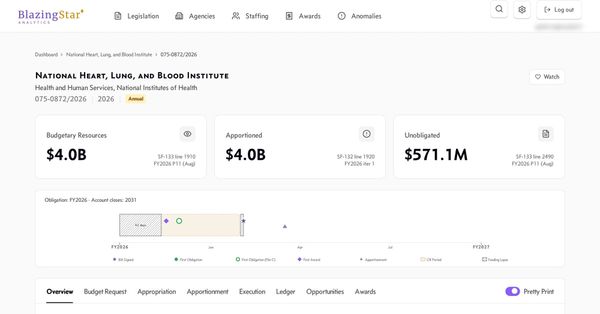
You can, technically. The appropriation is in the law. The apportionment is in OMB's portal. The execution is in a monthly spreadsheet. The award is in USASpending. The rule is in the Federal Register. The grant application notices are on grants.gov. It's all public — it's just scattered across multiple systems, each with its own format, its own quirks, its own learning curve. Following a single dollar from the page of an appropriations act to the moment it lands in a grantee's account means:
- knowing which systems to check,
- in what order, and
- how to read what you find when you get there.
That's not transparency. That's transparency on paper. The record exists, and almost no one can actually read it.
I spent thirteen years on the staff of the House Appropriations Committee and two years at the Office of Management and Budget. I also served as budget advisor to the Secretary of Housing and Urban Development. I know where this stuff lives because finding it was my job — and I know exactly how hard it is, because it was hard for me, and I did it for a living. The public record of how this country spends its money should not require an insider's map. So I drew one.
Here's the map
It started as a personal pile of bookmarks — the important, genuinely useful stores of federal budget data I'd accumulated over a career. Even when you know where to look, it's not the most intuitive constellation of sites. So I gathered them into one place: data.blazingstaranalytics.com.
But while bookmarks are great, I went a step further and mirrored the files. It always seemed like when I needed the data most, the internet turned uncooperative. The site downloads and mirrors the key financial data files, shows the provenance of every copy, and links back to the source.
The cleanest way to show you around is to follow the money the way it actually moves — and point out where each step lives on this site.
It starts as a request. Every year the President sends Congress a budget, and the line-by-line detail — every account, what it pays for, the people behind it — sits in the Budget Appendix. We publish it as structured data you can open and actually work with, not a few thousand pages of PDF. (→ the Appendix, and a guide to reading it)
Then Congress writes a bill. I'll be straight with you — this is one stop on the tour that's still under construction. We hold plenty of appropriations bills and committee reports; we just haven't built the public interface for them. In the meantime, the place you want is the CRS Appropriations Status Table— the cleanest single source for bills and reports as they move. We'll add ours when it's ready.
Then it becomes a limit. Once Congress appropriates the money, OMB decides how much an agency may spend, and when. That's apportionment. We mirror more than 1,500 accounts a year, back to 2022, and check OMB's portal nightly. (→ Apportionments, and how to read one)
And some limits come with strings. Some apportionments carry conditions — money held until an agency files a plan, a freeze, funds parked unallocated, a reference to an executive order. We surface those as Spending Constraints, each one linked back to the schedule it came from. And when an agency files one of those required plans, it lands in Spend Plans. (→ Spending Constraints · Spend Plans)
Credit where it's due. When we wrote our series on apportionments, OpenOMB.org was the original — and frankly the only genuinely user-friendly — place to read this data. We linked to it throughout. And when someone else's tool is the clearest way to show you a concept, we'll point you there — same as we always have. The point isn't who serves the data; the point is that the public has it.
Then it gets spent. Every month, agencies report what they've actually obligated on the SF-133. We mirror the raw files — scrubbed of the federal-staff names and emails buried inside them, and nothing else — and we show you how to confirm that for yourself. (→ SF-133, and a four-part walkthrough)
Then you can see who got it. Contracts and grants to specific recipients land on USAspending — and it's a lot, more than a terabyte. We work with it inside our platform, but we haven't found a good way to mirror that much data on the site yet. For now, USAspending's own custom download tools are the cleanest way to pull extracts.
Sometimes the rules change. When an agency proposes a rule that changes the Code of Federal Regulations, we redline the most impactful rules the morning it publishes — current text against the change, so you can see what's moving. And we track which dockets are drawing the most public comment, so you can see where people are showing up. (→ CFR Redlines · Most Commented)
Underneath all of it is the rulebook. The circulars, the GAO Red Book, the Treasury Financial Manual — the documents every budget analyst keeps a bookmark for—and if you're like me, the ones you can never seem to find right when you need them. We keep a durable copy where we can, and point you to the source where we can't. (→ Reference Library)
And if you'd rather it come to you, Necessary Expenses goes out Friday afternoons — the week's redlines, executive actions, notable grants, and what we flagged. Free, and that's the whole arrangement.
That's the tour. Start anywhere. None of it asks you to log in. Bookmark the one you'll keep coming back to. It's yours.
The two halves of the work
Many of you have been faithful readers of our blog. From the outset, our goal has been to teach you how to read budget documents. A spreadsheet you can't interpret isn't transparency. Each week we've provided guides on how to take in and interpret the information provided. We showed you examples, we gave you links. It's been a fun and exciting journey and I've been grateful for your company along the way.
This site is the other half: we assemble the public record in one place, free, with its provenance attached. Apportionments, the President's Budget, budget execution, the spend plans, the redlines of consequential rules, the standing rulebook. Mirrored from the source, served fast, released to the public domain. No login. No funnel. No catch.
Together, they let any citizen do their homework. And you should — it's your money.
Why it matters
Here's the line under all of it, and I'm not going to dress it up:
Public transparency and public scrutiny are what separate democracy from autocracy.
Not elections alone. Not good intentions. The ability of an ordinary person — a reporter, a grantee, a state budget office, a curious citizen — to look at what the government did with the money and check the work is what separates the two. An autocracy asks you to trust it. A democracy hands you the ledger.
Control over the purse is a pillar of our constitutional framework and central to who we are as Americans.
In Federalist 58, Madison wrote:
This power over the purse may, in fact, be regarded as the most complete and effectual weapon with which any constitution can arm the immediate representatives of the people, for obtaining a redress of every grievance, and for carrying into effect every just and salutary measure.
Madison was reflecting on the centuries-long development in British law that put more power over spending into the hands of Parliament, closer to the people, and further from the King.
See the English Bill of Rights of 1689:
That levying money for or to the use of the Crown by pretence of prerogative, without grant of Parliament, for longer time, or in other manner than the same is or shall be granted, is illegal;
That's why the founders wrote the appropriations clause into the Constitution:
No Money shall be drawn from the Treasury, but in Consequence of Appropriations made by Law; and a regular Statement and Account of the Receipts and Expenditures of all public Money shall be published from time to time.
Most people stop reading at "Appropriations made by Law." Keep going. The same sentence that hands Congress the power of the purse turns around and requires that the accounts be published — "a regular Statement and Account... of all public Money." Not furnished on request. Not reserved for insiders. Published. The founders wrote the power to spend and the duty to show it into a single breath.
And what the Constitution requires the government to publish, the First Amendment gives you the means to act on:
Congress shall make no law respecting an establishment of religion, or prohibiting the free exercise thereof; or abridging the freedom of speech, or of the press; or the right of the people peaceably to assemble, and to petition the Government for a redress of grievances.
Read to the end of that sentence too — the right "to petition the Government for a redress of grievances." You can't petition a government you can't see. And if you want to do what Madison asked — judge for yourself whether a measure is "just and salutary" — you need the evidence. When the measure is spending, the evidence is a ledger.
The Constitution didn't just permit this record to be public — it required it. The ledger has been public this whole time. We're making it more legible. And every time you read that ledger you're strengthening and exercising a right that harks back to America's founding.
How you know we're not making it up
We don't ask you to trust us. We show our work. Every asset on this site links directly back to its authoritative government source with a single click. Where we have to clean a file—like blanking out federal staff names and emails on the SF-133—we publish the exact column totals and row counts alongside our version so you can verify the financial data remains pristine. If you ever want the unedited raw file, the link to the official portal is right next to our download. The data belongs to you; we just handle the indexing.
If you see something off or just plain wrong, please let us know.
And yes, there's a product
There's a company behind this — which raises a fair question: why is a private outfit anywhere near a public good, and what's the catch?
The honest answer is that I can show you there's no catch instead of asking you to believe it. The record here is released under CC0 — which, if you haven't met the term, is less a license than the absence of one. Public domain. No rights reserved. We've already given it away. If we raise a price, get bought by someone you don't like, or just vanish after a well-earned lottery victory, the data is still yours: copy it, mirror it, hand it to a competitor. We couldn't lock the gate if we tried — we threw the key away on purpose. And every page links back to the government's own copy, so we're a convenience, never a chokepoint. After all, it's your public data.
So why a company at all? Because someone has to do the work — the mirroring, the parsing, the keeping it current — and that someone has to eat.
BlazingStar Analytics is building a platform on top of this record. Think of the site you're on as the map: detailed, accurate, free. A map won't drive the car or route you around the gridlock — for that you want a navigation system, or a driver. We happen to offer both. The platform is the navigation system: the whole pipeline, appropriation to award, searchable and alerting, in one place. And when an organization needs someone to do the driving, that's my consulting firm, Bluestem Consulting.
Those are the services with a cost. The map underneath them has none, and never will.
The public record is free, and it stays free. The literacy to read it is free, and it stays free. We don't gatekeep the homework. You never pay for public data — only, if you choose, for software that saves you the trouble of navigating it yourself. Useful to you? You'll find the one link. Not useful? You've still got everything on this site, for good.
Public money. Public record.
— Joe
What's Next
Over the next few weeks we've got some interesting topics for you in the pipeline:
- Scorekeeping
- Appropriations not authorized
- Understanding proposed rules and public comment
And later, we're going to start deep dives on the elements of an appropriation:
- Time,
- Purpose, and
- Amount.