A Closer Look: Government-Wide General Provisions
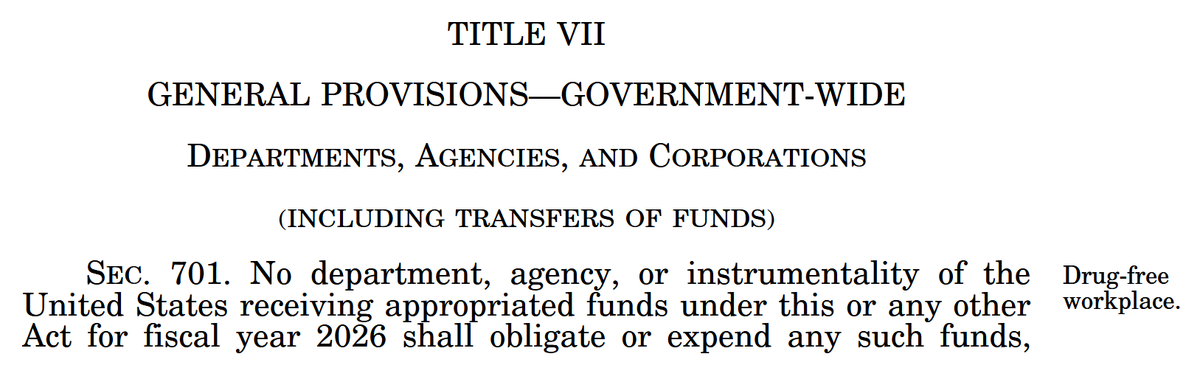
A single subcommittee funds the IRS, the SEC, and the FCC. So why does its bill also tell the entire federal government what it can't do?
If you've read Part 4 of our series on How to Read an Appropriations Act, you know the difference between administrative provisions (one department) and general provisions (the whole bill). This post zooms in on a special case that trips up even experienced budget people: the provisions in one appropriations bill that bind every agency in the government—including agencies funded by eleven other bills.
They live in Title VII of the Financial Services and General Government Appropriations Act. And once you know how to spot them, you'll never read an appropriations bill the same way again.
The 60-Second Version
| Question | Answer |
|---|---|
| What is FSGG? | The Financial Services and General Government bill—funds Treasury, the IRS, the EOP, the Judiciary, DC, and the management agencies (GSA, OPM, OMB) |
| What's in Title VII? | General provisions that apply government-wide—to every federal agency, not just the ones FSGG funds |
| What's in Title VI then? | General provisions that apply only to the agencies funded in this Act (FSGG) |
| What about Title VIII? | General provisions that apply only to the District of Columbia |
| How do they reach other agencies? | The magic words: "this or any other Act" |
| Why FSGG? | It funds the government's management agencies, so government-wide workforce and management rules naturally live here |
| Are they permanent? | Usually no—they expire with the fiscal year unless they say otherwise |
Key insight: A provision that says "None of the funds made available by this Act" binds only FSGG agencies (or whatever agencies contained in bill it appears in). A provision that says "this or any other Act" binds the whole government. Three extra words is the difference between a house rule and a federal-wide rule.
Pro Tip: Title VII names the government in several equally broad ways —
- "department, agency, or instrumentality of the United States",
- "the executive departments and independent establishments",
- "each Executive department and agency",
- "Federal departments and agencies",
- "executive branch agency"
The phrasing tells you who; the verb tells you what kind of rule. When the funds are the subject ("none of the funds… may be used"), it's setting terms and conditions on money. When the agency is the subject ("is hereby authorized to…," "shall submit…"), it's conveying authority or imposing a duty.
Why Government-Wide Rules Live in FSGG
Most appropriations bills fund a cluster of related agencies and set rules for those agencies. The Agriculture bill sets rules for USDA. The Interior bill sets rules for the Park Service. Tidy.
FSGG is different, because of what it funds.
FSGG is the home of the government's management agencies:
- OMB (the Office of Management and Budget)
- OPM (the Office of Personnel Management)
- GSA (the General Services Administration)
- Treasury (which runs the government's financial plumbing)
These agencies don't run programs for the public so much as they run the government itself—the workforce, the real estate, the procurement system, the financial management rules. So when Congress wants to set a rule that applies to every federal employee or every federal contract, the natural vehicle is the bill that funds the agencies in charge of employees and contracts.
It also funds many of the independent agencies that don't fit neatly in the other appropriations bills. This is the GG, general government, part of Financial Services and General Government.
Translation: FSGG is where Congress legislates the government as an employer and an institution. That's why a bill most people have never heard of quietly sets pay raises, travel rules, and hiring restrictions for the entire executive branch.
Title VI vs. Title VII: Read the Header
Open an FSGG bill and scroll to the back. You'll see two general-provisions titles in a row. They look almost identical. They are not.
| Feature | Title VI | Title VII |
|---|---|---|
| Header | "General Provisions—This Act" | "General Provisions—Government-wide" |
| Who's bound | Only agencies funded in FSGG | Every federal agency |
| Typical reach language | "funds made available by this Act" | "funds appropriated by this or any other Act" |
| Example content | Treasury reporting rules, IRS restrictions | Federal pay adjustment, anti-lobbying, travel limits |
The title header tells you the scope before you read a single section. "This Act" = the FSGG fence line. "Government-wide" = the whole executive branch.
An eagle-eyed reader will note that Title VIII of the FSGG bill is also general provisions—"General Provisions—District of Columbia". You're going to see the words "District of Columbia" a lot here, because these are GPs just for DC. If you're into DC issues, you should read this Title and pay attention to a different kind of scoping: "Federal funds" (the federal payment to DC), "local funds" (DC's own money), and provisions that reach "any funds" regardless of source.
Key insight: Don't infer scope from the content. Infer it from the title header and the reach language. The same prohibition can be FSGG-only or government-wide depending on which title it sits in and how its first clause is worded.
The Magic Words: "This or Any Other Act"
This is the whole game, so let's slow down on it.
A standard funding limitation starts with a phrase that defines its reach. Watch the opening clause:
That binds FSGG agencies and nobody else.
Now compare:
Translation: "This or any other Act" reaches across the entire appropriations process. It doesn't matter that the Defense Department is funded by the Defense bill or that NIH is funded by the Labor-HHS bill. Because Sec. 736 in FSGG Title VII says "this or any other Act," they are prohibited from using appropriated funds to pay for portraiture.
That's the practical reason this post exists. If you only ever read "your" bill, you're missing a whole layer of rules. You cannot understand the full set of restrictions on any agency by reading only that agency's appropriations bill. You also have to read FSGG Title VII.
That's how one subcommittee writes rules for agencies it doesn't fund.
Pro Tip: But wait, I read something in title I of the THUD bill that said "this or any other Act" why isn't that a general provision, government-wide? There are likely other scoping words that limit it to the agencies funded in that bill. Consider, Sec. 119G of the 2026 THUD Bill:
While technically it covers all money, the scoping words limit the impact to all money that could be used to plan, design, or implement things at the FAA. The main reason you might see this construction is to ensure that transfers from other agencies or supplemental appropriations later in the fiscal year contain the prohibition.
What's Actually in Title VII
Government-wide provisions cluster into a few recurring families. Most reappear year after year, lightly edited (usually it's just an update to the fiscal year). Here's the whole map.
The Cheat Sheet: Every Rule of the Road, FY2026
Below is the complete Title VII from the FY2026 bill—all 54 government-wide provisions, SEC. 701 through SEC. 754—each summarized in one line. This is the enacted text from Division A of P.L. 119-75 (Feb. 3, 2026), and the summaries are tightened from the Joint Explanatory Statement that accompanied the bill. (The JES summarizes every section, one line each. Appropriators write the cheat sheet for you—you just have to know it exists.)
Bookmark this. It's the set of rules that ride on every federal dollar this fiscal year.
| Sec. | Theme | What it does |
|---|---|---|
| 701 | Workforce | Each agency must maintain a drug-free-workplace policy as a condition of spending |
| 702 | Spending cap | Caps federal passenger-vehicle purchase prices ($40,000; $41,140 wagons), with exceptions |
| 703 | Money movement | Travel funds may also cover quarters and cost-of-living allowances |
| 704 | Workforce | No paying non-U.S. citizens whose duty post is in the continental U.S. (listed exceptions) |
| 705 | Money movement | Agencies may pay GSA for space, renovation, and related services |
| 706 | Money movement | Agencies may keep recycling/material-sale receipts for environmental and employee programs |
| 707 | Money movement | Administrative-expense funds may cover D.C. rent and service costs |
| 708 | Money movement | No interagency financing of boards/councils without prior, specific statutory approval |
| 709 | Oversight | No funds to enforce a regulation Congress disapproved by joint resolution |
| 710 | Spending cap | $5,000 cap on furnishing/redecorating a presidential appointee's office without advance notice to the Committees |
| 711 | Money movement | Permits interagency funding of national-security/emergency-preparedness telecom |
| 712 | Workforce | Must certify a Schedule C hire wasn't created mainly to detail the person to the White House |
| 713 | Workforce | No paying any official who blocks or retaliates against employees for talking to Congress |
| 714 | Workforce | No employee training unrelated to official duties (lists prohibited training types) |
| 715 | Propaganda | No publicity/propaganda to support or defeat legislation pending before Congress |
| 716 | Workforce | No giving employees' home addresses to labor organizations without consent or court order |
| 717 | Transparency | No releasing nonpublic info (mailing/phone/email lists) outside government without Committee approval |
| 718 | Propaganda | No domestic publicity or propaganda not authorized by Congress |
| 719 | Workforce | Employees must use official time in an honest effort to perform official duties |
| 720 | Money movement | May fund an appropriate share of FASAB administrative costs |
| 721 | Money movement | Authorizes transfers to GSA "Government-wide Policy" for management initiatives (capped; notice + spend plan) |
| 722 | Misc | Breastfeeding allowed anywhere in a federal building or on federal property |
| 723 | Money movement | Permits interagency funding of the National Science and Technology Council (OMB reports) |
| 724 | Procurement | Must identify the federal agency and amount on funding publications to States (2 CFR 200) |
| 725 | Transparency | No federal monitoring/aggregation of individuals' internet use (law-enforcement/security exceptions) |
| 726 | Procurement | Contraceptive coverage required in any FEHB contract covering prescription drugs (religious/moral exceptions) |
| 727 | Misc | Affirms U.S. commitment to anti-doping in Olympic/Pan Am/Paralympic sport |
| 728 | Spending cap | Travel funds may be used for the fractional aircraft ownership pilot program |
| 729 | Workforce | No funds for OPM detailee regs or restrictions on the Coast Guard Congressional Fellowship |
| 730 | Spending cap | No new federal law-enforcement training facilities without Committee approval (FLETC exception) |
| 731 | Propaganda | No agency "prepackaged news stories" unless they disclose the government as the source |
| 732 | Transparency | No funds used in contravention of the Privacy Act |
| 733 | Procurement | No contracts with inverted domestic corporations (national-security waiver) |
| 734 | Workforce | Agencies must remit OPM's retirement-claim processing cost for early-out/buyout retirements |
| 735 | Procurement | No requiring contract offerors to disclose political contributions |
| 736 | Spending cap | No paying to paint official portraits of federal officials (President, VP, Members, agency heads) |
| 737 | Pay | Limits pay increases for prevailing-rate (wage-grade) employees |
| 738 | Spending cap | IG reports required on conferences over $100,000 ($20,000 notifications); ties to OMB M-12-12 |
| 739 | Oversight | No shifting a program's funding as proposed in the President's budget unless enacted (or via reprogramming/transfer) |
| 740 | Workforce | No implementing OPM's 2008 "Competitive Area" reduction-in-force rule |
| 741 | Workforce | No starting/announcing an A-76 competition to contract out federal employee work |
| 742 | Procurement | No contracts/grants with entities that gag employees from reporting fraud, waste, or abuse |
| 743 | Procurement | No enforcing nondisclosure agreements lacking required whistleblower-protection language |
| 744 | Procurement | No awards to corporations with unresolved unpaid federal tax liabilities (absent suspension/debarment review) |
| 745 | Procurement | No awards to corporations with a recent felony conviction (absent suspension/debarment review) |
| 746 | Oversight | CFPB must brief the Appropriations subcommittee on its finances and notify Committees of transfer requests |
| 747 | Pay | Eliminates automatic statutory pay raises for the VP, Executive Schedule political appointees, noncareer SES, and senior political appointees |
| 748 | Oversight | Requires reporting Impoundment Control Act violations to Congress |
| 749 | Oversight | Agencies must notify the Committees when an apportionment isn't approved timely (or conditions/hinders execution) |
| 750 | Oversight | Treats certain earmark recipients as federal-award recipients for records retention and GAO access |
| 751 | Money movement | Permits interagency funding for Army medical research, CDMRP, and NIH research programs |
| 752 | Money movement | Authorizes transfers to GSA "Federal Citizen Services Fund" for IT/shared-services (capped; notice + spend plan) |
| 753 | Money movement | Lets agencies transfer IIJA (P.L. 117-58) balances to FWS/NMFS for Endangered Species Act consultations |
| 754 | Housekeeping | Clarifies these provisions don't apply to Title IV (D.C.) or Title VIII (D.C. general provisions) |
Source: P.L. 119-75, 140 STAT. 491–508 | Division E, FSGG Joint Explanatory Statement
Don't Skim Past These
Most of the 54 are quiet plumbing. A handful are policy fights you've probably read about without knowing they live here:
- SEC. 704 — A citizenship requirement for continental-U.S. federal jobs, rooted in 1930s law and still binding the whole government.
- SEC. 713 — The anti-gag rule. No one can be paid to stop a federal employee from talking to Congress.
- SEC. 715 and 718 — The anti-lobbying/anti-propaganda pair, reinforcing 18 U.S.C. 1913.
- SEC. 736 — No taxpayer-funded oil paintings of the Secretary. The famous "official portraits" ban.
- SEC. 737 and 747 — The pay levers: wage-grade limits, and a freeze on automatic raises for senior political appointees.
- SEC. 739 — Agencies can't pre-implement the President's budget. Congress appropriates; the budget is just a request.
- SEC. 748 and 749 — The impoundment/apportionment transparency pair—report ICA violations, and flag stalled or conditioned apportionments to the Committees.
How a Title VII Provision Reaches an Agency in Another Bill
Let's trace one all the way through, because this is the part people don't believe until they see it.
Take SEC. 745—no federal awards to a corporation convicted of a felony in the last 24 months. It's worded "None of the funds made available by this or any other Act." Now picture a contracting officer at the Department of Energy—funded by the Energy and Water bill, not FSGG—about to sign that award.
- The money comes from the Energy and Water Act.
- The rule comes from FSGG Title VII, SEC. 745.
- The reach language ("any other Act") pulls the Energy and Water money inside the FSGG rule.
- The result: the DOE contracting officer is bound by a provision in a bill that doesn't fund DOE at all.
Annual in Theory, Permanent in Practice
Technically, every provision in Title VII expires on September 30. Each one is scoped to "the current fiscal year" or "fiscal year 2026," none carry words of futurity, and none amend the U.S. Code. By the letter of the law, the whole title is temporary.
In practice, most of it is permanent.
The mechanism is reenactment. The same provisions come back—often word for word, under the same section numbers—year after year. The drug-free-workplace policy in SEC. 701, the anti-propaganda language in SEC. 715, the ban on official portraits in SEC. 736, the contraceptive-coverage requirement in SEC. 726: these aren't one-time choices. They're fixtures. Agencies build their compliance manuals around them precisely because they know they'll be back.
Key insight: A Title VII provision is temporary the way a magazine subscription is temporary. It expires every year—and renews every year. The expiration is real on paper and mostly irrelevant in practice.
This is why the smart way to read Title VII isn't to read all 54 provisions—it's to read the diff. Set this year's title next to last year's—the ones that came back unchanged are the settled rules of the road. The handful that changed—a new prohibition, a reworded cap, a provision that quietly dropped out—are this year's actual policy fight. Or start at the end and work backwards; the committee usually puts new provisions at the end. In a way you're reading tree rings of legislation. Sec. 701 has been around a long time, at least since P.L. 105-277, enacted in 1998. Sec. 753 refers to the Infrastructure Investment and Jobs Act, enacted in 2021.
Translation: Don't mistake "expires annually" for "might disappear." These are functionally permanent. But because they live in an annual bill instead of the U.S. Code, they're permanent by choice, every year—which means appropriators can also kill one simply by not reprinting it. But the status quo is overwhelming. There's a high bar to getting a new rider in an approps bill and an even higher bar for a government-wide GP. Members and staff are loath to refight a settled fight.
Why Should You Care?
"I work an agency that isn't funded by FSGG. Why would I read it?"
Because Title VII binds you anyway. The pay adjustment, the travel rules, the anti-lobbying limits, and a stack of policy riders all reach your agency through "this or any other Act." Reading only your own bill gives you an incomplete picture of the rules you operate under.
"How do I tell a government-wide provision from a regular one?"
Two tells: the title header ("Government-wide" vs. "This Act") and the reach language ("this or any other Act" vs. "this Act"). Check both.
"Where do the federal pay numbers come from each year?"
Often right here. Title VII is where Congress either ratifies the statutory pay formula, overrides it with a specific percentage, or freezes it outright.
"Why does Congress route government-wide rules through FSGG instead of a standalone bill?"
Same logic as any appropriations rider: the bill is must-pass, it's privileged in the Senate, it doesn't need the authorizing committee's blessing, and it lands on the President's desk as part of a package that's hard to veto. The difference is the reach—Title VII aims those advantages at the entire government.
The Bottom Line
Key takeaways:
- FSGG funds the management agencies (OMB, OPM, GSA, Treasury), so government-wide rules naturally live in its bill
- Title VI = "This Act" (FSGG agencies only); Title VII = "Government-wide" (every agency)
- "This or any other Act" is the reach mechanism that binds agencies funded by other bills
- The federal pay adjustment is often set or frozen here, government-wide
- Recurring families: pay, anti-lobbying, travel/conference limits, workforce and procurement rules, policy riders
- You can't see all the rules on an agency by reading only that agency's bill—you also have to read FSGG Title VII
What's Next
If you haven't read it yet, go back to How to Read an Appropriations Act, Part 4: General and Administrative Provisions for the foundational framework—how provisions constrain, redirect, and reshape appropriated funds, and why "none of the funds" is the most powerful phrase in appropriations law. This post was the government-wide special case. That one is the whole map.

Explore the receipts. The government publishes a lot of data, but it doesn’t make it easy to use. Introducing BlazingStar Public Data — our free, sourced mirror of the federal spending record: nightly apportionments, a new spend-plan archive, and the Budget Appendix. We’ve also started sharing CFR redlines of regulatory actions. And we’re working on adding more types of data to our repository. Each linked back to its government source. No login. Public domain.