Hearing Volumes and You
The most underused resource in the appropriations process. Here's how to mine it for the kind of information that doesn't show up anywhere else.
FY 2027 budget hearing are in full swing. Months after the hearing room empties, a bound book lands on GovInfo with everything that actually got said — plus the things members wished they'd had time to ask in person.
The hearing volume is the official published record of an appropriations subcommittee's annual hearings. It contains opening statements, witness testimony, the live Q&A transcript, the questions for the record (QFRs) members submitted in writing afterward, and the supplemental materials inserted into the record by members or witnesses. Pound for pound, page for page, it is the richest source of practitioner-level detail in the entire appropriations process.
And almost nobody reads it.
Reporters skim the day-of witness statements and move on. Advocates read their own organization's testimony. Researchers cite it only when they need a quote. Most of the people who could benefit from the QFRs section don't know it exists.
This post walks through what's in a hearing volume, where to find it, and how to mine it for what doesn't show up anywhere else.
The 60-Second Version
What it is: The official published record of an appropriations subcommittee's annual hearings — testimony, Q&A, written follow-ups, and supplemental materials, all bound together.
Where to find it: GovInfo.gov: Congressional Hearings — searchable, free, full text.
When it's published: Typically 6 to 18 months after the hearings. Sometimes longer.
What's in it:
- Member opening statements
- Witness prepared statements (often 20–40 pages each)
- The live Q&A transcript
- Questions for the Record (QFRs) — submitted in writing, answered in writing
- Supplemental materials inserted into the record by members
What makes it valuable: The QFRs section. That's where members ask their toughest questions, in writing, with the agency on the record. It's often longer than the live hearing transcript and contains data and admissions you won't find anywhere else.
Key insight: A hearing is theater. The hearing volume is forensics.
Anatomy of a Hearing Volume
Every appropriations subcommittee produces a hearing volume each fiscal year covering all of its hearings on the budget request. Some subcommittees produce multiple physical volumes per year — Defense and Labor-HHS-Ed are typically several thousand pages each.
Here's the typical structure, in order:
Front matter
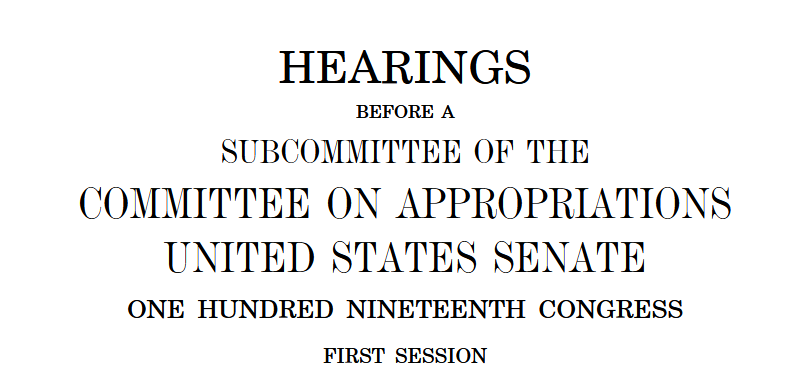
- Title page identifying the subcommittee, fiscal year, and Congress
- Committee membership roster (majority and minority)
- Table of contents listing each hearing day and its witnesses
For each hearing day
- Opening statements — chairman and ranking member, sometimes other members
- Witness prepared statement — the testimony submitted in advance, entered into the record
- Live transcript — the back-and-forth between members and the witness, transcribed
- Questions for the Record (QFRs) — written questions from members, written answers from the witness or agency
- Supplemental materials — charts, letters, statistics inserted into the record by members or witnesses
Translation: A hearing volume is a fiscal year in one subcommittee, captured in full. If you read one volume cover to cover, you understand what concerns members raised, what the agency said in response, and what got promised in writing.
The QFRs Section Is Where the Work Happens
A typical appropriations hearing runs two to three hours. Each member gets five minutes for Q&A. That's not a lot of time. By the time you've made a statement, asked a question, listened to the answer, and asked a follow-up, you've used your slot.
That's why members submit QFRs.
After the hearing, each member's staff drafts written questions for the witness. The witness — or the witness's agency — has a deadline to respond in writing. The questions and answers are then printed in the hearing volume.
That's where an additional, substantive exchange happens — a second hearing with all of the agency's facts and figures at the witness' disposal. Members use QFRs to:
- Pin down positions in writing. "Confirm that the Department does not intend to use these funds for X." Now it's in writing.
- Extract data the agency won't release publicly. "Provide the breakdown of program funding by state for the last five fiscal years." Agencies often produce data for QFRs that doesn't appear in any public report.
- Force the agency to defend specific decisions. "Justify the proposed cut to Program X in light of the Department's stated commitment to Y."
- Build a multi-year paper trail. Members ask the same question year after year. The agency's evolving answers become evidence.
Pro Tip: When you read a hearing volume, skip the opening statements and skim the live Q&A. Then read the QFRs carefully. That's where the substance is. Opening statements are messaging. Live Q&A is performance with substance mixed in. QFRs are the agency on the record.
A Worked Example: Van Hollen, Noem, and the National Fire Academy
The exchange below comes from a Thursday, May 8, 2025, Senate Appropriations Subcommittee on Homeland Security hearing (PDF | Text) on the FY 2026 DHS budget request. The witness was Secretary Kristi Noem. Senator Chris Van Hollen (D-MD) asked about the National Fire Academy in Emmitsburg, Maryland — which, in March 2025, the Administration had paused all in-person training for the roughly 100,000 firefighters who train there each year.
Here's the live exchange:
FIREFIGHTER GRANTS
Senator Van Hollen. Thank you, Madam Chair. Madam Secretary, I'm going to ask you about something I hope we can agree on. Are you familiar with the U.S. Fire Academy? It trains about 100,000 firefighters from around the country.
Secretary Noem. Yes.
Senator Van Hollen. So right now, as you may know, it's not being funded. All the in-person classes have been canceled. So I, together with some of my colleagues, including Congresswoman April McClain Delaney, who represents that district in Congress, wrote to you back on March 14th about the situation there. I would just ask, could you commit today to responding to our letter?
Secretary Noem. I believe we did respond even if it may have just been recently to you. But those grants and programs are being facilitated, and those dollars will be forwarded. So that is something that if I didn't get that back to you, we will get it to you within 24 hours.
Senator Van Hollen. Well, that would be some good news to come out of the hearing, because we really have not heard a thing I'm reading from a headline, "Trump Officials Silent as Firefighters Lobby to Reopen Training Academy in Maryland." This is an article from yesterday. So you're bringing good news today that we're going to renew funding for the National Fire Academy?
Secretary Noem. That is the direction that we are taking, and we will get that information to you.
Senator Van Hollen. Thank you, Madam Secretary. Thank you, Madam Chair.
That's what the C-SPAN viewer heard. A verbal commitment to respond "within 24 hours." A verbal commitment to bring "good news." A Secretary saying "that is the direction that we are taking." Quotable. Not actually an answer.
Now here's the QFR exchange on the same topic, submitted by Senator Van Hollen after the hearing and answered in writing by the Department:
the national fire academy
Question. In March 2025, the Administration canceled all in-person first responder training courses at the U.S. Fire Administration's (USFA) National Fire Academy (NFA) and the Emergency Management Institute (EMI), collocated at the National Emergency Training Center (NETC) in Emmitsburg, Maryland. I sent you a letter, along with Congresswoman Delaney and 64 of my fellow Members of Congress, on March 14th about the cancellations and never received a response. During the hearing you mentioned to me that, "I believe we did respond." Moreover, you also mentioned that "those grants and programs are being facilitated, and those dollars will be forwarded. So, that is something that if I didn't get that back to you, we will get it to you within 24 hours."
When will you provide the response to the letter?
Answer. DHS thoroughly evaluated our training programs and spending to ensure alignment with Administration priorities and support responsible spending. The Department's review has been completed, and the schoolhouses have reopened. In-person trainings resumed in early June.
In reviewing available trainings, the Federal Emergency Management Agency (FEMA) worked to ensure training and education resources are maximized to best serve our State, local, Tribal Nation, and territorial first responders. Our goal is to ensure that we are effectively and efficiently addressing the most critical preparedness outcomes for our partners while maintaining fiscal responsibility.
Question. When will the in-person classes resume and the restoration of funding for the NFA and EMI start?
Answer. In-person training has resumed at three national schoolhouses in June 2025 — the Center for Domestic Preparedness in Anniston, Alabama and the National Fire Academy and the National Disaster and Emergency Management University in Emmitsburg, Maryland.
Following a comprehensive review by FEMA and the U.S. Fire Administration, it was determined certain courses provide effective training to enhance national readiness for State, local, Tribal, and territorial emergency managers, first responders, and local leaders. FEMA's principles for emergency management assert that disasters are best managed when they are federally supported, state managed, and locally executed.
Same topic. Same Senator. Same witness. Two very different records.
Read what the QFR does that the live Q&A could not:
- It quotes the Secretary back to herself. "I believe we did respond." "We will get it to you within 24 hours." Those verbal commitments are now in writing, attached to a written question. They can't be walked back.
- It binds the question to 64 cosigners. Van Hollen reminds the Department this isn't one Senator — it's 65 Members of Congress who sent a letter on March 14 and never got a response. The agency now has to answer that too, on the record.
- It surfaces what the answer doesn't say. The Department was asked when it would respond to the letter. It didn't answer that question. It pivoted to what's already happened: schoolhouses reopened, training resumed in early June. That pivot — not answering the question that was asked — is what the QFR record preserves. The live exchange would have let it slide past. The written record does not.
When someone later researches the FY 2026 NFA fight — for next year's hearings, for an IG report, for a journalist's follow-up, for an oversight investigation — this is the exchange they will cite. The bill text won't capture it. The committee report won't capture it. Only the hearing volume — and only the QFR section of the hearing volume — captures what actually happened.
Another Worked Example: Peters, Noem, and Guantanamo
That was one classic use of the QFR: pinning down a witness whose verbal answer was vague. Here's a second, equally important: extracting data the agency hasn't published anywhere else.
The exchange below is from the same FY 2026 DHS budget hearing (PDF | Text). The witness is again Secretary Noem. The questioner is Senator Gary Peters (D-MI), Ranking Member of the Homeland Security and Governmental Affairs Committee (HSGAC).
In the live Q&A, Peters made a different kind of move — not asking about a single program, but raising a structural complaint about oversight responsiveness:
Senator Peters. I would if we could follow-up that'd be great after this hearing, I would appreciate that.
As ranking member of the Homeland Security and Government Affairs Committee (HSGAC), I have sent you nine letters since you have been sworn in as Secretary of Homeland Security. So far, I've received only two replies. And quite frankly, one of those was completely unsatisfactory. And while I understand you've had a busy start, you have a lot on your plate, including travel, responses to Congressional oversight requests are a priority. And I think you hold that view, but we're not seeing it being demonstrated, unfortunately.
So, my question for you is, when can I expect responses to these letters, and can you commit to getting me responses, certainly, before our budget hearing, before HSGAC coming up?
Secretary Noem. Yes, absolutely, sir. I was unaware that you had that many letters out yet. I know some of the letters you requested had a lot of data to gather and information.
Senator Peters. Yes.
Secretary Noem. And so, that may be the delay on a couple of them. But we will get those gathered and get them to you. As you know, when I came into this role, we had a backlog of letters from Senators and Congressmen up to 4 years, where the previous Administration did not respond to any of you. That was a universal complaint I had from Republicans and Democrats.
Senator Peters. Well, we want to see that change. So--yes, if we could get these letters back as quickly as possible, I'd appreciate that.
Secretary Noem. I bet.
That's the live exchange. A complaint about backlog. A verbal commitment to do better. No substance on any program.
Now here's a single QFR sequence Peters submitted on a topic that wasn't discussed in the live hearing at all: DHS operations at Guantanamo Bay.
Question. How many DHS personnel are currently stationed at Guantanamo?
Answer. As of May 8, 2025, there were 46 DHS personnel stationed at Naval Station Guantanamo Bay.
Question. How many DHS contractors are currently stationed at Guantanamo?
Answer. As of May 8, 2025, there were 75 DHS contractors stationed at Guantanamo Bay.
Question. How many U.S. military are currently stationed at Guantanamo in support of DHS's immigration detention mission?
Answer. The Department of Homeland Security respectfully defers to the Department of Defense.
Question. How many immigrants have been detained by ICE at Guantanamo? Please provide a count by nationality and dates of detention.
Answer. Please refer to the below table.
Detention at Naval Station Guantanamo Bay by Country of Citizenship
February 4, 2025 through May 18, 2025¹
| Country of Citizenship | Total Aliens Booked-In |
|---|---|
| Venezuela | 232 |
| Nicaragua | 160 |
| El Salvador | 25 |
| Guatemala | 15 |
| Ecuador | 15 |
| Colombia | 9 |
| Honduras | 9 |
| Dominican Republic | 6 |
| Vietnam | 4 |
| Brazil | 4 |
| Peru | 3 |
| Turkiye | 2 |
| Afghanistan | 2 |
| Cambodia | 1 |
| Senegal | 1 |
| Costa Rica | 1 |
| Liberia | 1 |
| Morocco | 1 |
| Belize | 1 |
| Sweden | 1 |
| Syria | 1 |
| Bolivia | 1 |
| Guinea | 1 |
| Laos | 1 |
| Romania | 1 |
| Egypt | 1 |
| Georgia | 1 |
| Total | 500 |
¹ ICE is unable to provide a breakdown of dates due to operational concerns.
Question. ICE has stated that the detention of immigrants is "temporary" at Guantanamo. What is the average length of detention for immigrants held at Guantanamo?
Answer. Please refer to the below table.
Naval Station Guantanamo Bay Detention Overview
| Average Days in Detention | Shortest Detention in Days | Longest Detention in Days | Aliens Booked-Out | Aliens Currently in Detention |
|---|---|---|---|---|
| 10.35 | 52 | 427 | 73 |
Question. What is the shortest length of time an immigrant has been held at Guantanamo?
Answer. The shortest detention stay is less than 24 hours.
Question. What is the longest amount of time that an immigrant has been held at Guantanamo?
Answer. The longest detention stay is 52 days.
Question. How many days does DHS consider detention at Guantanamo to be "temporary"?
Answer. U.S. Immigration and Customs Enforcement (ICE) leverages the Migrant Operations Center and Joint Task Force Camp Six for detention sites to arrange flights and removals. However, the time an alien remains in custody at Naval Station Guantanamo Bay depends on various factors, including the length of time it takes to secure a removal flight.
Question. What is the current maximum limit for usable detention space by DHS at Guantanamo? Please provide numbers for Camp VI, the Migrant Operations Center, and any other facilities.
Answer. U.S. Immigration and Customs Enforcement (ICE) is currently using Naval Station Guantanamo Bay to house detained aliens subject to executable final orders without legal impediments to removal. ICE leverages the Migrant Operations Center and Joint Task Force Camp Six for detention sites. The Migrant Operations Center can currently hold up to 50 persons and the current holding capacity for the Camp Six facility is up to 143 persons.
Question. What entity (i.e. ICE Air or Department of Defense) is responsible for transporting people to Guantanamo? From Guantanamo?
Answer. ICE Air Operations operates flights in and out of the location using a contracted carrier.
This is the QFR being used as a data call.
There was no live hearing exchange on Guantanamo. The topic didn't come up. Peters used his QFR allocation to ask, in sequence:
- How many DHS personnel? 46.
- How many contractors? 75.
- How many military? DHS defers to DoD — itself a finding worth preserving.
- Who's been detained, by nationality? 500 people from 27 countries, with Venezuela at 232 and Nicaragua at 160 leading the list.
- How long are they held? Average 10.35 days, longest 52.
- What's the capacity? Migrant Operations Center: 50. Camp Six: 143.
- Who flies them in and out? ICE Air Operations, using a contracted carrier.
None of that data appeared in an agency report. None of it was in the budget request. None of it was in a press release. It exists, on the record, in this one QFR exchange because a member asked.
That's the second classic use of the QFR. The first example showed how a QFR pins down an evasive verbal answer. This one shows how a QFR forces an agency to put numbers on the record about operations it would rather discuss only in generalities — and how the QFR isn't even limited to topics raised at the hearing. A member can ask whatever they want.
The pattern is the same: written question, written answer, both bound into the official record of the hearing, both citable forever. The Guantanamo nationality breakdown is now a primary source. If a journalist, an IG, a court, or a future member of Congress wants to know who was held at Naval Station Guantanamo Bay between February 4 and May 18, 2025, this table is where they start.
Where to Find Hearing Volumes
GovInfo.gov is the primary source. All published hearing volumes are searchable in full text.
Browse the CHRG (Congressional Hearings) collection by Congress, committee, and subcommittee. Or search across all hearings by keyword — agency name, program name, member name, witness name.
The catch: Hearing volumes are published months after the hearings. If you need same-day testimony, the subcommittee's own website is faster. If you want the full record with QFRs, you wait.
Pro Tip: Monitor the GovInfo RSS feed. New volumes appear with no announcement; the feed is the only reliable way to know when one drops.
| What You Want | Where to Look |
|---|---|
| Day-of witness statements | Subcommittee website |
| Full hearing transcript | Hearing volume on GovInfo |
| QFRs and agency answers | Hearing volume on GovInfo |
| Supplemental materials inserted into the record | Hearing volume on GovInfo |
| Historical hearings (decades back) | GovInfo, with caveats about coverage depth |
How to Mine a Hearing Volume
Once you have the PDF or the HTML, the workflow:
- Skip the front matter. Membership rosters and tables of contents are reference only.
- Skim the opening statements. They're prepared remarks — useful for tone and member priorities, not substance.
- Skim the live Q&A. Look for members who pushed back, pinned the witness down, or interrupted. Those exchanges flag the topics worth following into the QFRs.
- Read the QFRs carefully. This is where the agency commits to positions in writing.
- Note what's been inserted. Members insert charts, letters, and statistics into the record because they want them preserved and findable. If something is in the supplemental materials, the inserter wanted it on the record.
- Cross-reference across years. The same question asked in FY 2022, FY 2023, and FY 2024 reveals a sustained concern. The agency's evolving answers reveal whether — and how — the concern is being addressed.
Search strategy:
- Search by program name or account name to find every QFR touching the program
- Search by member name to track what one member has been asking over time
- Search by witness name to find cross-agency patterns in how the same person has responded
Why It Matters
Hearing volumes are the only place where you can read what an agency told Congress, on the record, in response to direct questioning.
The budget request shows what the agency wants. The committee report shows what Congress directs. The enacted bill shows what got funded. But the hearing volume shows what the agency said — about its own performance, its own data, its own decisions.
That distinction matters because:
- Agencies make commitments in QFRs they don't make anywhere else.
- Members extract data in QFRs that doesn't appear in any agency report.
- The multi-year record of QFRs reveals how programs, priorities, and agency positions have evolved — or haven't.
- Litigation, IG reports, and oversight investigations routinely rely on hearing volume excerpts as evidence of what an agency said and when.
For anyone doing serious appropriations work — agency relations, advocacy, oversight, research, journalism — the hearing volume is the document that gives you the most signal per page. The catch is that almost nobody knows how to read them.
The Bottom Line
Key takeaways:
- The hearing volume is the official published record of an appropriations subcommittee's annual hearings
- It contains opening statements, witness testimony, live Q&A, QFRs, and supplemental materials
- The QFRs section is where the real work happens — often longer than the live transcript and full of substantive written exchanges
- Volumes are published 6–18 months after the hearings on GovInfo.gov
- They are the richest source of practitioner-level detail in the appropriations process — and almost nobody reads them
- Read across years to see how an agency's positions evolve — or don't
A hearing is theater. The hearing volume is forensics.