How to Read an Appropriations Act, Part 6: Stages of Consideration
1. Where to start?
2. Structure
3. Account Text
4. General and Administrative Provisions
5. Reports and Explanatory Statements
6. Stages of Consideration
The earlier posts in this series taught you how to read an enacted appropriations bill. This one teaches you how to read it while it's being written.
If you've been following the appropriations series, you can read an enacted appropriations act with confidence. You know how the 12 bills are structured, how to find an account, how to parse general and administrative provisions, and how to read a committee report.
But an enacted bill is the end of the story, not the beginning. Before a single dollar gets appropriated, the bill moves through a series of stages — hearings, member requests, chairman's marks, subcommittee markups, full committee markups, floor consideration, conference, and enrollment. Each stage produces documents. Each stage gives you a window into what's likely to be in the final bill.
Knowing which document exists at which stage — and how to read each one — is the practitioner skill that separates people who follow appropriations from people who understand it. If you can only read the enacted bill, you're reading the past. If you can read the chairman's mark, the manager's amendment, and the committee report, you're reading the future.
This post walks through each stage, what documents it produces, and what you can learn from each.
The 60-Second Version
| Stage | Document | What It Tells You |
|---|---|---|
| President's Budget Request | Appendix, CBJs | What the Administration wants |
| Hearings | Hearing volumes (later) | What concerns members raised |
| Member requests | Member letters, sometimes published | What the rank and file are pushing for |
| Chairman's mark | Committee print | The first draft of the bill |
| Subcommittee markup | Reported bill, amendments | The first formal product |
| Full committee markup | Reported bill, committee report | The committee's official position |
| Floor consideration | Manager's amendments, floor amendments, RECORD | What the chamber actually voted on |
| Conference | Conference report or joint explanatory statement | The final negotiated text |
| Enrollment | Engrossed bill, enrolled bill, Public Law | The version that becomes law |
Key insight: Each stage is producing legislative product, and at each stage there are documents you can read. By the time the bill is enacted, almost everything in it has been visible — somewhere — for weeks or months. The skill is knowing where to look and what to look for.
Your guide: The CRS Appropriations Status Table should be your guide to appropriations season. It's all there as the process unfolds.
Stage 0: The President's Budget Request
The starting gun. The President's budget request lands at OMB's website (typically in February, sometimes later) and includes the Appendix, the agency Congressional Budget Justifications (CBJs), and the supplemental materials. We covered all of this in the PBR series.
For the appropriations process, what you care about is:
- The Appendix — the account-level detail and proposed appropriations language
- The CBJs — the agency-level justifications with program detail and performance metrics
- The supplemental materials — particularly anything addressing crosscuts (R&D, IT, real property)
What it tells you: What the Administration is asking for. This is the starting point for the entire annual cycle. Subcommittees will hold hearings on these proposals, members will submit requests in response, and the chairman's mark will respond to them — sometimes by adopting them, sometimes by rejecting them.
Translation: The President proposes. Congress disposes. Stage 0 is the proposal.
Stage 1: Member Requests
Once the budget is out, members of Congress submit programmatic and language requests to the appropriations subcommittees. These requests fall into three general categories:
- Project requests: These are earmark requests. "Provide $A for organization B to do activity C in City, State"
- Programmatic requests: "Please fund Program X at $Y million" or "Please increase the [account] by $Z."
- Language requests: "Please include the following report language" or "Please include the following bill provision."
Chamber rules require members to publish their project requests on their websites. Some programmatic requests are coordinated through caucuses (the Congressional Black Caucus, the Tax Credit Caucus, regional caucuses, etc.). Some come from outside groups. There are often large sign-on letters, and the coalitions often make them public.
What it tells you: What the rank-and-file membership is pushing for. By the time the chairman's mark is drafted, every subcommittee's staff has read hundreds of these requests. The chairman's mark won't reflect all of them — most won't make it — but the priorities of the majority's members generally do show up.
Pro Tip: If you work in advocacy, this is the stage at which your access to the process is highest. Every subcommittee accepts member requests. Every member office accepts constituent input. After the chairman's mark, the process becomes much more about negotiation and less about persuasion.
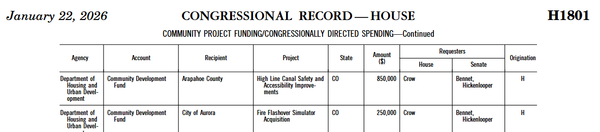
Pro Pro Tip: If you're tracking member requests, or member projects, or community project funding, or congressionally-directed spending or whatever you want to call earmarks, the report is going to be your friend. Earmarks are contained in a table in the report, and incorporated by reference in the bill text. The report is where the earmark action is.
Stage 2: Hearings
After the budget request lands, each appropriations subcommittee holds hearings — usually in March, April, and May. Agency witnesses testify, members ask questions, and the record is built.
What's produced:
- Same-day: member statements, opening remarks, the witness's prepared testimony. These are usually available on the subcommittee's website within hours.
- Eventually: the hearing volume — a bound transcript including the testimony, the Q&A, and "questions for the record" (QFRs) submitted in writing after the hearing.
What it tells you: What concerns members raised. Which programs they're scrutinizing. Which witnesses they're trusting. The hearings are partly performance — they're public — but they're also where the real questions get asked. If a subcommittee chair spends 10 minutes asking the FBI Director about cybersecurity, you can bet there will be cybersecurity language in the bill.
Pro Tip: The same-day testimony is what reporters write about. The hearing volume that comes later is what staff actually use. Most members ask their toughest questions in writing — through QFRs — so the hearing transcript is incomplete until the QFRs are added in. We're going to cover hearing volumes in depth next week.
Stage 3: Chair's Mark
The subcommittee chair's mark is the first formal draft of the bill. It's drafted by the subcommittee chair and his or her staff, in coordination with full committee leadership and (typically) the majority party's leadership.
The chairman's mark reflects:
- The Administration's request (accepted, modified, or rejected line by line)
- Member requests from the majority (it's more bipartisan than that seems)
- Negotiated priorities with leadership
- The political constraints of the year (overall topline, ratios between accounts, etc.)
What's produced: A committee print of the bill text. Sometimes circulated publicly before the markup; sometimes only available to committee members and staff until the markup begins.
What it tells you: The bill the chairman wants to pass. From this point forward, the process is more about modifying than starting over. The chairman's mark sets the floor for the conversation.
Translation: This is the chairman's bill. Everything that follows is about whether — and how — to amend it.
Stage 4: Subcommittee Markup
The subcommittee meets, considers the chairman's mark, accepts or rejects amendments, and reports a bill to the full committee.
What's produced:
- The reported bill — the chairman's mark plus any amendments adopted at the subcommittee level
- Amendments — both adopted and offered-but-not-adopted. Most subcommittees publish offered amendments and the disposition (agreed, withdrawn, defeated).
- Manager's amendment — sometimes the chairman packages a set of agreed-upon technical changes into a single amendment, often adopted en bloc.
What it tells you: Which provisions survived initial scrutiny. Which provisions got modified. Which fights were postponed to the full committee level (or the floor). Subcommittee markups can be perfunctory or contentious — it depends on the dynamics within the majority and the chairman's preferences.
Pro Tip: Subcommittee markups are often a non-event. In the Senate, sometimes they report the bill out by polling the subcommittee and head right to full committee. In the House, they hold a live subcommittee markup and typically there's opening statements from the chair and ranking member, maybe a few comments from a few subcommittee members. While it happens occasionally, amendments at subcommittee are rare; most amendments occur during full committee markup.
Stage 5: Full Committee Markup
The full appropriations committee considers the subcommittee-reported bill, considers further amendments, and reports a bill to the floor of its chamber.
What's produced:
- The reported bill — the subcommittee version plus any amendments adopted at the full committee level
- Additional amendments — including any that didn't make it through subcommittee
- The committee report — draft published 24 hours before the markup in the House and after the markup in the Senate, contains the rationale, section-by-section analysis, account-by-account explanation, earmark tables, and the report language we covered in Part 5.
What it tells you: The committee's official position. The committee report is the most authoritative document for understanding the committee's intent. If you want to know what the committee thinks the agency should do with the funding, read the report. The minority views give you an idea of what the minority's concerns are with the product.
Translation: This is the bill the committee wants to pass. From here, it goes to the floor.
Pro Tip: Markups happen in real time, on a schedule published in advance. If you care about a specific subcommittee's bill, watch (or listen to) the markup. Reading the marked-up text afterwards is fine, but watching the markup tells you the dynamics — who's offering amendments, who's voting how, what the chairman is willing to accept on the fly.
Bonus Pro Tip: The House posts amendment text and outcomes of the roll call votes within 24 hours of the markup on the Committee website.
Stage 6: Floor Consideration
The bill comes to the floor of the House or Senate for debate, amendment, and final passage.
What's produced:
- Floor managers' statements — the chairman and ranking member each make opening statements explaining the bill, usually published on the committee website immediately after delivery
- Manager's amendments — sometimes additional technical amendments are offered as a manager's package
- Floor amendments — individual amendments offered by members
- The Congressional Record — the official transcript of the debate, including all statements made
- The passed bill — the full committee version plus any floor amendments
What it tells you: What the chamber actually voted on. The differences between the committee-reported bill and the floor-passed bill tell you which provisions were politically vulnerable. The Congressional Record statements tell you how the chairman and floor managers want the language interpreted — these statements can be cited as legislative history.
Pro Tip: Floor amendments are sometimes more about messaging than legislating. Members offer amendments knowing they'll fail, just to put colleagues on the record. Other times, surprise amendments succeed. Either way, the floor stage is where unpredictability enters the process. Given the majoritarian nature of the House, the Rules Committee meeting before floor consideration is an important step in the process. The Rules Committee determines which amendments are in order and will be considered on the House floor. A similar process happens in the Senate, but it's governed by unanimous consent.
Stage 7: Conference (or Exchanging Amendments)
The House and Senate each pass their own version of the bill. Those versions need to be reconciled — historically through a formal conference committee, increasingly through informal negotiation.
Formal conference:
- A conference committee of House and Senate appropriators is appointed
- The conferees negotiate the differences, sometimes for weeks
- The result is a conference report — the negotiated bill text — and a statement that explains the conferees' decisions on each item
Informal conference (Exchanging Amendments):
- The two chambers negotiate without formally appointing a conference committee
- The result is typically a single bill that one chamber passes first, then the other (exchanging amendments, ping-pong)
- A joint explanatory statement, not a conference report, is produced as a supplementary document
What's produced: The negotiated bill text. The report or statement (in either format) is the most authoritative document about what each provision does and why.
What it tells you: The final agreed-upon language. By this stage, almost all the policy decisions have been made. The conference report or pre-conference text is the product that will be enacted.
Pro Tip: Reading the joint explanatory statement is the single best skill for understanding what's actually in the final bill. It's longer than the bill itself and explains the conferees' decisions on every meaningful item. If you read only one document at this stage, read the explanatory statement.
Bonus Pro Tip: As this stage is unfolding, you might hear the term "vehicle" discussed. No one in Congress is car shopping. Each House-passed bill is sent to the Senate. The Senate is free to amend it. Often the House bill, MilCon, for example, is amended with the negotiated text of MilCon, Ag, and Leg Branch. Each of these House-passed bills are "vehicles" for a conference minibus or omnibus.
Stage 8: Enrollment and Signature
The conference report (or pre-conference text) passes both chambers and goes to the President for signature.
What's produced:
- Engrossed bill — the version passed by the originating chamber
- Enrolled bill — the version passed by both chambers and ready for the President
- Public law — once signed, the bill becomes a public law with a number (P.L. 119-X)
What it tells you: The final, enacted text. From here, the law goes to OMB for apportionment and to the agencies for execution. We covered the apportionment process in earlier series.
What's Available When: A Quick Reference
If you're trying to follow a bill through the year, this is the document trail:
| Month (typical) | Stage | Document |
|---|---|---|
| February | Budget request released | Appendix, CBJs, press materials |
| After PBR | Member requests | Letters (where published) |
| March-May | Subcommittee hearings | Same-day testimony, witness statements |
| May-June | Subcommittee markup | Chairman's mark, reported bill |
| June-July | Full committee markup | Reported bill, committee report |
| July-September | Floor consideration | Passed bill, Congressional Record |
| September-December | Conference / pre-conference | Conference report or pre-conference text, joint explanatory statement |
| Variable | Enactment | Public law |
The schedule slips constantly. The fiscal year starts October 1, and the 12 appropriations bills have all passed by October 1 only a handful of times since 1977. Continuing resolutions usually fill the gap. We covered CRs in this post.
Where to Look at Each Stage
| What You Want | Where to Look |
|---|---|
| Budget request | whitehouse.gov/omb/budget |
| Agency CBJs | Agency websites or USAspending.gov agency pages |
| Subcommittee hearings | House and Senate Appropriations subcommittee pages |
| Hearing volumes | GovInfo.gov (eventually) |
| Member requests | Individual member websites, sometimes subcommittee pages |
| Chairman's marks | Subcommittee pages on the day of markup |
| Reported bills and reports | Congress.gov |
| Floor amendments | Congress.gov, Congressional Record |
| Conference reports | Congress.gov |
| Joint explanatory statement | Sometimes published with conference report; sometimes published separately in the Congressional Record |
| Public laws | Congress.gov, GovInfo.gov |
Right Now in May 2026
As of this writing, the House Appropriations Committee is in the middle of subcommittee and full committee markups for the FY 2027 cycle. Subcommittees have held hearings on the budget request, members have submitted their requests, and the chairman's marks are being released and considered.
If you want to watch the process in real time, this is the moment. Each subcommittee's markup is announced in advance on the House Appropriations Committee website and on the House Committee Repository. Markups are livestreamed in the House. Within hours of the markup, the reported bill text is published. Within days, the committee report is published.
The Senate Appropriations Committee is on a slower pace this year, with Senate markups likely to begin later in the spring or early summer.
Pro Tip: If you're new to this, pick one subcommittee and follow it all the way through. Watching one bill move from chairman's mark to public law gives you the feel of the process in a way that following twelve simultaneously cannot. The Military Construction bill would be a good starting point — it's typically less politically fraught than some others, and the process tends to run smoothly enough to see the stages clearly. But it's passd; The 2027 House MilCon mark was reported out 58-0. If you want to do something start to finish, try Energy and Water. Subcommittee markup is this Friday, May 15th at 9:00am.. The Full Committee markup is May 20 at 10:00am.
Why Should You Care?
"I just want to know what's in the final bill."
Then you'll be reading the bill in November or December. Everyone else has been reading the document trail since February.
"I work in advocacy. When should I engage?"
Immediately. You may have missed your best window, depending on the subcommittee. Member requests open after the budget request is out. By the time the chairman's mark is released, the bill is mostly written. Engaging at full committee or floor consideration is much harder than engaging at the request stage.
"I'm a reporter. Where do I find the most useful documents?"
The committee reports and the joint explanatory statement. These contain the explanations that aren't in the bill text itself. The bill says what; the report says why.
"I'm a budget analyst. What's the most important document?"
The report or joint explanatory statement, every time. It's the most detailed authoritative source on what the funding is supposed to do.
The Bottom Line
Key takeaways:
- Every appropriations bill moves through multiple stages — budget request, hearings, requests, chairman's mark, subcommittee markup, full committee markup, floor consideration, conference, enrollment
- Each stage produces documents you can read — and reading them in real time gives you a head start on the final bill
- The chairman's mark sets the floor for the conversation; from there, the process is mostly about amendment
- The committee report and the joint explanatory statement are the most authoritative explanations of what the bill is actually doing
- Engaging the process is easiest at the request stage and gets harder at every subsequent stage
- The schedule slips constantly — fiscal-year-on-time appropriations are the exception, not the rule
What's Next
Next week, we're going to dig into one of the most underused resources in the appropriations process: hearing volumes. They're the bound transcripts of the subcommittee hearings — testimony, Q&A, questions for the record, and supplemental materials. They're published months after the hearings, but they're a goldmine if you know how to use them. We'll cover where to find them, what's in them, and how to mine them for the kind of information that doesn't show up anywhere else.