What Is Reconciliation?
Buried in the budget resolution are instructions that unlock one of the most powerful, yet complicated, tools in Congress: reconciliation. Here's what it is, why it exists, and how it's evolved from a deficit-reduction mechanism into the primary vehicle for party-line policy.
In Part 1, we covered the budget resolution — Congress's fiscal plan for the year. We ended with a teaser about reconciliation instructions: the provisions in a budget resolution that unlock a fast-track legislative process.
Now we get into that process.
Reconciliation is how some of the biggest legislation of the last 45 years has become law — the Bush tax cuts, welfare reform, the Affordable Care Act, the Trump tax cuts, the American Rescue Plan, the Inflation Reduction Act. Understanding what it is — and how it's changed — is essential to understanding how Congress actually works.
The 60-Second Version
| Question | Answer |
|---|---|
| What is it? | A fast-track legislative process for changing mandatory spending, revenues, or the debt limit |
| Where does it come from? | Title III of the Congressional Budget Act of 1974 |
| What's the big deal? | It can pass the Senate with 51 votes instead of 60 |
| What can't it do? | Change discretionary spending, make policy changes unrelated to the budget, or change Social Security |
| Who decides what's allowed? | The Senate Parliamentarian, applying the Byrd Rule |
| How often is it used? | When the majority party has the votes and wants to move a bill the minority would otherwise block |
Key insight: Reconciliation was designed in 1974 as a tool for enforcing the budget resolution — a way to make existing mandatory spending and tax law conform to Congress's fiscal plan. Over 50 years, it has become the primary vehicle for major partisan policy legislation. That evolution is one of the most consequential changes in how Congress operates.
Resource: CBO: The Reconciliation Process: Frequently Asked Questions
What Reconciliation Is
Reconciliation is a special legislative process established by Section 310 of the Congressional Budget Act of 1974. It allows Congress to move legislation that changes mandatory spending, revenues, or the debt limit on an expedited basis.
The key word is reconcile. The original purpose was procedural bookkeeping: if Congress adopts a budget resolution that calls for lower spending or higher revenues than current law would produce, reconciliation is the process for changing existing law to reconcile it with the resolution.
In practice, reconciliation has become much more than that. But the formal structure is still the same: a budget resolution includes reconciliation instructions to specific committees, those committees draft legislation, and that legislation moves through Congress on a fast track.
Translation: Reconciliation is a procedural shortcut for changing tax and mandatory spending law. Its power comes not from what it does, but from how it moves.
Why It Matters: The 51-Vote Threshold
In the Senate, most legislation requires 60 votes to end debate (invoke cloture) and proceed to a final vote. This is the filibuster. With rare exceptions, if a bill can't get 60 votes, it can't pass the Senate.
Reconciliation is one of those rare exceptions. A reconciliation bill is protected from filibuster. Debate is limited to 20 hours. It can pass with a simple majority — 51 votes (or 50 plus the Vice President).
That's the whole game.
When one party controls the White House, the House, and the Senate — but doesn't have 60 votes in the Senate — reconciliation is how they move major legislation without needing minority party support. Most of the biggest partisan bills of the last 25 years passed this way.
Translation: Reconciliation matters because it's the only way to move major spending and tax legislation through a narrowly divided Senate without bipartisan support.
The Other Procedural Advantages
The 51-vote threshold gets most of the attention, and rightly so — it's the biggest deal. But reconciliation comes with a bundle of other procedural protections in both chambers that make these bills move faster and with fewer obstacles than normal legislation. It's worth understanding them, because they shape how reconciliation bills actually come together.
In the Senate
Beyond the filibuster exemption, reconciliation bills get several other procedural protections:
- Limited debate. Debate on a reconciliation bill is capped at 20 hours, divided equally between the two parties. There's no way to stretch it. In a normal Senate debate, there's no time limit at all without unanimous consent or cloture.
- Limited amendments. Amendments must be germane — they have to be directly related to the subject of the bill. In normal Senate practice, senators can offer non-germane amendments on almost anything (which is how a transportation bill can end up with an amendment about abortion or gun rights). Not on reconciliation.
- No amendments to the motion to proceed. In normal Senate practice, the motion to proceed — just starting debate on a bill — is itself debatable and amendable. On a reconciliation bill, it's not.
- Vote-a-rama. This is the Senate term for the extended amendment voting session that happens at the end of the 20-hour debate clock. Any senator can offer amendments, and the Senate votes on them in rapid succession — sometimes for 12 or more hours. It's the minority party's main remaining tool of resistance: they can force votes on politically uncomfortable amendments and drag out the process. But at the end of vote-a-rama, there's a final vote.
Fun fact: The Congressional Budget Act limits Senate debate on the measure to 20-hours. There isn't a limit on the time for consideration of a reconciliation measure on the Senate floor. So when you see a Vote-a-rama happening on the Senate floor, know that you're observing a peculiar liminal space that often captures the Senate at its most active. You can't speak, but you can most definitely vote.
In the House
Before getting into what reconciliation changes for the House, it's worth pausing on what the Constitution already says about the House's role in spending and revenue:
All Bills for raising Revenue shall originate in the House of Representatives; but the Senate may propose or concur with Amendments as on other Bills.
— U.S. Constitution, Article I, Section 7, Clause 1
That's the Origination Clause. When Congress is raising revenue — taxes, tariffs, anything that takes money from the public — the House goes first. The Senate can amend. The Senate cannot originate. This isn't a tradition or a custom. It's in the Constitution.
By long-standing custom, this primacy extends to appropriations bills too — the House originates the annual appropriations bills even though the Constitution doesn't strictly require it.
In reconciliation conversations, the Senate gets most of the attention because its rules changed the most under the 1974 Act. But on fiscal matters, the Constitution made the House the driver and the Senate the passenger. That's the baseline. Reconciliation operates on top of it. It's like a HOV lane for budgetary legislation.
What reconciliation adds for the House — beyond its baseline advantages of simple-majority rule and the Rules Committee's ability to structure floor debate — is:
- Compressed committee-to-floor timeline. Reconciliation instructions come with a deadline. Committees have to report their titles by a date certain. The Budget Committee then assembles them (we'll cover this in Part 3) and reports a combined bill. This creates pressure to move quickly.
- A bill the Senate will actually consider. This is the quiet benefit. Most bills the House passes die in the Senate because they can't get 60 votes. A reconciliation bill, by design, can pass the Senate with 51. For the House majority, reconciliation is a way to make sure the work isn't wasted.
Translation: The 51-vote threshold is the marquee feature, but the 20-hour debate cap, the germaneness requirement, and the structured amendment process are what actually make reconciliation move in the Senate. And on the House side, reconciliation reinforces a constitutional role the House already held — originating the bills that raise revenue and spend money.
What Reconciliation Can Do
Reconciliation instructions in a budget resolution can direct committees to report legislation that does three things:
- Change mandatory spending — programs like Medicare, Medicaid, SNAP, student loans, and farm programs. These are the programs whose spending is determined by existing law, not by annual appropriations.
- Change revenues — tax law. Rates, credits, deductions, exclusions, and any other element of the tax code.
- Change the debt limit — though this has only rarely been used.
A single reconciliation bill can combine all three. The Inflation Reduction Act of 2022, for example, included tax provisions (new minimum tax on large corporations, new IRS funding that affected revenues), mandatory spending provisions (drug pricing reforms in Medicare, clean energy tax credits that scored as spending), and other elements.
Key insight: Reconciliation can touch almost everything in the federal budget except discretionary spending. The annual appropriations bills are not reconciliation bills. They move through a different process and follow different rules.
One Bill Per Category Per Resolution
A budget resolution can unlock up to three reconciliation bills — one each for spending, revenues, and the debt limit. But a single reconciliation bill can address more than one category, and in practice Congress almost always uses a single combined bill. The Inflation Reduction Act of 2022, for example, addressed both spending and revenues in one bill.
What Congress cannot do is pass multiple reconciliation bills in the same category under the same budget resolution. If the resolution instructs committees to produce a revenue-related reconciliation bill and that bill is enacted, Congress can't come back later and pass a second revenue reconciliation bill under the same resolution.
This constraint has practical consequences. It's part of why reconciliation bills tend to be large and comprehensive — if you only get one bite at the apple per category per resolution, you make it a big bite.
To get another reconciliation bill in the same category, Congress has to adopt a new budget resolution. That's how Congress got two major reconciliation bills in 2021 — one under the FY 2021 budget resolution (the American Rescue Plan) and another under the FY 2022 budget resolution (what eventually became the Inflation Reduction Act).
Translation: One shot per category per resolution. That shapes the size and scope of what reconciliation bills contain — and the strategic choices the majority party makes about what to include.
What Reconciliation Cannot Do: The Byrd Rule
In 1985, Senator Robert Byrd of West Virginia — a longtime guardian of Senate procedure — grew concerned that reconciliation was being used to move legislation that had little to do with the budget. His response was the Byrd Rule, now codified in Section 313 of the Budget Act.
The Byrd Rule prohibits "extraneous" provisions in reconciliation bills. A provision is extraneous if it:
- Has no budgetary effect (it doesn't change spending or revenues)
- Produces a budgetary effect that is "merely incidental" to its non-budgetary policy purpose
- Produces an increase in outlays or a decrease in revenues and the instructed committee is not in compliance with its reconciliation targets
- Increases the deficit in any year beyond the budget window (typically 10 years)
- Changes Social Security
- Falls outside the jurisdiction of the committee that reported it
The Senate Parliamentarian — a nonpartisan procedural expert — rules on whether provisions violate the Byrd Rule. Violating provisions can be stripped from the bill on a point of order.
The Byrd Rule is why major reconciliation bills often have sunsets — provisions that expire after a set number of years. The 2001 Bush tax cuts expired after 10 years (most were later made permanent) because making them permanent would have increased the deficit beyond the budget window and violated the Byrd Rule. The 2017 Trump tax cuts did the same — the individual income tax provisions are scheduled to expire in 2025 for the same reason.
We'll cover the Byrd Rule in more detail in Part 4, when we walk through how to read a reconciliation bill and see where its effects show up in the final text. For now, the key point is that reconciliation is a constrained fast-track process. It's powerful, but it's not unlimited.
Translation: The Byrd Rule keeps reconciliation focused on budgetary matters. It's why major tax cuts passed through reconciliation often expire, and why Social Security is off-limits.
Fun fact: You may hear folks talk about the "Byrd bath". Don't let your mind go to painted buntings, it's not nearly as cute, but equally colorful. In a Byrd bath, Senate staff meet with the Senate parliamentarian to get a ruling on how a particular provision in the bill conforms with the Senate's rules for reconciliation measures. If a provision doesn't comply, it needs to be removed or reworked. It's frenzied.
The History: Three Eras
Reconciliation has been used more than 20 times since 1980. But how it's been used has changed dramatically. The arc breaks into three rough eras.
Era One: Deficit Reduction and Macroeconomic Policy (1980–1997)
In its early decades, reconciliation was used largely as the framers of the 1974 Act envisioned — as a tool for bringing federal spending and revenues into alignment with an agreed-upon fiscal plan. The focus was macroeconomic: deficits, growth, and the overall shape of the federal balance sheet.
- Omnibus Reconciliation Act of 1981 — The first major use. Enacted as part of President Reagan's economic program, it cut spending across a wide range of mandatory programs to complement the tax cuts enacted earlier that year. Bipartisan support.
- Deficit Reduction Act of 1984, Consolidated Omnibus Budget Reconciliation Act of 1985 (COBRA), Omnibus Budget Reconciliation Act of 1987 (OBRA 1987) — A series of bills throughout the 1980s that used reconciliation to address the growing deficit. These bills made changes to Medicare, Medicaid, welfare programs, and the tax code, but the overarching frame was fiscal. If you've ever paid to keep for your employer-provided health coverage after you left a job, this is the COBRA that's responsible for that paperwork. It’s also a prime example of the era: a piece of social policy that became law, tucked inside a broader fiscal compromise.
- Omnibus Budget Reconciliation Act of 1990 (OBRA 1990) — Negotiated between President George H.W. Bush and a Democratic Congress. Raised taxes, cut spending, and established the Budget Enforcement Act's pay-as-you-go rules. Bipartisan.
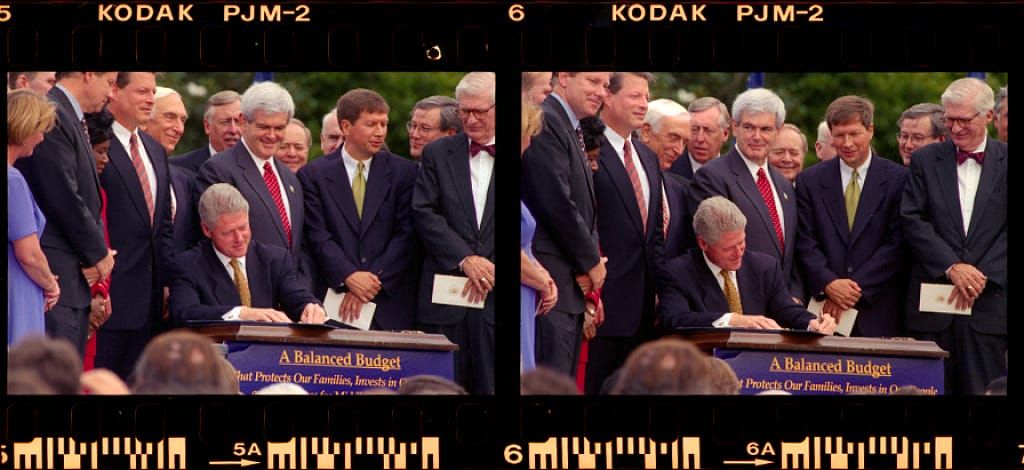
- Omnibus Budget Reconciliation Act of 1993 (OBRA 1993) — President Clinton's deficit reduction package. Raised taxes on higher incomes, expanded the Earned Income Tax Credit, and made various Medicare and other changes. Passed without Republican support, but the frame was still fiscal consolidation.
- Personal Responsibility and Work Opportunity Reconciliation Act of 1996 — Welfare reform. A major policy change, but enacted through reconciliation as part of a broader budget deal with the Clinton administration.
- Balanced Budget Act of 1997 and Taxpayer Relief Act of 1997 — A pair of reconciliation bills negotiated between President Clinton and a Republican Congress. Balanced the budget, created the State Children's Health Insurance Program (S-CHIP), and reduced taxes. Bipartisan.
Through this era, reconciliation was often partisan at the margins, but it produced major bipartisan fiscal deals. Policy changes were layered in, but the primary purpose was fiscal.
Era Two: Tax and Mandatory Spending Policy (2001–2010)
The second era marked a shift. Reconciliation began to be used less for comprehensive fiscal deals and more as a vehicle for specific tax and mandatory spending policy changes — often along party lines.
- Economic Growth and Tax Relief Reconciliation Act of 2001 (EGTRRA) — The Bush tax cuts. Major reductions in individual income tax rates. Because of the Byrd Rule, most provisions were set to expire after 10 years.
- Jobs and Growth Tax Relief Reconciliation Act of 2003 (JGTRRA) — A second round of Bush tax cuts, accelerating and expanding provisions from EGTRRA.
- Deficit Reduction Act of 2005 — Changed Medicaid, student loans, and other mandatory programs. Passed with Vice President Cheney breaking a 50-50 tie in the Senate.
- Tax Increase Prevention and Reconciliation Act of 2005 — Extended key provisions of the Bush tax cuts.
- Health Care and Education Reconciliation Act of 2010 — Part of how the Affordable Care Act was finalized. After the main ACA bill passed through regular order (with 60 Senate votes), reconciliation was used to make modifications and enact additional provisions.
In this era, reconciliation was still used for things with budgetary effects — taxes, mandatory spending — but the bills were more often partisan and more often focused on specific policy goals rather than comprehensive fiscal deals.
Era Three: Party-Line Policy Vehicle (2017–Present)
The third era is defined by reconciliation as the default mechanism for major partisan legislation. When one party controls the White House, the House, and the Senate, reconciliation is how they enact their agenda.
- Tax Cuts and Jobs Act of 2017 (TCJA) — The Trump tax cuts. Permanent corporate tax rate reduction, individual tax changes with scheduled sunsets (Byrd Rule again), and other provisions. Passed entirely along party lines.
- American Rescue Plan Act of 2021 — $1.9 trillion in COVID-19 relief spending. Stimulus checks, expanded unemployment, state and local aid, expanded Child Tax Credit. Passed entirely along party lines.
- Inflation Reduction Act of 2022 — Clean energy tax credits, Medicare drug pricing reforms, new corporate minimum tax, IRS funding. Passed entirely along party lines.
- One Big Beautiful Bill Act of 2025 — Combined an extension and expansion of TCJA tax provisions with major changes to mandatory spending programs including Medicaid, SNAP, and student loans, plus substantial new funding for immigration enforcement and defense. Passed entirely along party lines.
In each case, the bill was the majority party's central domestic policy achievement for that Congress. In each case, it moved through reconciliation because the minority party would not provide the votes needed to overcome a filibuster.
The evolution is stark. In Era One, a reconciliation bill was often the product of a negotiated deal between the White House and Congress, sometimes across party lines. In Era Three, a reconciliation bill is almost always the majority party's policy bill, passed with zero minority support.
Translation: Reconciliation has become the default vehicle for major partisan policy. If you want to understand how big policy gets made in modern Congress, understand reconciliation.
Pro Tip: You've read "10-year budget window" a few times now-let me explain. This refers to the "score" that the Congressional Budget Office (CBO) provides on the legislation. CBO, along with the Joint Committee on Taxation (for, you guessed it, tax stuff), generate estimates on the change in revenue a bill against a current law baseline. They give estimates on the change in outlays in each fiscal year for 10 years. These estimates are used to assess how the bill complies with the targets set out in the reconciliation instructions. The CBO score and the Byrd bath are the two big technical hurdles a provision needs to leap over in order to make it to the finish line.
Fun Fact: Senate rules and precedent have determined that the official title of a bill is "extraneous" under the Byrd rule. These bill names are sometimes absent from the final bill. A Senator can raise a point of order and ask that the extraneous title be struck. Officially, the Inflation Reduction Act is something the communications team can really get behind: "To provide for reconciliation pursuant to title II of S. Con. Res. 14.". And the One Big Beautiful Bill Act, equally sexy: "To provide for reconciliation pursuant to title II of H. Con. Res. 14."
Why Should You Care?
"I don't work on tax or mandatory spending. Why does this matter to me?"
Because reconciliation touches almost everything in the federal budget except annual appropriations. If you work in health policy, energy policy, tax policy, immigration, education financing, or social insurance — reconciliation can affect your area. And even if you don't, reconciliation shapes the overall fiscal landscape that constrains everything else Congress does.
"Is reconciliation the same thing as a budget bill?"
No. A "budget bill" in casual usage often means an appropriations bill, a continuing resolution, or the budget resolution itself. Reconciliation is a specific process for changing mandatory spending, revenues, and the debt limit. Appropriations bills are not reconciliation bills.
"How do I know if a bill is a reconciliation bill?"
The budget resolution will include reconciliation instructions specifying which committees are instructed and what they must produce. We'll cover how to read those instructions in Part 3, and how to read the resulting bill in Part 4.
"Why do reconciliation bills have expiration dates?"
Because of the Byrd Rule. Provisions that increase the deficit beyond the budget window (typically 10 years) violate the rule and can be stripped. Putting a sunset on a tax cut or spending provision is one way to avoid that outcome — the provision expires before it violates the rule.
The Bottom Line
Key takeaways:
- Reconciliation is a fast-track legislative process established by the Congressional Budget Act of 1974
- It can change mandatory spending, revenues, and the debt limit — but not discretionary spending
- Its power comes from the 51-vote threshold in the Senate — reconciliation bills are not subject to filibuster
- The Byrd Rule constrains what can be included — provisions must have more than incidental budgetary effects, can't increase the deficit beyond the budget window, and can't change Social Security
- Reconciliation has evolved through three eras: fiscal consolidation (1980–1997), tax and mandatory policy (2001–2010), and party-line policy (2017–present)
- If you want to understand how major legislation gets passed in modern Congress, understand reconciliation
What's Next
In Part 3, we'll cover reconciliation instructions and referral — how to read the "shall report changes" language in the budget resolution, how committee-by-committee dollar targets work, how multiple committees with overlapping jurisdiction coordinate, and how the Budget Committee assembles the final product. Part 4 will then walk through how to read the resulting bill, including how the Byrd Rule shapes the final text and what happens on the Senate floor.
This is Part 2 of the "How to Read a Reconciliation Bill" series. Part 1 covered the budget resolution — the document that contains the reconciliation instructions. Part 3 will cover how to read reconciliation instructions. Part 4 will cover how to read the final product.
BlazingStar Analytics is building real-time budget execution tracking that connects appropriations, apportionments, and SF-133 reports. Get early access to our platform, launching later in 2026.