Supplemental Appropriations: When Congress Adds Money Mid-Year
The regular appropriations act isn't the last word on a fiscal year. Mid-year, the government's budget gets amended — and supplementals are the main way that happens. Here's how to read one when it lands.
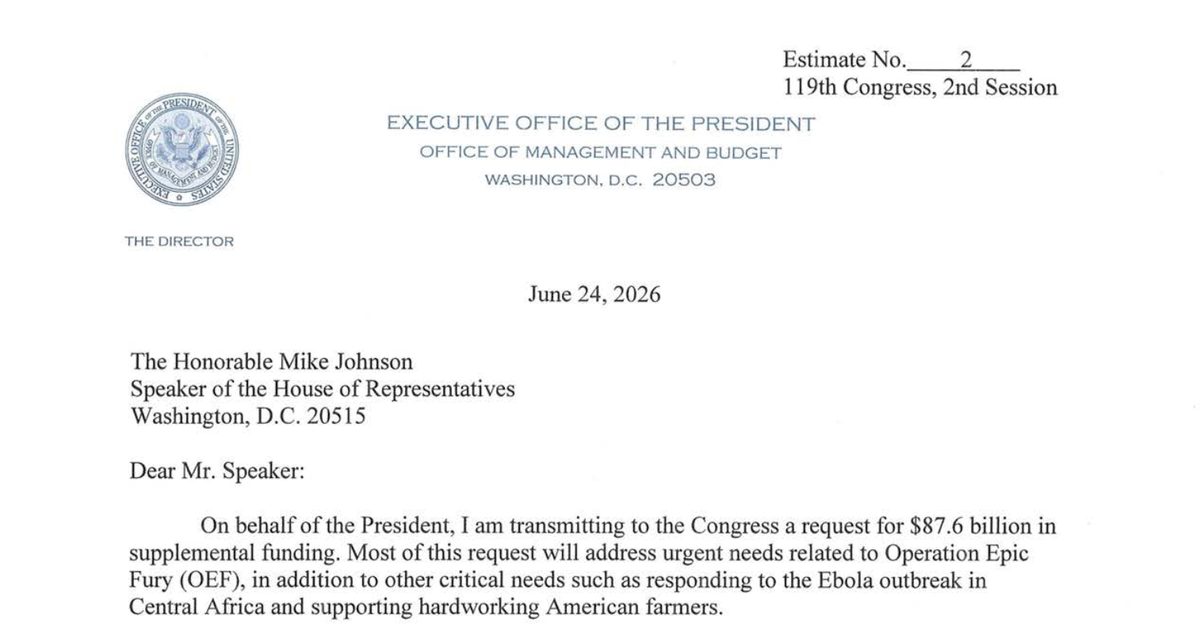
On June 24, 2026, OMB transmitted a letter to Congress requesting $87.6 billion in supplemental funding. While primarily addressing costs from Operation Epic Fury (about $72 billion), the rest ($15.6 billion) is spread across Ebola response, economic assistance for farmers, a modernized Penn Station, GSA elevators, and a fix for certain pensioners — among others.
That's a wide spread of purposes for one document. And that's exactly what a supplemental is: the budget you thought was settled in the regular bills, reopened to add money Congress didn't appropriate the first time around. Part of the reason is timing.
If you know how to read a supplemental request, the structure tells you almost everything before you reach the dollar figures. This post is that structure. We'll use the June 24 request as the worked example throughout, but the mechanics outlast this particular package — the next supplemental will land the same way.
The 60-Second Version
| Term | What it signals |
|---|---|
| Supplemental appropriation | New budget authority enacted after the regular appropriation, during the fiscal year |
| "For an additional amount" | The bill-text tell — money stacked on top of an account that already exists |
| Request ≠ law | What OMB transmits is a request (an "Estimate"). Congress writes the bill. Most of what you'll read this week is the former |
| Emergency designation | Money flagged so it doesn't count against the discretionary spending caps. Watch for it when the bill is drafted — it's a choice, not automatic |
| Authorities | A supplemental can carry policy changes with no dollars attached. Read those too |
| Offset | The pay-for — money raised or pulled back elsewhere to cover the new spending |
Key insight: A supplemental request is a budget document. A supplemental appropriation is a law. The June 24 package is the first kind — OMB asking. Nothing in it is enacted, and Congress is free to fund all of it, none of it, or a different number with different strings. Read it as a proposal, not a done deal.
Pro Tip: A request is optional. Congress can, and has, moved a supplemental funding package without receiving a formal request from the President. Sometimes that comes down to politics, sometimes it's more about insufficient data to articulate a request at the time Congress is moving.
What a Supplemental Is — and Isn't
The regular appropriations process produces twelve bills a year, one per subcommittee, each funding its slice of the government for the fiscal year. A supplemental comes after those are enacted, when something the regular bills didn't cover — a war, a disaster, an outbreak, a bankruptcy settlement — needs money before the next regular cycle. Congress appropriated funding for the military and Department of State in P.L. 119-75 on February 3rd. Operation Epic Fury (OEF) started on February 28. The Ebola outbreak in the Democratic Republic of the Congo and Uganda started in May.
A few distinctions worth keeping straight:
- Supplemental vs. continuing resolution. A CR keeps last year's funding going when the new bills are late. A supplemental adds money on top of bills that already passed. (We covered the CR mechanics in the restaurant metaphor — a CR is ordering "the same as last time"; a supplemental is someone handing you extra cash mid-meal because you didn't realize that market price for lobster and steak was more than the $20 you have on you.) Sometimes the two are packaged together — a CR has often had a disaster supplemental added to it and considered as one bill.
- Supplemental vs. budget amendment. Both arrive as OMB "Estimates" transmitted to the Speaker. An amendment revises a pending request; a supplemental asks for money during the year of execution. The June 24 letter is headed "Estimate No. 2" — the formal serial number these transmittals carry.
- Request vs. enacted. This is the one that trips people up. The administration can only request. The document is a letter plus tables. It becomes spending only if Congress writes it into a bill and the President signs it.
Translation: When you read "the administration requested $87.6 billion," that number is an opening bid, not an appropriation. The interesting question is always what Congress does with it.
Theme and Packaging: A supplemental package often has a theme. You'll hear them referred to as a "disaster supp", "war supp", "Ukraine supp", or "domestic supp" and so on. Congressional leaders will often make a call on scope and theme and drop everything that doesn't fit it. For example, we're in the middle of hurricane season. A hypothetical outcome could be that Congressional leaders sever the $15.6 billion in domestic requests from the OEF requests, consider the OEF requests now, then do a domestic one later when any potential disaster-related costs are fully known.
The Anatomy of the Request
The June 24 package has three parts, and learning to separate them is half the skill.
1. The transmittal letter. Two pages, signed by the OMB Director, addressed to the Speaker. This is the why — narrative justification, top-line numbers, and the political framing. It's where you learn that $87.6 billion breaks down into Operation Epic Fury costs, $1.4 billion for Ebola, $11.1 billion for farmers, and a tail of smaller items.
2. The "Urgent Supplemental Funding Needs" table. Three pages, organized by appropriations bill → agency → bureau → account, with a budget-authority figure and a description for each line. This is the money. The total at the bottom — $87,596,238,000 — is the real ask, down to the dollar.
3. The "Urgent Supplemental Authorities" table. Two pages, same bill-by-bill structure — but no dollar column. This is the authority: legislative changes the administration wants Congress to enact alongside the money. We'll come back to this, because it's the half most readers skip.
Key insight: The funding table is sorted by the same twelve subcommittee bills as the regular process — Defense, Energy and Water, CJS, FSGG, Homeland Security, Interior, Labor-HHS, State-Foreign Ops, THUD, Agriculture. A supplemental doesn't invent a new structure. It reaches into the existing one and stacks money on accounts that are already there.
Reading the Money: "For an Additional Amount"
Here's the single most useful pattern to recognize. When a supplemental adds money to an account that already got a regular appropriation, the eventual bill text won't restate the whole account — it'll open with "For an additional amount for [account name]."
You can see it foreshadowed in the request's own prose. Look at the State Department's Embassy Security, Construction, and Maintenance (ESCM) line:
$300 million to the Embassy Security, Construction, and Maintenance (ESCM) account… These amounts are in addition to the up to $1 billion currently allocated in the ESCM fiscal year 2026 Operating Plan to address Operation Epic Fury.
Read that carefully and you're looking at three layers of money on one account:
1. The base — ESCM's regular FY2026 appropriation, enacted months ago.
2. The operating-plan reallocation — up to $1 billion the agency already steered toward OEF within existing funds (an execution-level move, not new money).
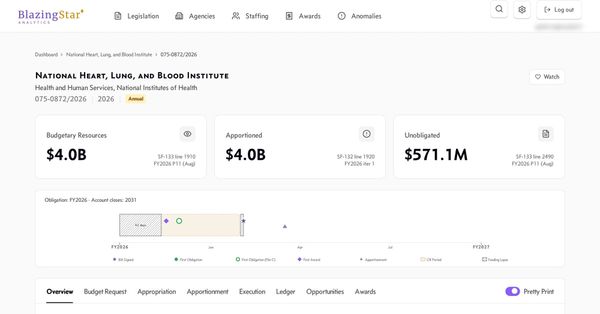
Here's the latest apportionment for the account.
3. The supplemental — this new $300 million on top.
When this becomes bill text, it'll read "For an additional amount for 'Embassy Security, Construction, and Maintenance', $300,000,000…" — and the new money may carry its own availability period and its own provisos, separate from the base.
Here's the statutory construction Congress used when providing supplemental funding for the ESCM account in P.L. 117-128, The Additional Ukraine Supplemental Appropriations Act, 2022:
Two things you need to look at here: "For an additional amount" means that this is in addition to the base appropriation for “Embassy Security, Construction, and Maintenance” for that fiscal year.
Here's the FY 2022 appropriation:
This account is a little tricky — it's actually 2 appropriations in the same account:
- $850,722,000, available until September 30, 2026, For necessary expenses for carrying out the Foreign Service Buildings Act of 1926...
- $1,132,427,000, available until expended, for the costs of worldwide security upgrades, acquisition, and construction as authorized
The supplemental funds are:
- $110,000,000, available until expended, to respond to the situation in Ukraine and in countries impacted by the situation in Ukraine
Nerdy point, but you would match 3 with 2 because their periods of availability are the same. Put these together and you get a composite purpose like this:
- $110,000,000, available until expended, for the costs of worldwide security upgrades, acquisition, and construction to respond to the situation in Ukraine and in countries impacted by the situation in Ukraine.
It's the totality of the two appropriations together that gives you the potential scope of use of those funds.
Translation: When you see "for an additional amount," you are not looking at the whole account. Find the base appropriation. Find any reprogramming already done in the operating plan. Add them together. Then read both sets of strings — they may not match.
The classified lines
Several lines tell you almost nothing on purpose. The Department of War's $67.1 billion includes "$12.1 billion for other classified programs." The FBI's $40 million is "for… classified needs. Additional details… are classified and can be provided in a separate setting." DOE, Treasury, and DHS each have a classified line too.
This is normal, and worth knowing how it reads: a named account, a precise dollar figure, and a description that stops at the edge of what's public. The dollars are real and auditable downstream (not by you, but by Congressional staff with a need to know) even when the purpose isn't published — the figure flows to an apportionment, then onto the account's SF-133, like any other. You might recall seeing apportionment footnotes like this:
A1: A classified attachment displaying the apportionment of specific classified programs within the amount displayed may be included. All documents associated with this apportionment are unclassified except for the Classified Attachment. The classified apportionment shall be allotted in full and executed without change. Such apportionment shall remain valid during the fiscal year until such time as a reapportionment of such classified apportionment is required. Allotments shall be made no later than 30 days after OMB signs the apportionment or the start of the subsequent calendar month, whichever is later. Rationale: Footnote informs that there may be a classified attachment, and provides other related requirements concerning allotments.
That's the tell.
The Other Half: Authorities Without Dollars
Now the part most people miss. The second table — Urgent Supplemental Authorities — has no money column. These are policy changes the administration wants to ride along with the appropriation:
- Updating the statutory definition of hemp-derived cannabinoid products (an Agriculture rider).
- Codifying year-round sale of E-15 (an EPA administrative provision).
- Letting the FAA reallocate the $12.52 billion already provided for air-traffic-control modernization.
- Removing a statutory barrier to the DFC investing in Venezuela.
- Raising SBA loan limits for small manufacturers.
None of these spend a dollar by themselves. They change what existing or requested dollars are allowed to do. This is the same money-vs-authority distinction that runs through every appropriations bill: some text moves money, other text grants or restricts authority. A supplemental is a convenient vehicle for both — which is exactly why riders attach to it.
And the authorities aren't confined to the second table. Watch the Penn Station line in the funding table:
$1 billion… to assist in the final design and construction of a modernized Penn Station… The Administration also requests that 49 U.S.C. 24911(d)(3) not apply to these funds.
That "notwithstanding"-style carve-out is legislative language stapled directly to an appropriation — a limitation waived so the money can move faster. The State Department's "Emergencies in the Diplomatic and Consular Service" line does it too, asking for transfer authority and a higher repatriation-loan ceiling alongside the cash.
Key insight: Read a supplemental for two things, always — the dollars and the authorities. A request can hand an agency new money, new flexibility, or both, and the flexibility often outlasts the money.
Pro Tip: Sometimes when drafting a supplemental provision, Congress will need to turn various parts of the base appropriation off to get the new money to do what it needs to do. In that case you'll see something like "Notwithstanding the second proviso" or "The second, fifth, and eighth provisos shall not apply" or other similar language that turns off terms in the base appropriation.
Where's the pay-for?
Most of this $87.6 billion is new budget authority, unoffset. One line is the exception, and it's instructive — the PBGC / Delphi pension request notes its cost "could be fully offset, or a revenue generator, by accelerating pension insurance premiums." That's an offset: a source of money to cover the new spending. When a supplemental is silent on offsets — as most of this one is — it's leaning on emergency designation instead: a flag that exempts the money from the discretionary caps so it doesn't have to be paid for. Whether these dollars get that designation is a decision Congress makes in the bill text, not something the request settles. The word "Urgent" in the table titles is the rhetorical setup; the budgetary designation is the thing to watch for when the bill appears.
In P.L. 117-128, here's how Congress handled it:
Why One Event Scatters Across the Whole Budget
Here's the part that makes supplementals genuinely hard to track — and the reason "follow the money" is more than a slogan.
Operation Epic Fury is one event. Trace its funding through this request and it lands in at least six different appropriations bills:
| Appropriations bill | OEF-related line |
|---|---|
| Defense | Department of War — $67.1B |
| Energy and Water | DOE / NNSA — $768M |
| Commerce-Justice-Science | FBI — $40M |
| Financial Services | Treasury (Terrorism & Financial Intelligence) — $36M |
| Homeland Security | Coast Guard — $2.03B |
| State-Foreign Ops | State (Diplomatic Programs, ESCM) — $1.8B+ |
One operation, six bills, a dozen accounts, two of them classified. In the regular process those would move as six separate measures on six separate timelines. The supplemental request bundles them — but once enacted, the money disperses right back into six corners of the budget, and reassembling "what did Epic Fury cost?" means knowing every account it touched.
The same happens in a disaster supplemental. You might see appropriations for FEMA, HUD, EPA and Transportation for damage to homes and infrastructure, Agriculture for crop losses, GSA and other agencies for damaged federal facilities, and more depending on the scope and characteristics of the natural disaster.
That reassembly is the whole job. A figure in a transmittal letter is a starting point. The accountability question — did the money go where the letter said? — can only be answered by following each account from request to appropriation to apportionment to outlay.
Why It Matters
Supplementals are where budget discipline is most likely to slip, and not because anyone's hiding anything. They move fast, often attached to must-pass legislation. They carry emergency designations that sidestep the caps. They bundle classified lines, policy riders, and notwithstanding clauses alongside the cash. And they're framed, by design, as too urgent to slow-walk.
That combination — speed, exception, and bundling — is precisely the spending most worth watching closely. Not because urgency is illegitimate; Ebola and a shooting war are real. But "urgent" is also the most effective wrapper for anything you'd rather not see scrutinized line by line. The discipline is to read the package the same careful way regardless of the wrapper: separate the money from the authority, find the base before you judge the addition, and follow each account past the press release.
The Bottom Line
The budget is never finished. The twelve regular bills are a snapshot, and supplementals are the proof that the picture keeps changing all year. Reading one well comes down to a short checklist: it's a request until it's a law; the money and the authorities are two different tables; "for an additional amount" means find the base; and one event can hide in a dozen accounts across half the appropriations bills. Get those four straight and an 87-billion-dollar package stops being a headline number and becomes something you can actually trace.
What's Next
Supplementals are also a scorekeeping problem — emergency designations, cap adjustments, and offsets are all about how this money counts (or doesn't) against the budget's ledgers. That's the next post: how the scorekeepers at CBO and OMB decide what every dollar does to the bottom line.
Keep following the money.
We do this every week. Necessary Expenses goes out Friday afternoons: the week's CFR redlines, executive actions, notable grants, and what we flagged. Free, and that's the whole arrangement.