Continuing Resolutions: An Analytic History (FY2000-2026)
A new continuing resolution drops at 6 p.m. Your inbox lights up: "Have you seen Section 108? Is this new? Should we be worried?" Here's the answer, backed by every first-of-the-year CR since 2000: no.
Every fall, the same thing happens. Congress misses the October 1 deadline, passes a continuing resolution to keep the lights on, and somewhere a budget analyst opens the text, lands on a dense procedural section, and feels their stomach drop. Is this a trap? Did they slip something in? Why does this section exist?
Almost always, the honest answer is the least dramatic one: that section has read the same way for a quarter-century, and nobody slipped anything anywhere. The part of a CR that actually changes year to year is small, specific, and — once you know where to look — easy to isolate from the part that never does.
We read all of it. Every first continuing resolution of the fiscal year, FY2000 through FY2026 — 27 of them, pulled from the same public source, compared line by line. This post is what 27 years of CRs look like when you lay them on top of each other.
Think of it as a cookout. You have a good idea that there's going to be meat on a smoker or a grill, but the sides that go along with it that's less certain.
The 60-Second Version
Every CR is a cookout with four things you can measure:
| What you measure | The cookout | What 27 years shows |
|---|---|---|
| When it's enacted | When the invitations are sent | Almost always at 11:59 (median: 1 day before Oct 1). Twice in 27 years they showed up after dinner started. |
| How long it runs | How long the party lasts | Median ~2 months ("home by the holidays"). Range: a 3-day bridge to a 177-day marathon. |
| The boilerplate | The entrée | The dish everyone comes for. Same recipe, essentially unchanged since the template settled around 2008. |
| The anomalies | The side dishes | The only part that really varies — from 7 in a quiet year to 58 in a messy one. |
Key insight: The entrée is boilerplate — the procedural machinery that makes a CR work, and it barely changes. The sides are the anomalies — the account-specific carve-outs — and they're the only place worth spending your reading time. If a provision scares you, first ask: is this the entrée (relax) or a side (read it)?
When the Party Starts
The first thing to measure is when the invite gets sent out: when did the CR actually become law, relative to the October 1 start of the fiscal year? And it's one of those weird parties where everyone knows that there's going to be an attempt at a cookout every year on October 1st, but no one really knows if Dave got the permit for Pavilion A until the last minute.
Across 27 years, the pattern is almost comically consistent. The median CR was enacted one day before the deadline. Congress shows up at 11:59. Look at the run of dates: September 28, September 29, September 30, September 30, September 30. Year after year, the CR clears with hours to spare.
Twice in 27 years, the CR passed after October 1 had already come and gone — meaning the government was in a funding lapse when it finally cleared:
- FY2014 — enacted October 17, 2013, 16 days late. That's the 16-day shutdown.
- FY2026 — enacted November 12, 2025, 42 days late. That's the long 2025 shutdown, the one we took apart section by section last fall.
And once, a CR arrived strikingly early. FY2018's was enacted September 8, 2017 — 23 days ahead of the deadline, the earliest in the whole set. Why so eager? Because it didn't come alone: it rode along on the post-Hurricane-Harvey disaster relief and debt-limit package. Hold that thought — the 2017 hurricane season is about to show up again, on the other side of the table.
Translation: Enactment date is a decent proxy for how much of a fight the year was. Right at the buzzer is normal. After the buzzer means somebody let it lapse. Earlier usually means the CR hitched a ride on something more urgent.
How Long It Runs
The second measurement is departure: how long does the stopgap actually cover?
The median CR runs about two months — roughly 63 days from October 1, expiring somewhere between mid-November and mid-December. That's the "we'll sort this out after the election and by the holidays" CR, and it's the single most common shape one takes.
But the spread is enormous, and the extremes tell you something:
- The "we'll be right back" bridges. FY2003 and FY2012 each ran three days. These are placeholders on top of placeholders — Congress buying itself a long weekend while a deal firms up.
- The half-year marathons. FY2013 ran 177 days, all the way to March 27. FY2009 ran 156 days, to March 6. When a CR stretches into spring, the "temporary" framing has quietly broken down — the stopgap became the plan for half the year.
Key insight: A short CR is an indication that Congress thinks a deal could be close. A long CR is an admission that it isn't. The duration is Congress telling you how confident it is, in days.
Pro-Tip: A signal of confidence sometimes turns out to be a signal of overconfidence in retrospect. In FY2003, there were 7 CRs - the next 2 were a week each, then a month. While Defense and Milcon passed in October, the Omnibus funding the other 10 bills didn't pass until February.
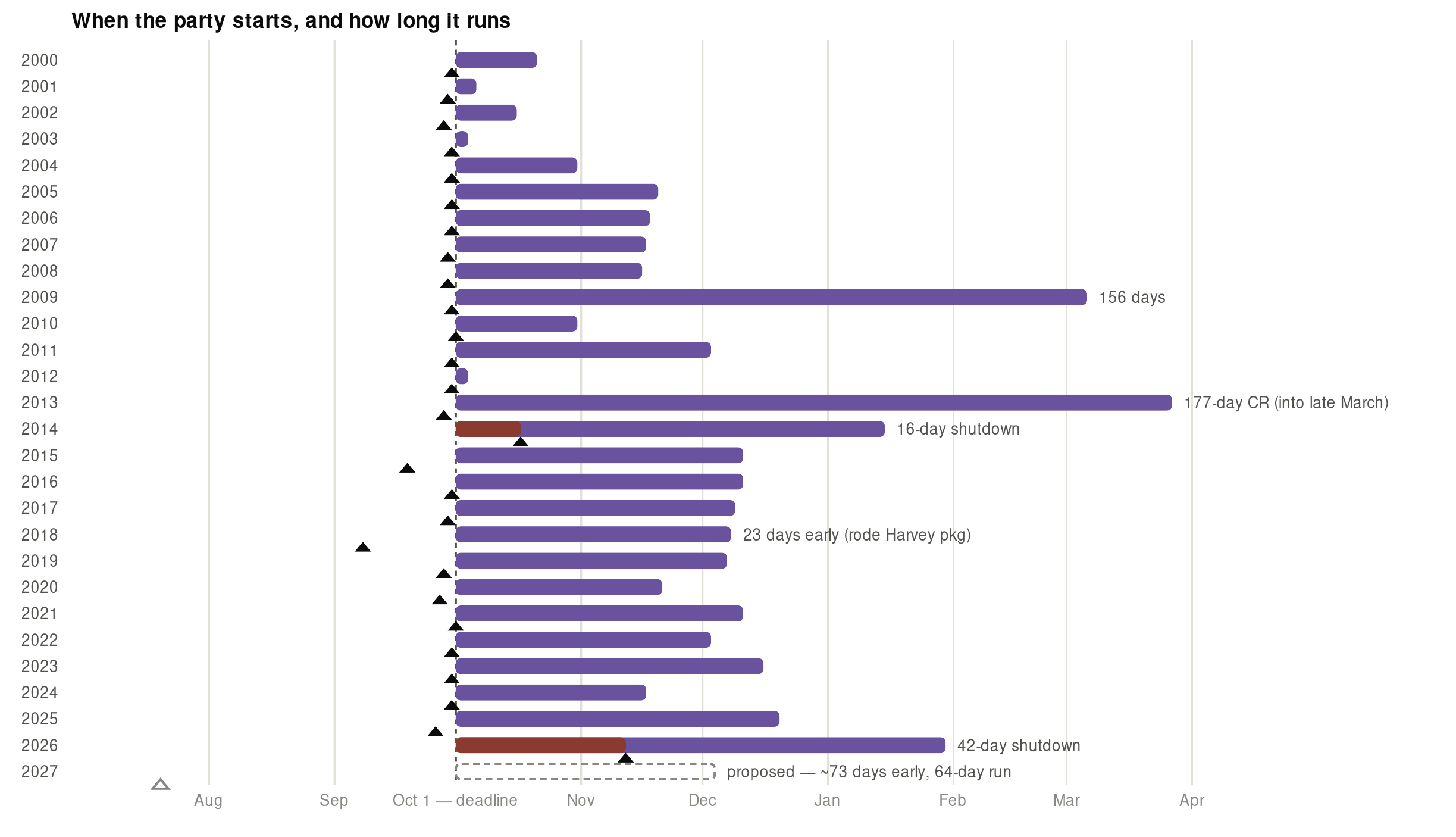
Every first CR, FY2000–2026: the bar is coverage (Oct 1 → expiration), the triangle is the enactment date. Triangles at the deadline line = on time; pushed right into a red segment = a lapse; poking left = enacted early.
Arrival and duration bracket every CR. Now for what's actually inside one.
The Entrée: The Boilerplate
Here's the reassuring part, and it's the heart of the post.
The procedural machinery of a CR — the sections that make the thing legally function — is remarkably, almost boringly stable. The clearest example is the one that panics people most: the time-limitation and apportionment-waiver provision, often landing around "Section 108."
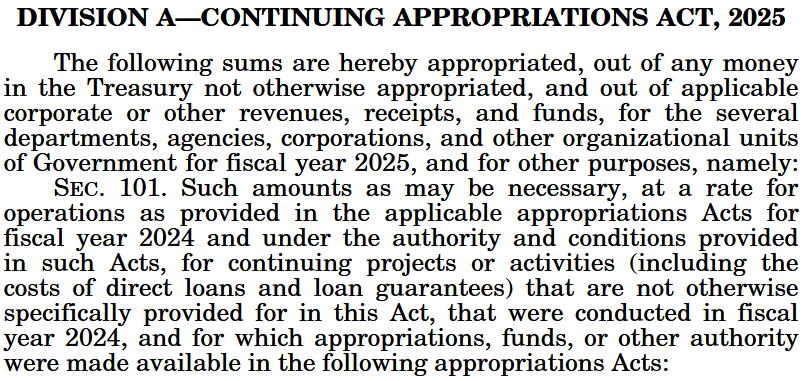
It waives the normal clock on OMB's apportionment process so agencies can actually get money out the door fast under a CR, while explicitly not waiving any other apportionment law. Here it is in the most recent full-year-context CR, FY2025:
Now here's the same provision from FY2000 — Public Law 106-62, enacted in 1999, a full 25 years earlier:
Read those twice. The entire 25-year difference is two cosmetic swaps: "this joint resolution" became "this Act," and "nothing herein shall" became "nothing in this Act may." The operative clause — the part that does the legal work — is word-for-word identical. Not similar. Identical.
That's the whole "should I be terrified of Section 108?" answer, and it's not a similarity score or a vibe. It's the same sentence, 27 years running.
The rest of the entrée is nearly as steady. The continuing-rate formula — "such amounts as may be necessary, at a rate for operations as provided in the applicable appropriations Acts for [last fiscal year]" — is the sentence that makes a CR a CR, telling every covered account to keep spending at last year's pace. It's been in its modern form since FY2011 and stable in substance since around FY2008. Before that, it was phrased differently. That's an honest boundary, not a hidden one: the modern CR template consolidated around 2008, and has held ever since.
You can see that consolidation in the raw counts. The stable procedural spine of a CR runs just 2 to 6 provisions before FY2008, then steps up to 14–20 provisions from FY2008 onward and stays there. The recipe got finalized once, and then it stopped changing.
Translation: The machinery that keeps money moving under a CR is not where the action is. It was written, it settled, and it's been on autopilot for 15 years. A "scary" section that belongs to this spine is almost never the story.
You can see the whole thing at once. Here's every standing provision (Sec. 101–115) across 27 years, colored by whether its wording changed:
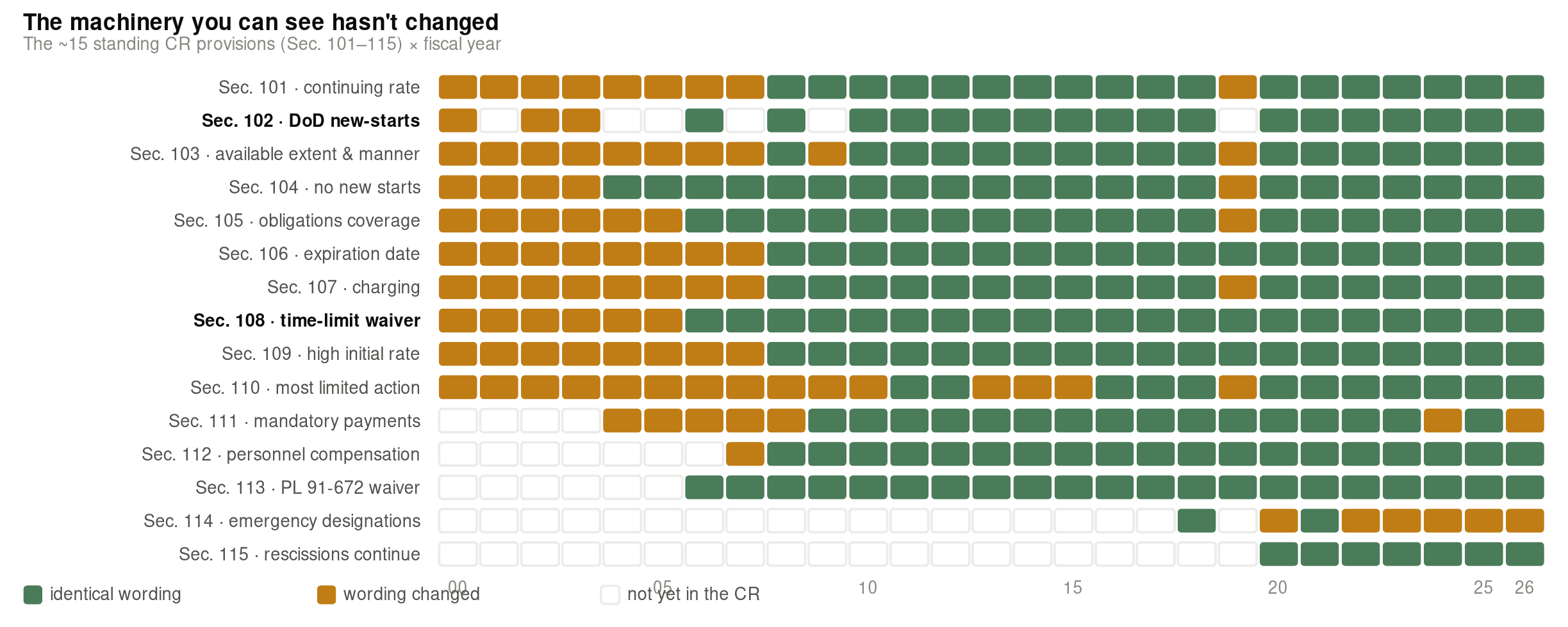
The takeaway you can read off the chart in one glance: a field of green. The DoD new-production restriction (Sec. 102) is byte-identical every year it appears — 18 of them. This is the visual answer to "is this section new?"
The Sides: The Anomalies
So if the entrée never changes, what does? The sides. The anomalies — account-specific and program-specific exceptions to the "just keep doing last year" rule.
This is the part everyone means when they say a CR "has stuff in it." An anomaly might let one account spend faster than the prorated rate, set a specific dollar figure, extend an expiring authority, or appropriate genuinely new money. (If you want the five flavors of anomaly with worked examples, that's the how-to-read-a-CR post. Here we're counting them across time.)
And the count moves. A lot:
| Era | Sides on the table (anomalies) |
|---|---|
| Early 2000s (FY2000–2003) | 7–9 |
| Mid/late 2000s (FY2004–2008) | 18–34 |
| The two biggest — FY2009 and FY2021 | 58 and 52 |
| 2010s (FY2010–2019) | 21–49 |
| 2020s normal years | 17–43 |
Let me be careful about the shape here, because it's tempting to call this an "explosion" and it isn't one. It's a regime change followed by a noisy plateau. In the early 2000s, a first CR carried single digits of anomalies — a spare table. Then, in the mid-2000s, the number stepped up into the 20s and 30s and stayed there, bouncing between roughly 20 and 60 for the last 15 years. It spikes in the chaotic years — FY2009 in the teeth of the financial crisis, FY2021 coming out of a shutdown and a pandemic — and settles back down after.
So the honest sentence is: the side dishes multiplied once, around the mid-2000s, and have swung between a light spread and a loaded table ever since, piling up in the messy years. Congress didn't slowly lose discipline. It changed how it uses CRs, roughly two decades ago, and has been consistent about it since.
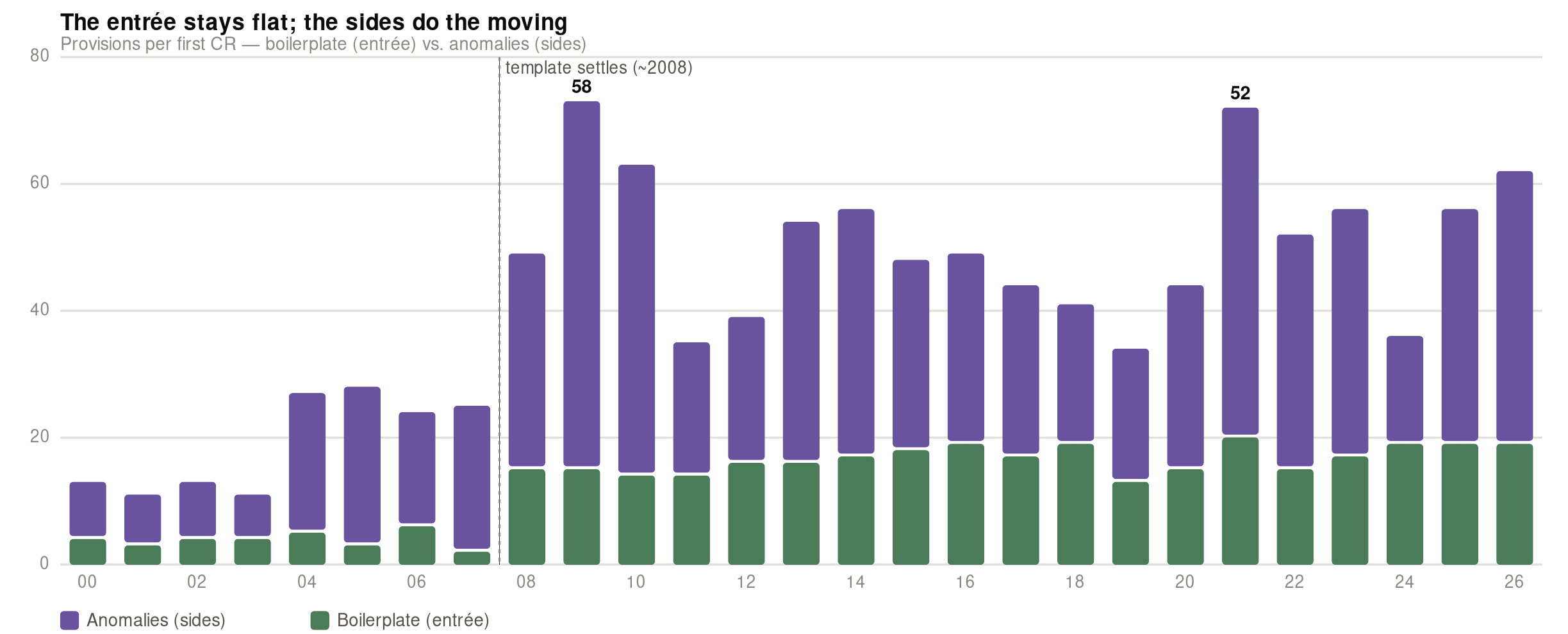
The entrée (green boilerplate) settles around 2008 and barely moves after. The sides (purple anomalies) are the whole story — single digits early, then a noisy 20–60 plateau that spikes in the messy years.
(One honest caveat, carried from the analysis: a handful of these years — FY2009, FY2019, FY2021, FY2026 — are laws that bundled the CR together with full-year appropriations and other divisions. We isolated the CR division by hand for those, and the totals for the biggest bundled years may tighten by a provision or two on a later structural pass. The trend and the entrée findings don't move.)
WARNING: If you were reading this article in 2007, it would have read basically the same. This cookout is a snooze! Hamburgers, turkey burgers, and brats for decades! But unbeknownst to you, Uncle Stanley bought a smoker this spring and when you show up to the cookout it's only smoked brisket and pork shoulder. That might be an awesome change of pace, but if you have Alpha-gal syndrome it's a real letdown. In 2008, Congress did the same thing and changed the form and structure of the CR. The intent is generally the same, but the words were different. If your livelihood or reputation depend on words in the CR, you need to read those words. It's the same words until it isn't.
Regular Sides vs. One-Time Sides
Here's the part that actually makes you good at reading a CR — and it's the answer to "is this new?" that a sharp client is really asking.
Not every anomaly is new. When you group all 27 years of anomalies by the specific account they name, they split cleanly into two kinds.
The regular sides (calcified anomalies)
Some "anomalies" started as genuine exceptions and then showed up so many years running that they became fixtures — the dish that's now just expected at the table. Technically still an anomaly. If you go to a cookout, you wouldn't be surprised to see potato salad and coleslaw. These anomalies are those sides.
The cleanest example is the one whose origin we already flagged. The FEMA Disaster Relief Fund gets an accelerated-apportionment carve-out — permission to spend as fast as disasters require, instead of the prorated CR trickle:
This provision has appeared in every first CR from FY2018 through FY2026 — nine straight years, word-for-word. And its first appearance, FY2018, is the same CR that arrived three weeks early riding the Hurricane Harvey package. The 2017 disaster season added it, and it never came off. So if you open the next CR, find this section, and wonder whether it's new — it hasn't been new since 2017.
The DRF isn't alone. Across the corpus, 35 account-level anomaly lineages recur in four or more years, and several run on real-world clocks you can predict:
- The perennial — District of Columbia Funds appears in every first CR for 23 straight years (FY2004–2026), the longest-running fixture of them all. The reason is structural: the District has to be able to spend its own locally raised money even during a federal lapse, so the carve-out is effectively permanent.
- The quadrennial cluster — the GSA Presidential Transition account (plus National Archives and the Secret Service) lights up on the election-and-inauguration cycle: FY2009, FY2013, FY2017, FY2021, FY2025. Every four years, like clockwork, because presidential transitions are a known, scheduled expense.
- The decennial ramp — the Census Bureau's periodic-programs account swells as each decennial census approaches (it recurs FY2009–2011 and again around FY2018–2021). The count comes every ten years; so does the anomaly.
- The disaster-and-fire cluster — the DRF, alongside Forest Service Wildland Fire Management, recurring on the rhythm of a country that has fire seasons and hurricane seasons whether or not Congress has passed its bills.
Key insight: A recurring anomaly isn't a red flag — it's a calendar. Transitions, censuses, and disaster seasons are predictable, and the CR quietly budgets for them the same way every cycle. "It's an anomaly, but it's been there every year since FY____" is a sentence you will say a lot, and it should lower your blood pressure, not raise it.
The one-time sides (true one-offs)
And then there's the genuinely new dish — the provision that is unique to one year and one situation. These are the ones actually worth your full attention.
Of the roughly 296 distinct accounts that show up as anomalies across all 27 years, about 201 appear exactly once. The vast majority of named carve-outs are true one-offs. Some are consequential; some are almost touchingly specific, like the FY2025 memorial payments:
Nobody is confused about whether this one recurs. It is the definitional one-off — a specific appropriation for a specific circumstance in a specific year. When you find something like it, you're looking at the actual news in the CR.
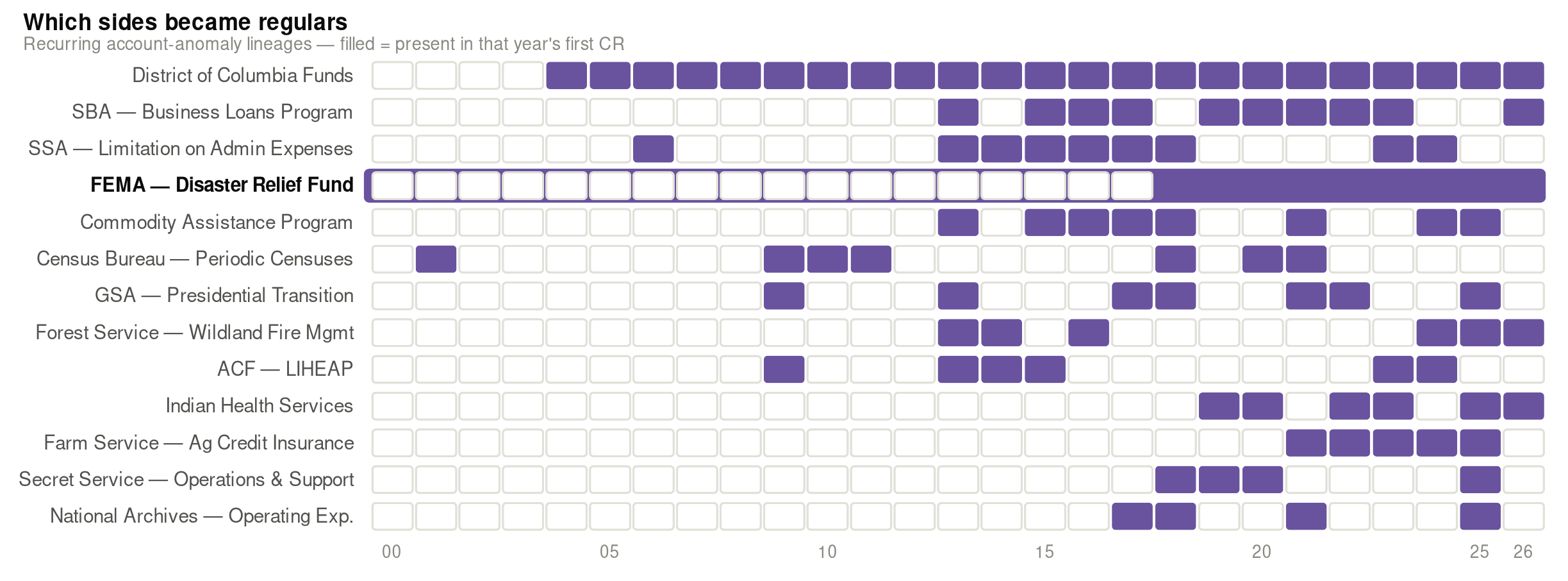
The calcified minority: 13 of the 35 account lineages that recur across the 27 years. District of Columbia Funds anchors the top (23 straight years); the FEMA Disaster Relief Fund runs solid from FY2018; the transition and census rows keep time with the election and census calendars.
This is the skill. When a new CR lands and someone asks "is this section new?", you're really sorting the table into three piles: entrée (the boilerplate — 27 years old, relax), regular side (a calcified anomaly — been there for years on a known cycle, relax), or one-time side (a true one-off — this is the news, read it closely). Ninety percent of what scares people is in the first two piles.
How We Know (and How You Can Check)
A post that tells you "relax, it's boilerplate" is only worth anything if you can verify it yourself. So here's exactly how this was done, and where the receipts are.
- One source, all 27 years. Every CR came from the same place: the GovInfo public-law plain text. Same source, same format, FY2000 through FY2026. Fully re-fetchable.
- We matched on words, not section numbers. Section numbers drift year to year (the DRF carve-out is "Section 134" one year and something else the next), so the analysis anchors on the text of each provision, not its label.
- We disclosed exactly what we normalized. To compare provisions across years, we masked the tokens that are supposed to change — the fiscal year, dates, dollar amounts, public-law citations, and whether the vehicle calls itself an "Act" or a "joint resolution." Those aren't substantive edits, and we kept the raw text so anyone can check. Nothing hides behind a similarity score.
- When the data disagreed with the story, the data won. One example, in the open: the DRF carve-out is quoted with a "Department of Homeland Security—" prefix in FY2018–19 and without it in FY2020–26. That briefly split one nine-year fixture into two rows and nearly cost us the "since 2018" claim. We canonicalized the account names (dropping the redundant department prefix when a sub-agency is already named), and the row now reads what the prose reads: nine straight years. That fix is documented, with the DRF as the worked example.
- This analysis was AI-assisted. The extraction, normalization, and cross-year matching were done with AI assistance over a deterministic pipeline — no black box deciding what counts as "the same." The method is auditable and the underlying texts are public.
Here are direct links to the source text:
| FY | Public Law | Enacted | Expires |
|---|---|---|---|
| 2026 | P.L. 119-37 | 11/12/2025 | 1/30/2026 |
| 2025 | P.L. 118-83 | 9/26/2024 | 12/20/2024 |
| 2024 | P.L. 118-15 | 9/30/2023 | 11/17/2023 |
| 2023 | P.L. 117-180 | 9/30/2022 | 12/16/2022 |
| 2022 | P.L. 117-43 | 9/30/2021 | 12/3/2021 |
| 2021 | P.L. 116-159 | 10/1/2020 | 12/11/2020 |
| 2020 | P.L. 116-59 | 9/27/2019 | 11/21/2019 |
| 2019 | P.L. 115-245 | 9/28/2018 | 12/7/2018 |
| 2018 | P.L. 115-56 | 9/8/2017 | 12/8/2017 |
| 2017 | P.L. 114-223 | 9/29/2016 | 12/9/2016 |
| 2016 | P.L. 114-53 | 9/30/2015 | 12/11/2015 |
| 2015 | P.L. 113-164 | 9/19/2014 | 12/11/2014 |
| 2014 | P.L. 113-46 | 10/17/2013 | 1/15/2014 |
| 2013 | P.L. 112-175 | 9/28/2012 | 3/27/2013 |
| 2012 | P.L. 112-33 | 9/30/2011 | 10/4/2011 |
| 2011 | P.L. 111-242 | 9/30/2010 | 12/3/2010 |
| 2010 | P.L. 111-68 | 10/1/2009 | 10/31/2009 |
| 2009 | P.L. 110-329 | 9/30/2008 | 3/6/2009 |
| 2008 | P.L. 110-92 | 9/29/2007 | 11/16/2007 |
| 2007 | P.L. 109-289 | 9/29/2006 | 11/17/2006 |
| 2006 | P.L. 109-77 | 9/30/2005 | 11/18/2005 |
| 2005 | P.L. 108-309 | 9/30/2004 | 11/20/2004 |
| 2004 | P.L. 108-84 | 9/30/2003 | 10/31/2003 |
| 2003 | P.L. 107-229 | 9/30/2002 | 10/4/2002 |
| 2002 | P.L. 107-44 | 9/28/2001 | 10/16/2001 |
| 2001 | P.L. 106-275 | 9/29/2000 | 10/6/2000 |
| 2000 | P.L. 106-62 | 9/30/1999 | 10/21/1999 |
The honest caveats: the anomaly totals for the few bundled, multi-division laws (FY2009, FY2019, FY2021, FY2026) are hand-isolated and may shift by a provision or two on a later pass. The entrée findings — Section 108's 27-year identity, the continuing-rate stability — never touched that segmentation and don't move.
Why Should You Care?
"A new CR just dropped. Which sections do I actually need to read?"
Skip the procedural spine — it hasn't changed since 2008. Go straight to the account-specific sections (the anomalies), and within those, find the ones naming your agency or program.
"My client is panicking about Section [whatever]. Is it new?"
Check whether it's boilerplate machinery (almost certainly old) or an account-specific carve-out. If it's a carve-out, check whether that account is a recurring fixture (transition, census, disaster) or a genuine one-off. Most panic dissolves at step one.
"But, I'm writing a memo, I can't be wrong."
Pull up last year's CR and compare them. If something's load bearing, you should absolutely compare this year's text to last year's text.
"How serious is this year's funding fight?"
Look at the arrival and the duration. Enacted after October 1 means a lapse. A CR running into spring means no deal is close. A three-day CR means one may be.
"Is Congress sneaking more into CRs over time?"
Not really — not the way people think. The count of anomalies stepped up once, in the mid-2000s, and has been noisy-but-flat since. The messy years (crises, shutdowns) carry more; the quiet years carry fewer. It's responsive, not a ratchet. Duration also matters; longer CRs often require more anomalies.
The Bottom Line
Key takeaways:
- A continuing resolution has an entrée and sides. The entrée is the boilerplate machinery; the sides are the anomalies.
- The entrée barely changes. The apportionment-waiver provision ("Section 108") is word-for-word identical across all 27 years. The template settled around 2008 and has held.
- The sides are the only real variable — from 7 anomalies in a quiet year to 58 in a crisis year. They stepped up in the mid-2000s and have plateaued, noisily, ever since.
- Not every anomaly is new. 35 account lineages recur for years, several on predictable cycles (transitions every four years, the census every ten, disasters every season). Most of the rest — roughly 201 of about 296 named accounts — are true one-offs.
- The reading skill is sorting the table into entrée / regular side / one-time side. The first two are almost always fine. The third is where the news lives.
- Arrival and duration tell you the temperature of the fight: at-the-buzzer and two months is routine; after-the-buzzer or into-the-spring is not.
What's Next
If this post is the 30,000-foot view — 27 years at once — the companion piece is the ground-level one: how to actually crack open a single CR, section by section, and read the anomalies for yourself. Together they're the whole skill: know what never changes, so you can spend all your attention on what does.
Keep following the money.
We do this every week. Necessary Expenses goes out Friday afternoons: the week's CFR redlines, executive actions, notable grants, and what we flagged. Free, and that's the whole arrangement.
Not keen on another newsletter? Our public archive of fiscal data is at: data.blazingstaranalytics.com.