The Rescission Package, Account by Account: What the Money Had Been Doing
Two weeks ago we launched BlazingStar Analyst. On launch day, someone asked in the comments of our LinkedIn post whether it could show pocket rescissions. They'd heard that HUD's housing counseling grant money might be caught in one.
I gave the short answer there: "If you're in month 11 of the fiscal year, and an account has 80% unobligated funds in it, how does that compare to prior years? If it's just like prior fiscal years, you've got an account that executes late. If it's usually sitting around 10% unobligated, then you've got a signal."
This post is the long answer. It's the math, account by account.
First, the term. A rescission is an enacted law canceling money Congress had already appropriated.
Congress enacts rescissions routinely in annual appropriations bills. Take a look at the general provisions of most appropriations bills and you'll find examples of rescissions. The President also outlines rescissions they would like Congress to take up in the budget request each year. A rescission, enacted through this process isn't that exceptional.
What's less common are formal rescission requests from the President. Under the Impoundment Control Act, the President can propose one or many in a special message sent to Congress, and the money can be held back while Congress considers it, for 45 days of "continuous session," a count that skips congressional recesses. If Congress hasn't passed a rescission bill by then, the law says the money must be made available. The same law also says it does not supersede any other law that requires the money to be obligated.
"Pocket rescission" is what many are calling a proposal, sent close enough to September 30 such that Congress's 45-day consideration period outlasts the period of availability of the money. Money in its last year of availability expires on September 30; after that it can no longer be newly obligated.
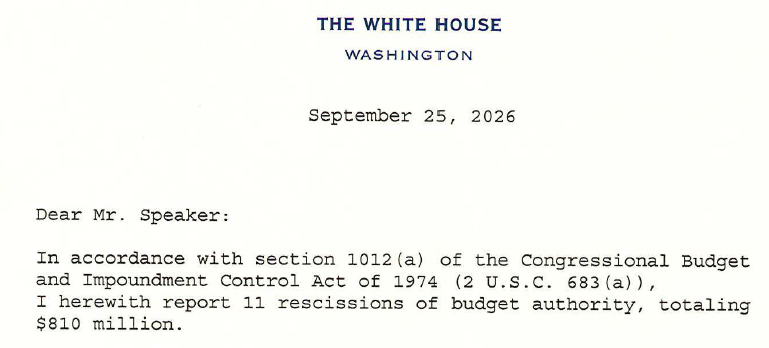
On September 25, the President sent Congress a special message proposing that they rescind $809,501,022 from eleven pots of federal funding, every one of them in its last year of availability. Five days later, the fiscal year ended.
On September 29, the Government Accountability Office, Congress's auditor, sent Congress its review of the message. GAO's preliminary review found that all 11 accounts expire at the end of fiscal year 2026, and that the period for congressional consideration "will end no earlier than November 9, 2026." It wrote: "The Constitution vests in Congress the power of the purse, and Congress did not cede this important power through the ICA." Its conclusion: the proposals "do not permit the President to withhold the appropriations beyond the end of fiscal year 2026." GAO added that its conclusion "should not be interpreted as taking a position on the policies or programs contained in the special message." OMB Director Russell Vought responded on X the same day.
We don't break news. We do math and stitch the files together. And the first question everyone asks, was that money just sitting there?, is a math question.
Here's the trouble with that question. Plenty of money sits unobligated in August. That's not a scandal. For many programs, agencies obligate a large share of their money in the final weeks of the fiscal year, and anyone who has worked a September in a budget office or a procurement shop can tell you about it.
So "was there a lot left?" is the wrong question. The right one is narrower and more useful: was this account further behind than this account usually is, at the same point in its life? That question has an answer, and the answer is public.
The 60-Second Version
-
What happened. On Sept. 25, the President proposed rescinding $809,501,022 from 11 accounts, all in their last year of availability. The fiscal year ended five days later.
-
What GAO said. On Sept. 29, GAO, Congress's auditor, concluded that the proposals "do not permit the President to withhold the appropriations beyond the end of fiscal year 2026."
-
Each account against its own history. As of August 31, 4 of 11 accounts were further behind on obligating funds than at the same point in any prior year on file. 2 more were just above their highest prior year, with last year close behind. 4 were within their own prior range. 1 has no comparable prior year.
-
Below the account. Inside the accounts, the record for 6 of the 11 programs shows more, in three ways. 2 (both at Education) never had the proposed money apportioned by OMB to the program's own line all year; it was held on "Unallocated" until it was withheld. Both accounts looked normal overall; the gap is inside them. 2 others had no funding notice for this year's money. 2 posted competitions with no awards yet: one closed applications and was then withheld whole; the other's case comes with caveats.
-
What OMB recorded. Every account in the package got a new apportionment on Sept. 28, 29 or 30 with a line reading "Withheld pending rescission", equal to the proposed amount to the dollar.
-
What we don't know yet. How each account finished the year. That's in the September SF-133, which hasn't been published.
Key insight: An unobligated balance means nothing until you compare it with something. The best comparison often isn't another account. It's the same account, in prior years, at the same point in its life.
Pro Tip: You're going to see us compare accounts to execution at the end of August. You might be thinking, "Well, aren't these BlazingStar folks just a bunch of layabouts!". There are a few reasons for this: 1) At the time the rescission request was transmitted, August data was the most recent available. 2) While fiscal year 2026 is over, execution data for September is not yet available. We expect to see that data in November.
How We Measured It
Every month, agencies report the status of each pot of money to OMB and Treasury on a form called the SF-133, the Report on Budget Execution and Budgetary Resources. Two lines carry this whole post:
- Line 1910, total budgetary resources: everything the account had available to it this year.
- Line 2490, unobligated balance: the part of that not yet committed to a contract, grant, salary, or anything else.
Divide the second by the first and you get the share still unobligated. We read it at the end of August, the most recent month published.
Then the comparison. Each proposal names a specific TAFS (Treasury Appropriation Fund Symbol: one account's money for one period of availability). Every one was in its final year of availability in FY2026, the last year the money could be obligated. So we compared each one with the same account's earlier money at the same point in its life: its final year, read in August, for every year on file from FY2019 to FY2025. Up to seven comparisons per account. Where a comparable year doesn't exist, we say so and don't substitute anything.
One adjustment for money that lasts more than a year: we measure what's left against what the money started with (line 1910 in August of its first year), not against what was left by its last year. Otherwise a year when the agency obligated most of the money early looks like a small year. For one-year money the two are the same thing.
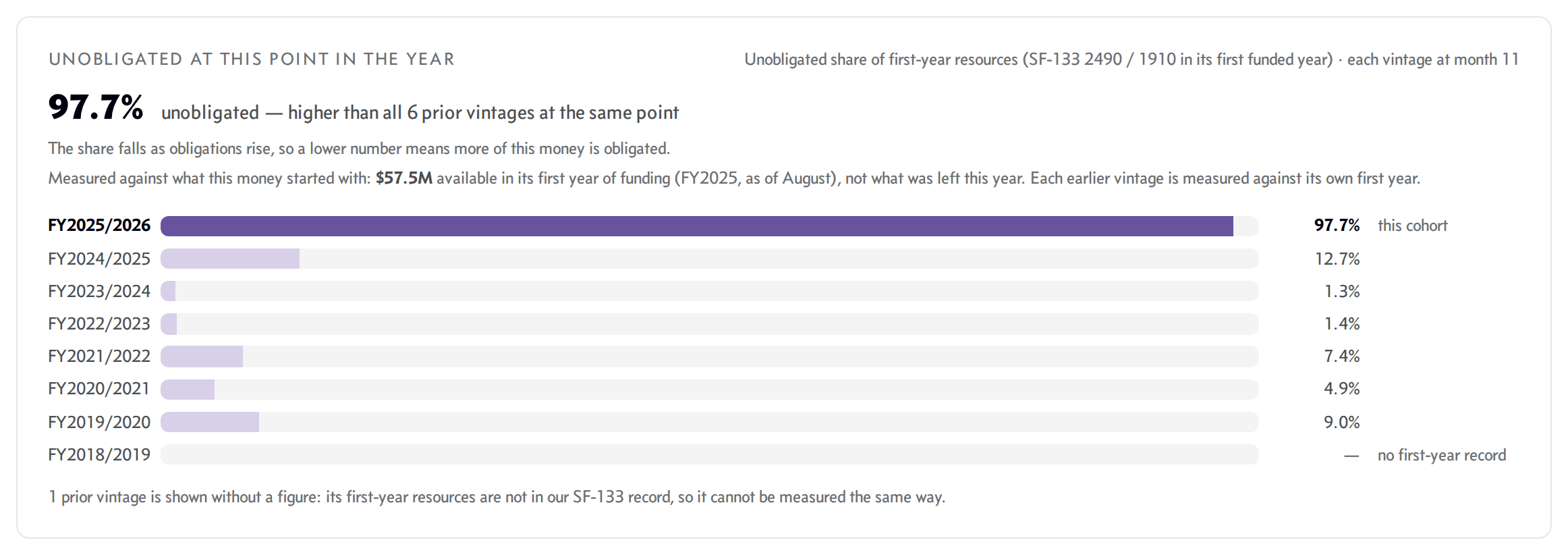
Translation: HUD's two-year housing counseling money for FY2025–2026 started with $57.5 million. We asked how much of that was still unobligated in August 2026, its last year, and compared it with the same measure for the FY2024–2025 money in August 2025, the FY2023–2024 money in August 2024, and so on back.
As the Pro Tip says, August is not year-end. In these same accounts' prior years, the median share still unobligated after September ran between 0% and 11%, so "further behind in August than in any prior year" is a statement about August, not about what happened next.
What the Record Shows
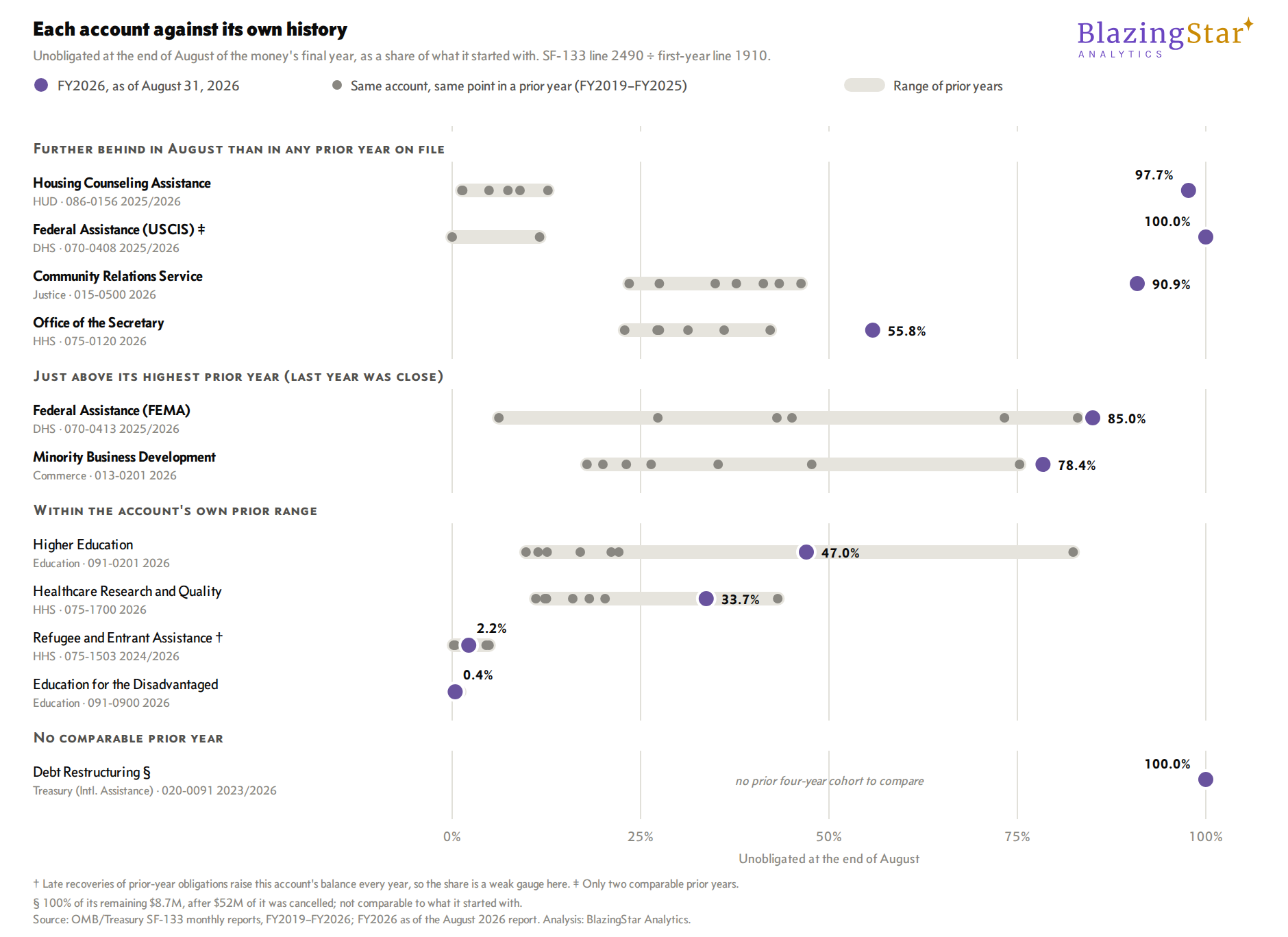
Four accounts were further behind in August than in any prior year on file, most of them by a wide margin:
- Housing Counseling Assistance (HUD): 97.7% of its $57.5 million still unobligated, against 1.3–12.7% for every earlier year on file. More on this one below.
- USCIS Federal Assistance (DHS): 100% of its $10 million, against 11.6% and 0.0% for the only two comparable years. The FY2023–2024 money had 89% of its $25 million obligated in its first year alone.
- Community Relations Service (Justice): 90.9%, against 23.5–46.3%. In prior years this account had obligated $9.1M–$16.1M by August. This year, $1,727,687 of $19.0M. OMB's February 26 apportionment put $16.9 million of the $20.0 million in the fourth quarter, available from July 1; in FY2022–2024 the fourth quarter held 13–26%.
- Office of the Secretary (HHS): 55.8%, against 22.9–42.2%. The prior years, in order: 27.3% in FY2022, 31.3% in FY2023, 36.1% in FY2024, 42.2% in FY2025.
Two were just above their highest prior year, with last year close behind:
- FEMA Federal Assistance (DHS): 85.0% of the $780 million it started with, against 6.2–83.0%. It obligated $117 million in its first year, then nothing in FY2026 through August. Last year's money was at 83.0% in August, and then obligated $663 million in September. For the account as a whole, that's a September question. But the proposal is $15 million of it, all for one program, and that program's record says more. The program-level record is below.
- Minority Business Development (Commerce): 78.4%, against 17.9–75.3%. FY2025 was 75.3%. FY2025's money ended its final year with 67.7%, or $46.2M, still unobligated.
Four were within their own prior range (that is, in line with their own history), and that half of the result is just as real: Higher Education (Education, 47.0%), Healthcare Research and Quality (HHS, 33.7%), Education for the Disadvantaged (Title I, 0.4% of a $10.9B account), and Refugee and Entrant Assistance (HHS, 2.2% of the $6.3 billion it started with, against 0.2–4.9%). We wouldn't lean on that last one in either direction: this account takes in large recoveries of prior-year obligations late in the year, which raise what's left without changing what it started with.
One has no comparable prior year. Treasury's Debt Restructuring money is four-year money, and the only earlier four-year cohort had nothing left in its fourth year. The proposed rescission was equal to the account's entire remaining balance, $8,704,713, after a $52 million permanent reduction earlier in the year.
| Account | Unobligated, Aug 2026† | Prior Augusts (years) | Proposed rescission | Compared with its own history |
|---|---|---|---|---|
| HUD, Housing Counseling Assistance R26-10 · 086-0156 2025/2026 | 97.7% | 1.3–12.7% (6) | $56,100,000 | Above every prior year |
| DHS, USCIS Federal Assistance R26-3 · 070-0408 2025/2026 | 100% | 0.0–11.6% (2) | $10,000,000 | Above every prior year (2 years only) |
| Justice, Community Relations Service R26-5 · 015-0500 2026 | 90.9% | 23.5–46.3% (7) | $15,000,000 | Above every prior year |
| HHS, Office of the Secretary R26-11 · 075-0120 2026 | 55.8% | 22.9–42.2% (7) | $5,098,000 | Above every prior year (rising trend) |
| DHS, FEMA Federal Assistance R26-2 · 070-0413 2025/2026 | 85.0% | 6.2–83.0% (6) | $15,000,000 | Just above prior high (FY2025 close) |
| Commerce, Minority Business Development R26-7 · 013-0201 2026 | 78.4% | 17.9–75.3% (7) | $10,000,000 | Just above prior high (FY2025 close) |
| Education, Higher Education R26-8 · 091-0201 2026 | 47.0% | 9.8–82.4% (7) | $69,588,896 | Within range |
| HHS, Healthcare Research and Quality R26-9 · 075-1700 2026 | 33.7% | 11.1–43.2% (7) | $27,700,000 | Within range |
| HHS, Refugee and Entrant Assistance R26-1 · 075-1503 2024/2026 | 2.2% | 0.2–4.9% (5) | $567,401,904 | Within range (weak gauge) |
| Education, Education for the Disadvantaged R26-4 · 091-0900 2026 | 0.4% | 0.0–1.0% (7) | $24,907,509 | Within range |
| Treasury, Debt Restructuring R26-6 · 020-0091 2023/2026 | 100%§ | none | $8,704,713 | No comparable year |
† As a share of what the money started with (line 1910 in August of its first year). § Of what remained after a $52 million cancellation; not comparable to what it started with.
Source: OMB/Treasury SF-133 monthly reports, FY2019–FY2026; FY2026 as of the August 2026 report. Proposed amounts: OMB apportionments, line 6180, Sept. 28–30, 2026.
Below the Account: Four Indicia
An account can hide a program. FEMA's Federal Assistance account had $663 million to work with in FY2026. The proposal is to rescind $15 million of it, all for one program. The account's August number says nothing about that program.
So we went one level down, to the programs the special message names. We look at four indicia, each in public data:
- 1. No awards from this year's money. Prior years' money produced grant awards. This year's produced none through August. Where it shows: Treasury/OMB SF-133 (BlazingStar shows it) · award data on USAspending.
- 2. It never reached its program line. Apportioned to "Unallocated," then withheld. Where it shows: OMB's apportionments.
- 3. No funding notice. Every prior year's money had a grant competition. This year's didn't. Where it shows: grants.gov · USAspending.
- 4. A notice, no awards, then withheld. The agency posted a competition and applications closed. No awards followed, and the whole amount was withheld. Where it shows: grants.gov · USAspending · OMB's apportionments.
1. No awards from this year's money
USAspending's award data records which pot of money each grant was paid from. For three of the package's grant programs, last year's money produced awards and this year's produced none through August:
- USCIS Citizenship and Integration Grants: 66 awards ($20.0 million) from the FY2022 money, 65 ($22.4 million) from FY2023, 36 ($10.0 million) from FY2024. From the FY2025 money in the package: none. (USCIS's own page for the FY2023 round reports "over $22 million in grants to 65 organizations," which matches.)
- HUD Housing Counseling: 164 grants from the prior money (FY2024–2025). From the money in the package: none.
- Higher Education, International Education and Foreign Language Studies: 225 awards from the FY2023 money, and the same 225 again from the FY2024 money (multi-year grants, funded each year). From the FY2026 money: none.
2. Never reached its program line
Before an agency can obligate money, OMB has to apportion it, releasing it on a signed, public form called the SF-132. OMB doesn't just release money; it releases it into categories. Category A releases money by quarter. Category B releases it by program, project, or activity, on a line with the program's name on it. And there's a third place money can sit: line 6100, "Unallocated," which is apportioned but assigned to nothing in particular. Money held back pending a rescission goes on yet another line, 6180, "Withheld pending rescission." Money on that line can't be obligated. (More on that line at the end.)
For nine of the eleven proposals, the withheld money came out of the account's regular apportionment lines in the same apportionment that withheld it, dated Sept. 28, 29 or 30 depending on the account. For Housing Counseling, Minority Business Development, Debt Restructuring, and part of Refugee and Entrant Assistance, it came off a program (Category B) line. For Community Relations Service, Healthcare Research and Quality, and USCIS, it came off the fourth-quarter (Category A) line. For FEMA and the HHS Office of the Secretary, whose money had been apportioned in earlier quarters, OMB added a negative fourth-quarter line for the exact amount.Four of the quarterly accounts (Community Relations Service, Healthcare Research and Quality, USCIS, and the Office of the Secretary) are apportioned by quarter every year, so the absence of a program line there is normal.
The other two, both at Education, are different. In each, the money in the proposal never reached its program line all year. It sat on Unallocated, and went from there to line 6180.
Title I: Special Programs for Migrant Students. In FY2022 through FY2024, this program's money went onto its own line in the first apportionment after the appropriation was enacted, 24 to 42 days after the bill was signed: $48.1 million in April 2022, $52.1 million in February 2023, and $52.1 million in April 2024. In FY2026 the line got $181,701 on April 3, then $421,701 on May 19, then $27,215,491 on June 16, and never more. That same June 16 apportionment put the other $24,907,509 on line 6100, Unallocated, under a footnote:
"available for obligation upon reapportionment to an applicable Category B line"
Translation: this money is apportioned to nothing in particular. It can't be obligated until OMB signs another apportionment putting it somewhere.
The agency's own SF-133 shows the same $24,907,509 as unapportioned from June onward. On September 29, it moved to line 6180, withheld pending rescission. Add the two pieces together, $27,215,491 + $24,907,509, and you get $52,123,000: the program's full amount in each of FY2023, FY2024 and FY2025.
Higher Education: International Education and Foreign Language Studies, Domestic Programs. In FY2022 through FY2024, this program's full amount went onto its line 24 to 43 days after enactment: $71.9 million, $75.4 million, and $75.4 million. In FY2025 the line was $0 in every apportionment. In FY2026 it peaked at $500,280. Meanwhile the account's Unallocated line, which held $3.50 billion on March 6, shrank as other programs were released. By September 18 it held exactly $69,588,896. That's the same day the overseas half of the same program got its full $10.3 million. On September 29, the $69,588,896 moved to line 6180.
Parking money on an Unallocated line isn't unusual by itself. Some agencies do it every year, and the number of federal accounts with money parked on Unallocated rose from 6 in FY2022 to 33 in FY2026. Education parked money on Unallocated across many accounts in FY2026 and released almost all of it by late September. Of the money that expired on September 30, the only amounts still parked there at the end were the two in the package.
3. No funding notice
Most federal grant money goes out through a competition: the agency posts a notice of funding opportunity on grants.gov, takes applications, and makes awards. For two programs in the package, every prior year's money had a notice. This year's didn't.
USCIS Citizenship and Integration Grants. USCIS posted a funding notice for this program's money every year from FY2009 through FY2024. The last was posted May 15, 2024. No notice has been posted for the FY2025 funds, the money in the rescission package. OMB first apportioned the money in May 2025, across all four quarters. Its first apportionment for fiscal 2026, on Sept. 30, 2025, moved all $10 million to the fourth quarter, available from July 1, 2026. The special message itself says DHS "has already paused the program."
DHS Case Management Pilot Program (the $15 million inside FEMA's account). One notice, and one award, for each year's money: $15 million for FY2022, $20 million for FY2023, $15 million for FY2024, with the last notice posted October 22, 2024. No notice and no award for the FY2025 money. USAspending's transaction records show something more: on February 10, 2025, all four earlier awards (EMW-2022-CM-00005, EMW-2023-CM-00001, EMW-2023-CM-05000, and EMW-2024-CM-05002) were cut on the same day, each back to roughly what had already been paid out, $47.2 million in all. The FY2023 and FY2024 awards now stand at $0. As of August, that's three straight years of this program's money with nothing net obligated.
No notice doesn't mean there was no way to fund these programs. Agencies have other ways to make awards. What the record shows is narrower: a notice for every prior year's money, and none for this year's.
4. A notice, no awards, then withheld
The agency posted a competition and applications closed. No awards followed, and the amount was withheld.
- HUD Housing Counseling ran a $56.1 million competition for exactly the money included in the rescission proposal, and then the whole amount was withheld. That's the Spotlight below.
- Higher Education, International Education and Foreign Language Studies posted a $70 million competition under the same program in June 2026 (applications June 5 to July 7). No awards under the program have come from the FY2026 money. The notice doesn't say which year's money it would use, so this is the same program in the same year, not necessarily the same dollars.
- HHS Office of the Secretary, Office of Minority Health awards late in the year: in FY2022–2025, 40 to 65 of its awards each year (most or all of them), and 75–100% of its grant dollars, came in September. It posted two competitions in June 2026, $3.0 million (National Lupus Outreach) and $2.0 million (Center for Indigenous Innovation and Health), and applications closed in July. No awards had come from the FY2026 money by the end of August, and USAspending shows no award action under its main grant listing at all from June 1 through October 14. On September 25, the special message proposed rescinding $5,098,000 from the Office of the Secretary's FY2026 General Departmental Management funding, of which, it said, Congress had set aside $75 million in report language for the Office of Minority Health. On September 29, OMB's apportionment put that amount on line 6180, withheld pending rescission. The money's availability ended September 30. (The two notices total $5.0 million; the grants.gov listings don't say which year's money they would use.) Through August, the Office's grant program, Community Programs to Improve Minority Health, shows no award at all from the FY2026 money.
One program that might look like it belongs here doesn't. Title I's migrant education programs (HEP and CAMP) did run their FY2026 competitions: $11.55 million and $13.01 million, posted May 13, 2026 by the Labor Department's Employment and Training Administration on Education's behalf.
All eleven, side by side
| Program | 1. No awards / still unobligated | 2. Never reached its line | 3. No notice | 4. Notice, no awards |
|---|---|---|---|---|
| HUD Housing Counseling R26-10 | ✅ | — (on its line from Oct 1) | — | ✅ |
| Higher Ed: Intl. Education & Foreign Language R26-8 | ✅ (no awards) | ✅ | — | ✅ (same program, same year) |
| Title I: Migrant Students R26-4 | — (account 0.4%) | ✅ | — (competition ran) | — |
| USCIS Citizenship & Integration R26-3 | ✅ | n/a (quarterly) | ✅ | — |
| DHS Case Management Pilot R26-2 | ✅ (no awards; account just above its prior high) | n/a (quarterly) | ✅ | — |
| DOJ Community Relations Service R26-5 | ✅ | n/a (quarterly) | n/a (salaries) | n/a |
| Minority Business Development R26-7 | just above prior high (FY2025 close) | n/a (one line) | — (notices went out May 29) | — (awards made) |
| Debt Restructuring R26-6 | ✅ (no comparable year) | n/a | n/a (not a grant program) | n/a |
| HHS Office of the Secretary R26-11 | ✅ (on a rising trend) | n/a | — (notices went out in June) | ✅ (late awarder; see above) |
| Healthcare Research and Quality R26-9 | — (account within range; program awards down since FY2025) | n/a (quarterly) | partial (no new notice since Jan. 2025; standing announcements open to Mar. 25, 2026) | — |
| Refugee and Entrant Assistance R26-1 | weak (recoveries move both lines) | n/a (account-wide) | — (notices went out) | — |
✅ = present in the record. — = checked, not present. Weak = present but not telling. n/a = the test doesn't apply. Sources: OMB/Treasury SF-133 (as of August 2026), OMB apportionments, grants.gov, USAspending.
Spotlight: Housing Counseling Assistance
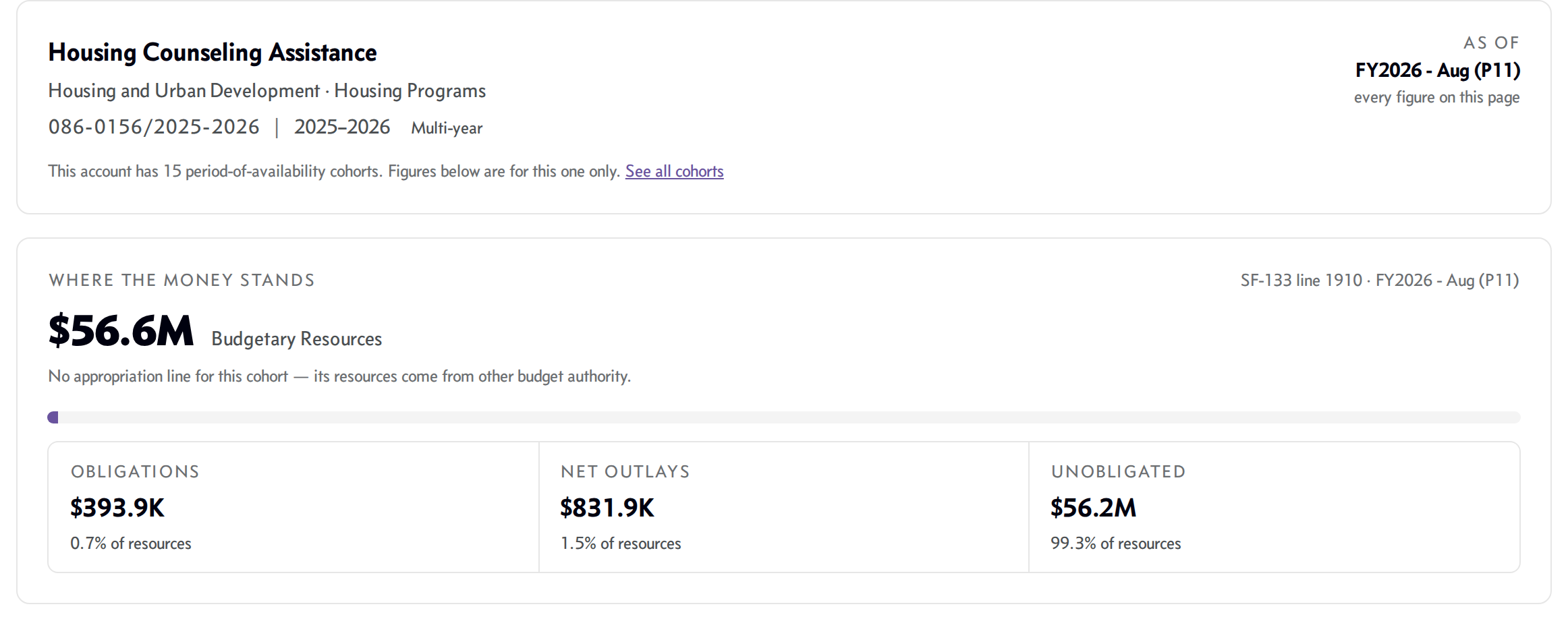
This is the program the launch-day question asked about.
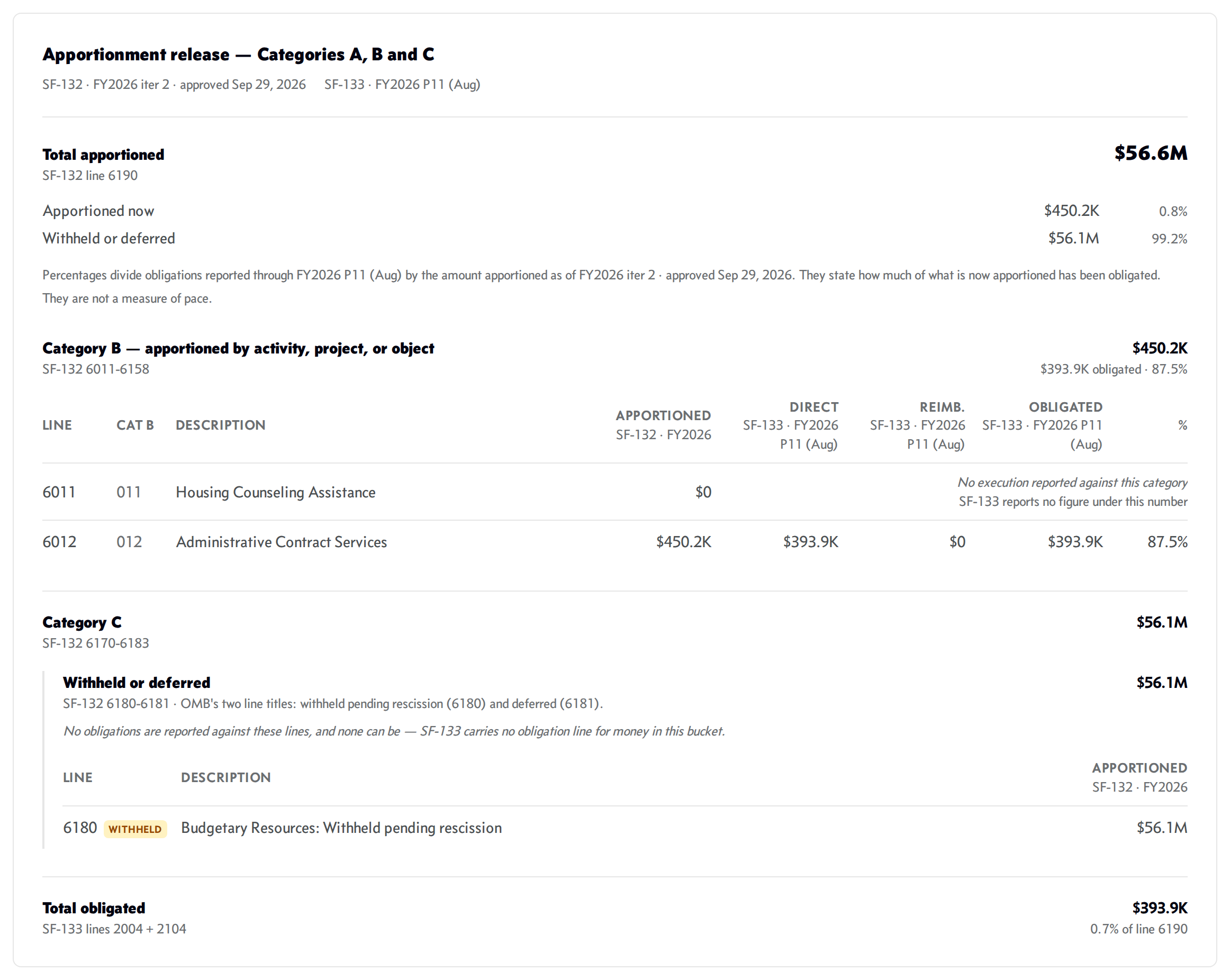
- October 1, 2025. OMB's first apportionment of the year for this two-year money puts $56,100,000 on the Housing Counseling Assistance line, available immediately, and $450,248 on a separate line for administrative contract services.
- March 26, 2026. HUD posts a funding notice for this money, FR-6900-N-33, titled "(FY2025)," for $56,100,000, with about 175 awards expected. Earlier notices in the series were posted 8 to 16 months into their money's life; this one, 18 months.
- May 26, 2026. Applications close, four months before the money's availability ends.
- August 31, 2026. $393,919 of $56,550,248 obligated (what was left of its $57.5 million after $0.95 million was obligated in its first year), all of it administrative: 99.3% unobligated (97.7% of the $57.5 million the money started with). No grants from this money. In the three rounds before it, awards came about three to four months after applications closed.
- September 29, 2026. A new apportionment moves the Housing Counseling Assistance line to $0 and puts $56,100,000 on line 6180, withheld pending rescission. The administrative line stays at $450,248.
The withheld amount equals the program line, to the dollar. USAspending shows 164 grants from this program's prior money, and none from this money.
One more thing in the record: HUD posted its FY2026 housing counseling notice, $53.0 million, on April 22, 2026, four weeks after the FY2025 one. That money isn't in the package.
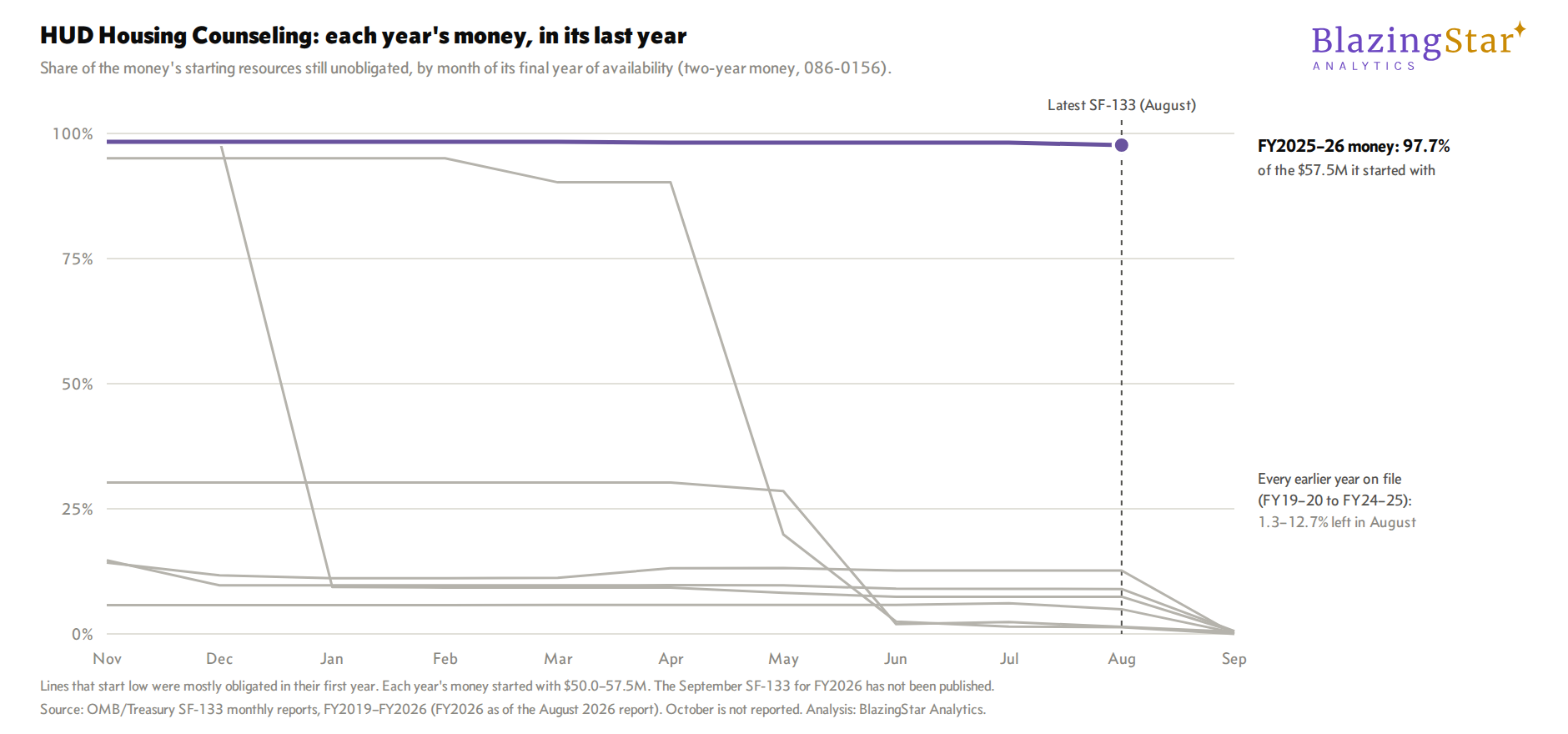
Now the honest check. In the final-year numbers alone, this account looks like it has had slow years: in August 2020, 2021, and 2025 it was 61–79% unobligated. But those weren't small or slow years. Every year's money started with $50.0–57.5 million, and in those years HUD had already obligated most of it in the money's first year, so there was little left for the last. Measured against what each year's money started with, every earlier year on file had 1.3–12.7% left by August of its last year. This year's money had 97.7%. The $949,752 obligated in the money's first year shows up in USAspending as three contracts, for oversight and quality control, housing counselor training and certification, and research services, to the cent. That is what took the account's administrative contract services line from $1.4 million to the $450,248 still on it in 2026.
| Contract (opens on USAspending) | Type | Obligated from this money, FY2025 |
|---|---|---|
| Oversight and quality control services | Delivery order | $576,517.37 |
| Housing counselor training and certification | Delivery order | $328,703.58 |
| Agency and participant research service | Purchase order | $44,531.25 |
| Total | $949,752.20 | |
| SF-133, FY2025 final, line 2190 (obligations) | $949,752.20 |
Amounts are the part of each order obligated from the 2025–2026 Housing Counseling money; the orders also draw on other years' money. Source: USAspending.gov (agencies' award-to-account reports) and OMB/Treasury SF-133.
OMB Wrote It Down
The special message went to Congress on September 25. Over the next five days, OMB put it on its own record.
Every one of the eleven TAFS got a new apportionment signed between September 28 and September 30. Every one carries line 6180, "Budgetary Resources: Withheld pending rescission." And in every case, the amount on line 6180 equals the proposed rescission to the dollar. The transmittal and the paperwork match, account by account.
GAO's review notes the same step. It cites an OMB reapportionment letter dated September 25 and says OMB "issued a reapportionment letter for the affected accounts, withholding the amounts proposed for rescission from obligation." The apportionment files that carry it, line by line, are dated September 28, 29 and 30.
That's not an inference from spending patterns. It's OMB's own signed record, filed in public. You can open each one:
| Account | Apportionment signed | Line 6180, withheld pending rescission |
|---|---|---|
| Refugee and Entrant Assistance R26-1 | Sept. 30, 2026 OMB file | $567,401,904 |
| FEMA Federal Assistance R26-2 | Sept. 29, 2026 OMB file | $15,000,000 |
| USCIS Federal Assistance R26-3 | Sept. 29, 2026 OMB file | $10,000,000 |
| Education for the Disadvantaged R26-4 | Sept. 29, 2026 OMB file | $24,907,509 |
| Community Relations Service R26-5 | Sept. 29, 2026 OMB file | $15,000,000 |
| Debt Restructuring R26-6 | Sept. 28, 2026 OMB file | $8,704,713 |
| Minority Business Development R26-7 | Sept. 29, 2026 OMB file | $10,000,000 |
| Higher Education R26-8 | Sept. 29, 2026 OMB file | $69,588,896 |
| Healthcare Research and Quality R26-9 | Sept. 29, 2026 OMB file | $27,700,000 |
| Housing Counseling Assistance R26-10 | Sept. 29, 2026 OMB file | $56,100,000 |
| Office of the Secretary R26-11 | Sept. 29, 2026 OMB file | $5,098,000 |
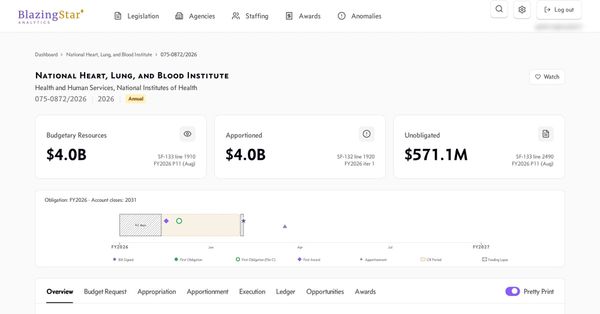
Each date opens the apportionment on our free public data site, which shows every line of OMB's filing and links to the original. "OMB file" is OMB's own spreadsheet. Every FY2026 apportionment is browsable at data.blazingstaranalytics.com.
Key insight: Line 6180 is the detector. If you want to know whether money is being withheld pending a rescission proposal already sent to Congress, you don't have to infer it from a slow spending curve. Read the apportionment.
What We Don't Know Yet
The September SF-133, the year-end report for FY2026, hasn't been published. It comes after agencies finalize their year-end numbers; last year's final version on OMB's site is dated December 3, 2025, after a lapse in appropriations, including OMB's own, that ran from Oct. 1 until Nov. 12, 2025. The three before it were dated in November. We expect it in November. It will settle three things:
- Whether any of the "behind" accounts caught up in September. Plenty of accounts obligate heavily in their last month. These might have. The August numbers can't tell you.
- Whether FEMA's account did what it did last year. Last year's money obligated $663M in one month, September 2025. (The $15M program in the proposal is covered under Below the Account.)
- What happened to Refugee and Entrant Assistance's late recoveries. When an agency cancels or reduces an obligation from an earlier year, the freed-up money is a recovery, and it comes back to the account as budgetary resources. OMB's November 2025 apportionment (the file covers several pots of money; this is the 2024–2026 column) counted on $400 million in anticipated recoveries and $670 million in total budgetary resources. Its September 30 apportionment, the one that withheld $567.4 million, lists $563 million in actual recoveries and $833 million in total. The August SF-133 showed $272 million in recoveries to date. The year-end report will show the rest.
Separately, by GAO's count, the period for Congress to act on the special message ends no earlier than November 9, 2026.
When it lands, we'll come back and report what actually happened, account by account, same method.
Why It Matters
"Is this account's money being held back?"
Read the apportionment, not the spending curve. Line 6180 says so directly. Line 6100, "Unallocated," with a footnote requiring reapportionment, says money is parked. Both are public, signed, and dated. We flag notable apportionment restrictions and make them public. So do the folks at Protect Democracy.
"An account is 80% unobligated in August. Is that a problem?"
Compared with what? Pull the same account's prior years at the same point in their life. If it usually sits at 10%, you've got something worth asking about. If it's always 80% in August and near zero by the end of September, you've got a September account.
"Is the program actually getting its money?"
Look below the account. Check the program's line on the apportionment, its funding notices on grants.gov, and its awards on USAspending. Each one is public. Joined together, they tell you whether this year's money is moving the way last year's did.
"Can I say the money would have gone unused?"
Not from August data. Say what the record shows: further behind than any prior year on file, as of August. Then wait for the September report.
The Bottom Line
- Measure an account against itself. An unobligated balance means nothing until you compare it with the same account at the same point in prior years.
- As of August, 4 of the 11 accounts in the package were further behind than in any prior year on file: Housing Counseling Assistance, USCIS Federal Assistance, Community Relations Service, and the HHS Office of the Secretary. Two more (FEMA and Minority Business Development) were just above their highest prior year, with last year close. Four were within their own range, and one has no comparable year.
- Two Education amounts never reached their program lines. They sat on "Unallocated" until they were withheld. Education released almost everything else it had parked there by late September.
- Go below the account. Six of the eleven programs show at least one program-level indicium: money parked on Unallocated, no funding notice, or a competition with no awards before the whole amount was withheld.
- OMB recorded every withholding on line 6180, "Withheld pending rescission," to the dollar, in public apportionments signed Sept. 28–30.
- September decides the rest. We'll report it when the year-end SF-133 posts.
How We Know (and How You Can Check)
- Execution data: the monthly SF-133 files published by OMB and Treasury on MAX, FY2019–FY2026. ⚠️ OMB replaces the FY2026 file in place each month, so the links below will serve the September report once it posts. Every FY2026 figure here is from the August 2026 report. We archived that copy and recorded its SHA-256 fingerprint, so anyone can confirm the file we used.
- FY2026 files: Commerce · Justice · International Assistance Programs · Homeland Security · Health and Human Services · Housing and Urban Development · Education
- The Impoundment Control Act: 2 U.S.C. 682–683 for the special message and the 45 days; 2 U.S.C. 681 (§1001(4)) for the clause on other laws requiring obligation.
- Line 6180: OMB Circular A-11 §112 defines it as budgetary resources withheld from obligation pending congressional action on a rescission proposal; 31 U.S.C. 1517(a)(1) bars obligating more than is apportioned.
- Apportionments: OMB's public apportionment site, linked per account in the table above, and mirrored on our free public data site, data.blazingstaranalytics.com, where each filing opens as a page and links back to OMB's original.
- Funding notices: grants.gov, linked per notice above. To check a missing notice yourself, search grants.gov by Assistance Listing: 97.010 (USCIS Citizenship and Integration), 97.102 (DHS Case Management Pilot), 14.169 (HUD Housing Counseling).
- Awards: USAspending.gov award data, from agencies' own reports of which account each award was paid from: USCIS Federal Assistance (070-0408) and Housing Counseling Assistance (086-0156). The Case Management Pilot awards are linked above by award number.
- The special message: the President's September 25, 2026 rescission message, published by OMB in the Federal Register on September 30 (document 2026-19965, full text, searchable). The signed original is also posted as a PDF on whitehouse.gov.
- GAO's review: B-338788 (full text, PDF), September 29, 2026, "Impoundment Control Act of 1974: Review of the President's Special Message of September 25, 2026."
- Every cell checked. All 44,940 SF-133 values behind this post (every pot of money in the 11 accounts, FY2019–FY2026, 11 lines, every month) were compared against OMB's published files. Zero mismatches.
- What we measured: line 2490 in August of the money's final year ÷ line 1910 in August of its first year (what it started with), for the TAFS each proposal names, against the same measure for that account's earlier money. Debt Restructuring is the one exception, because $52 million of it was cancelled rather than obligated. Nothing was substituted where a comparable year was missing.
- How this was made. The analysis was AI-assisted, over deterministic scripts whose outputs were checked against the source files above. The first draft was AI-assisted too. I edited and polished it, and I stand behind every number in it.
What's Next
So, to the question from launch day: can BlazingStar show a pocket rescission? It shows you the account running behind its own history, and OMB's own line saying the money is withheld pending rescission. The rest, the funding notices and the awards, is public too, on grants.gov and USAspending. You just have to join it. If there's an account you'd like to see this way, that's what it's for.
A note on blog timing: We're slowing our roll. Expect new blog content about twice a month.
Up next: The Office of Management and Budget has the most staff of any component inside the Executive Office of the President. We're going to do a 2-part series on the structure of OMB. One post on the Budget side and another on the Management side. Impactful, important, poorly known.
Keep following the money.
We do this every week. Necessary Expenses goes out Friday afternoons: the week's CFR redlines, executive actions, notable grants, and what we flagged. Free, and that's the whole arrangement.
Not keen on another newsletter? Our public archive of fiscal data is at: data.blazingstaranalytics.com.
Learn more about the platform that links all this data together at: www.blazingstaranalytics.com