Understanding OMB, Part 1: The Resource Management Offices

Every apportionment ends with a signature line. Behind it is a ladder of people. That same ladder governs how budget-related decision making happens at OMB.
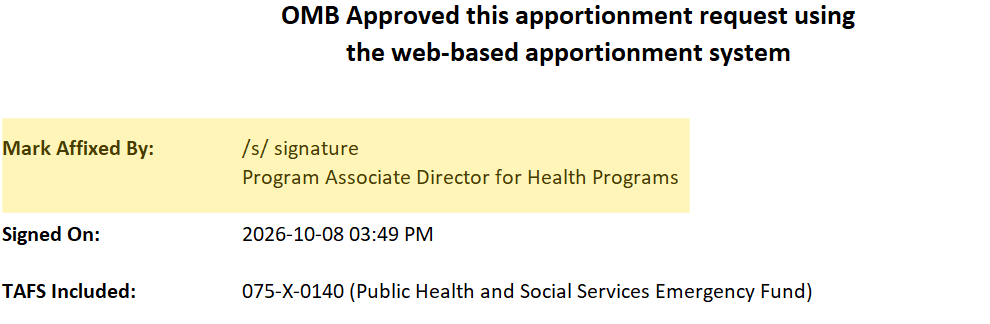
On October 8, at 3:49 in the afternoon, OMB approved an apportionment for the Public Health and Social Services Emergency Fund, HHS's account for public health emergencies, preparedness, and response. It was the first apportionment of fiscal year 2027 for that account. It had no footnotes and nothing unusual about it.
There's a line on the second tab of the Excel sheet that most people never read:
Mark Affixed By: Program Associate Director for Health Programs
If you've been following along, you've followed the money from the law that appropriates it to the apportionment that releases it (What Is an Apportionment?). The apportionment is the last box before an agency can obligate a dollar. Someone signed it.
But one name on a signature line hides the whole ladder of people who touched that apportionment before it was signed, and the people above it who could have. Most people picture OMB as one building with one opinion. It's a ladder, and your agency's money climbs it.
So let's climb it, starting from the bottom.
The 60-Second Version
| Rung | Career or political | On your apportionment |
|---|---|---|
| Program examiner | Career | Reads and reviews the agency's request and makes a recommendation |
| Branch chief | Career | Reviews the examiner's work; settles most issues |
| Deputy Associate Director (DAD) | Career senior executive | Runs a division. Signed apportionments through February 2025 |
| Program Associate Director (PAD) | Political, not Senate-confirmed | Runs a Resource Management Office. Signs apportionments now |
| Executive Associate Director (EAD) | Political, not Senate-confirmed | Coordinates the PADs. |
| Deputy Director | Political, Senate-confirmed | Runs the budget side day to day |
| Director | Political, Senate-confirmed | Owns the President's Budget. Holds the apportionment authority the law gives the President |
Key insight: The first three rungs are career. Everything above them is political. The signature line tells you which side of that line signed, and since February 2025, the answer has changed from DAD to PAD. Prior to the first Trump administration DADs signed apportionments, then the First Trump began delegating approval to PADs. The Biden Administration switched it back to DADs, then the second Trump administration switched it back to PADs.
Author's Note: This post relies on "The Office of Management and Budget: An Insider’s Guide" from the White House Transition Project. It also relies on my personal experience as Associate Director for Housing, Treasury, Commerce and then PAD for General Government Programs during 2023-2025. As I prepared for my role as HTC PAD, I read the Guide. Together, these two sources should give you an approximation of how things work.
-Joe
The Map: One Paragraph, Then We Climb
OMB sits in the Executive Office of the President. On the budget side, the work is organized into Resource Management Offices (RMOs), each covering a set of agencies. The RMOs are where your agency's budget actually gets read. Alongside them, the Budget Review Division keeps the rules and the score: Circular A-11, the budget documents, and MAX, the system apportionments are built in. The management side runs the statutory offices: OIRA (regulations), Federal Financial Management, Federal Procurement Policy, and the Federal CIO. OMB-wide offices include the General Counsel and Legislative Reference Division.
The management side gets its own post. This one is about the RMOs and the ladder inside them.
Rung 1: The Program Examiner
The examiner is the person who matters most to your account, and the one you've never heard of.
Each examiner covers a set of accounts. The guide's profile: usually a policy-school graduate (MPP or MPA), often hired straight out of school, historically through the Presidential Management Fellows program. If you ever hear about the institutional power of OMB, it's this level that provides the oomph. Examiners have narrow, but very deep, portfolios. And they stick around.
On an apportionment, the examiner does the real work:
- Checks the agency's request against the law: the appropriation, any CR, transfers, the period of availability.
- Decides the categories (Category A by quarter, Category B by project or activity) and how money is spread across them.
- Drafts the footnotes. These are the conditions, the reporting requirements, and the "funds will be made available upon…".
- Works it out with the agency's budget office and program staff, usually by phone and email, often more than once.
The examiner does the same job across the whole budget year. In the fall they read the agency's budget request line by line and write the memo recommending what the President should request. In the spring they help defend it. Year-round they review apportionments. One person, one set of accounts, every stage. That's why the examiner knows your account better than anyone else in the building.
While this post uses apportionments as the motivating example, know that the examiners play a similar role in policy coordination through the clearance process. And are a conduit to many EOP-wide and interagency working groups.
Translation: When an agency says "OMB has questions about our apportionment," it almost always means one examiner has questions.
Pro Tip: OMB gets a bad reputation with agencies because OMB is often the bearer of bad news. It could be that an examiner has questions about the prudent execution of funds. It could also be that a policy council has unresolved questions about a policy proposal and the associated funding. Either way, it's OMB that has to bring the rain to the parade.
Rung 2: The Branch Chief
Examiners sit in branches, and each branch has a career branch chief, typically a former examiner. The branch chief reviews the examiner's work, is the second set of eyes on the footnotes, and settles most disagreements before they go any higher. Like the examiner, the Branch Chief is in regular contact with agency staff, typically the agency's budget director.
Most apportionments never need anyone above this rung to think about them. They still need a signature from above.
Rung 3: The Deputy Associate Director (DAD)
Branches roll up into divisions, each led by a Deputy Associate Director, a career member of the Senior Executive Service. The DAD is OMB's institutional memory for a slice of the government: they've seen the account through several administrations and remember why that footnote was added in 2014 or why we front load the first quarter and don't do an even split.
The Insider's Guide has a section titled "Behind every good PAD there is a great DAD… or two." The guide is correct, and I had two.
Until February 2025, the DAD signed your apportionment. Every one of the 18,831 apportionment files we hold from fiscal years 2022 through 2024 was signed by a Deputy Associate Director.
The DAD-era signatures also give us a map. They name eight divisions, and they're the same eight the Insider's Guide lists under its five RMOs:
| RMO (Insider's Guide, 2020) | Divisions named in the DAD signatures, FY2022–25 |
|---|---|
| Natural Resource Programs | Energy, Science and Water · Natural Resources |
| Education, Income Maintenance and Labor | Education, Income Maintenance and Labor |
| Health Programs | Health |
| General Government Programs | Transportation, Homeland, Justice and Service · Housing, Treasury and Commerce |
| National Security Programs | International Affairs · National Security |
The book and the record agreed, line for line. Hold that thought.
Rung 4: The Program Associate Director (PAD)
Each RMO is led by a Program Associate Director. The Plum Book lists the job as "Associate Director for {policy area}." The apportionment form says "Program Associate Director for…" Same job, two names. If you're searching for one, try both. PADs are political appointees, but the Senate doesn't confirm them. The guide calls the PAD the lowest-level political appointee at OMB, and that's historically been the job's defining fact. A Cabinet secretary can hand a political call to a deputy. Everyone below a PAD is career, so the PAD has nobody to hand it to.
The second Trump administration created the position of "Deputy to the Associate Director for {policy area}", so there's another level of political appointees today. It has appeared on the signature line exactly once in our apportionment records: a DOJ apportionment in November 2025.
The job, per the guide, is to project the President's policies into the agencies. That means turning priorities into numbers for a few dozen accounts and defending them to the Director, the agencies, and sometimes the Hill. The guide calls it the 800-meter run of political jobs: still a sprint, just the longest one.
A bit of geography: the PADs sit in the Eisenhower Executive Office Building, next to the West Wing. The career staff sit across the street. It's a short walk, and a meaningful one.
Since February 2025, the PAD signs your apportionment. In our records, the last DAD signature before the change is dated February 11, 2025. The first PAD signature is February 13. By March, nearly every apportionment we hold was PAD-signed.
The PAD-era titles show a different map. They name eight offices, but with a different split than the DAD era. Energy/Science/Water and Natural Resources merged. Homeland split off from Transportation and Justice. Intelligence joined International Affairs. "General Government" doesn't appear in any title. Whether those are eight RMOs, or five RMOs whose PADs sign at the division level, the signature can't tell you. We're not going to draw boxes OMB hasn't drawn.
What the signatures can show is which office signs for which agency:
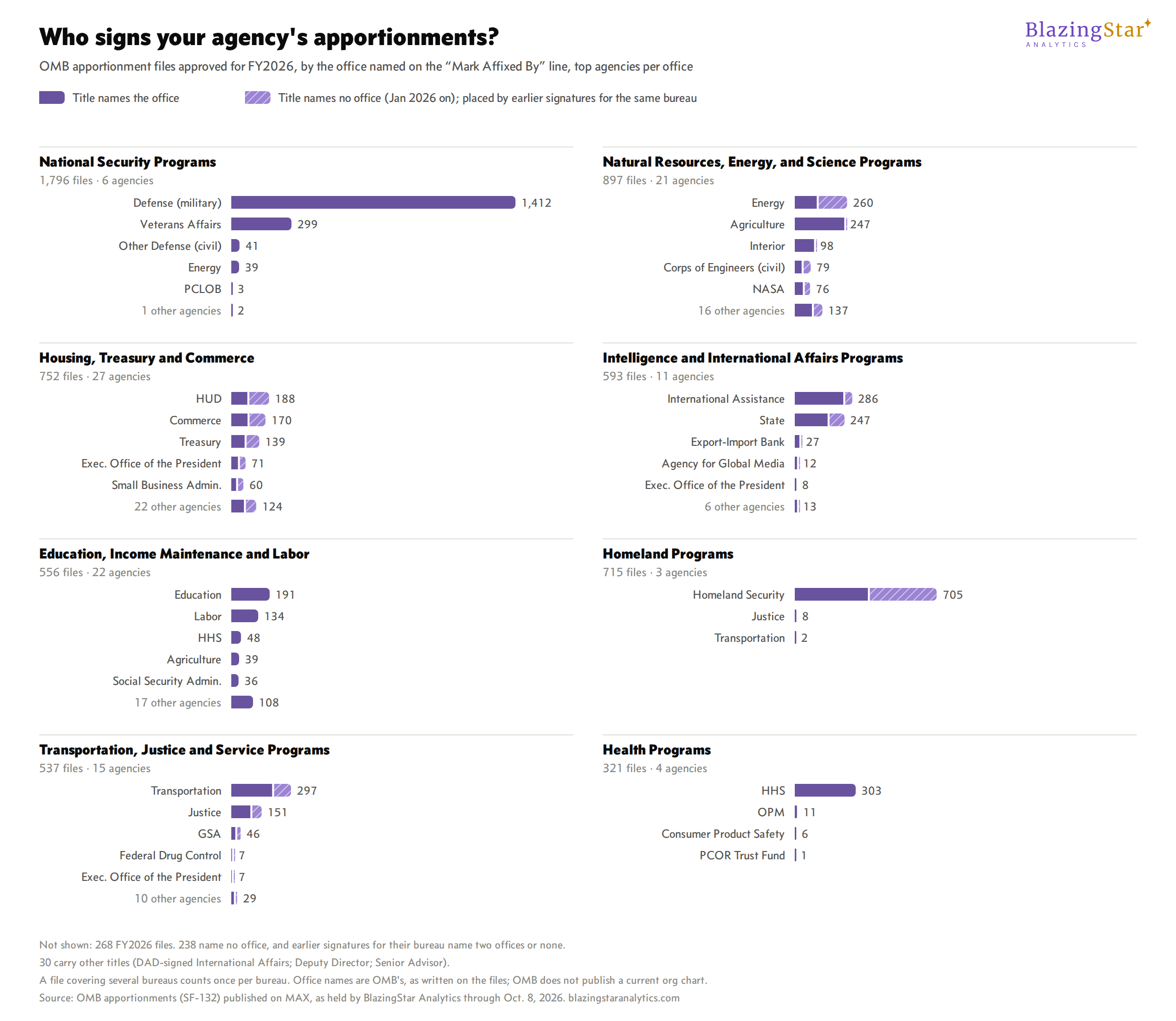
A few placements that might surprise you:
- Veterans Affairs is signed by National Security Programs.
- Energy is split. Most of it falls under Natural Resources, Energy, and Science, and some of it falls under National Security.
- HHS is split too. Health Programs signs most of it, but Education, Income Maintenance and Labor signs part. A simplified way to think of it is Health = Health; Human Services = EIML.
- OPM is signed under Education, Income Maintenance and Labor, with some accounts under Health. The pensions and retirement part is typically EIML while the Federal Employees Health Benefits Program is under Health.
- The District of Columbia, The White House, and OMB itself sit under Housing, Treasury and Commerce.
One more thing the signatures show. Since January 23, 2026, a growing share of apportionments are signed just "Program Associate Director" or "Acting Program Associate Director," with no office named. That's a quarter of fiscal year 2026 files, and more than half of fiscal year 2027 files so far. For the chart, we placed those under the office that signed the same bureau on earlier apportionments, and we hatched every placement made that way. Where a bureau's earlier signatures named two offices, we left it out.
One caution about the title. It tells you whether a PAD or a DAD signed. It doesn't tell you whether the person signing is a political appointee or a career official. That's especially true of "Acting" PADs, who have signed more than 1,200 apportionments since 2025. An acting official can be either political or career.
From a PAD: Going outside of apportionments for a second, the issues that find their way to a PADs desk are difficult. In a sense, they're problems that have failed to find resolution through an agency and three rungs of OMB. They still need a solution. This likely means discussion and negotiations with a Deputy Secretary or a Chief Financial Officer. There's a lot of pressure to find a solution at this level, because there aren't many steps between the PAD and the Director and the President.
Rung 5: The Executive Associate Director (EAD)
Above the PADs, OMB has an Executive Associate Director, a senior political official who coordinates the RMOs for the Director. The EAD doesn't sign apportionments. An apportionment reaches the EAD when it stops being an apportionment and becomes a policy question: a hold, a footnote the agency is fighting, an account the White House is watching.
The EAD also plays a key role in the budget formulation process and the assembly of supplemental requests. The EAD also coordinates with the leadership of policy councils.
Rungs 6 and 7: The Deputy Director and the Director
At the top are the two Senate-confirmed officials on the budget side.
The Deputy Director runs the budget side day to day, and is Senate-confirmed under 31 U.S.C. 502(b). The Deputy Director "for Budget" is different than the "Deputy Director for Management". We touched on the differences in the spans of control earlier in our post.
The Director owns the President's Budget. Formally, the apportionment authority the Anti-Deficiency Act gives the President is exercised through OMB (31 U.S.C. 1513(b); delegated by Executive Order 6166, 1933). Everything below the Director signs on the Director's authority. To wit, see this Federal Register notice (90 FR 9737) delegating apportionment authority to the PADs.
The ladder works like any chain of delegation: most decisions are made at the bottom, the signature sits a few rungs up, and the authority sits at the top. What's changed is the rung where the signature sits.
Why It Matters
The signature tells you where the decision sat. If your apportionment came back with a footnote you didn't expect, the title on the "Mark Affixed By" line tells you which office to ask, and the examiner in that office's branch is the one who drafted it. If you're on the Hill, it tells you which office to call about an agency's money. (When the title names no office, look at the bureau's earlier apportionments; that's how we built the chart.)
The rung tells you which arrangement you're in. OMB's delegation to the PADs took effect on February 11, 2025, according to the Federal Register notice. The last DAD signature in our records is dated the same day. The first PAD signature is two days later. The notice and the files were published separately, and they tell the same story.
If you work at an agency: know your examiner and their branch. They read your request before anyone political sees it, and they read your apportionment before anyone signs it.
How we know. Every figure here comes from OMB's public apportionment files (the SF-132s OMB publishes through MAX), as held in our database through October 8, 2026: 33,323 files from fiscal years 2022 through 2027. We grouped them by the title on the "Mark Affixed By" line alone, sorting PAD from DAD by the words in the title and nothing else. A file covering several bureaus counts once per bureau. The RMO and division names in the 2020 table come from the Insider's Guide, not from the files.
The Bottom Line
- Your apportionment climbs a ladder: examiner → branch chief → DAD → PAD → EAD → Deputy Director → Director. The first three rungs are career; the rest are political.
- The examiner does much of the work. The signature sits a few rungs up. The authority sits at the top.
- Since February 2025, a political PAD signs. Before that, a career DAD did, on every file we hold.
- OMB doesn't publish a current RMO org chart, so we built one from the signatures. The current titles name eight offices, not the five in the books, and since January 2026 many don't name an office at all.
What's Next
Next in this series: the management side of OMB. That's OIRA, plus the financial management, procurement, and IT offices, and the circulars they write. Those circulars run through every agency's budget office whether anyone reads them or not.
On the pocket rescission: we're waiting for the next USAspending data before we follow up, so we can show you what changed.
Keep following the money.
We do this every week. Necessary Expenses goes out Friday afternoons: the week's CFR redlines, executive actions, notable grants, and what we flagged. Free, and that's the whole arrangement.
Not keen on another newsletter? Our public archive of fiscal data is at: data.blazingstaranalytics.com.
And when you need to do this for a living, there's BlazingStar Analyst: every account, from the law that appropriated it to the award that spent it. $200 a month, or ask us for a demo.